Clinical Peptide Medicine — Structured. Applied. Evolving.
PEPTIDE FUNDAMENTALS

Start With the Biology Before You Study the Molecule
Clinical peptide medicine becomes much easier to understand once you stop treating peptides as isolated compounds. Before diving into peptide fundamentals or studying individual molecules, it helps to grasp the biological language they operate within. This understanding involves concepts such as amino acids, peptide structure, receptors, signaling pathways, agonists and antagonists, dose-response relationships, feedback loops, hormone signaling, tissue specificity, pharmacokinetics, biological adaptation, evidence, risk, and monitoring. These elements are crucial in understanding peptide signaling pathways and serve as the foundation for everything that follows. Once you comprehend the system, evaluating individual peptides in clinical peptide medicine becomes a more straightforward process. Conversely, without this foundational understanding, peptide medicine can quickly devolve into a mere list of names, claims, and protocols.
The Body Is a Signaling Network
The Body Is a Signaling Network
The Body Is a Signaling Network

Human physiology is not governed by a single hormone, neurotransmitter, receptor, or peptide. Instead, it is regulated through complex and interacting signaling systems. Cells continuously gather information from their environments, which may include hormones, peptides, neurotransmitters, nutrients, metabolites, cytokines, growth factors, mechanical signals, electrical activity, oxygen availability, stress signals, and inflammatory mediators. The cell interprets these signals and adjusts its behavior accordingly. Such changes may involve gene expression, enzyme activity, glucose uptake, protein synthesis, inflammatory signaling, cell growth, tissue repair, hormone release, neurotransmitter release, mitochondrial activity, and immune activation or suppression. Clinical peptide medicine operates within this intricate network, as no peptide acts in isolation. Understanding peptide fundamentals is essential, as they influence signaling through established peptide signaling pathways in an already active biological system.
Peptides Work Through Targets
The Body Is a Signaling Network
The Body Is a Signaling Network
Many peptides exert their effects by interacting with specific biological targets, particularly in the realm of clinical peptide medicine. One of the most important targets in peptide fundamentals is the receptor. A receptor is a structure that recognizes and responds to a biological signal, functioning as a key component of a cellular communication system. When the correct signal interacts with the receptor, the cell receives valuable information, triggering a series of events known as a signaling cascade. This interaction can activate multiple downstream pathways, illustrating the complexity of peptide signaling pathways. These pathways may influence various processes, including enzymes, genes, ion channels, hormones, inflammatory mediators, metabolic processes, cellular growth, and cellular repair. This complexity helps explain why a relatively small biological signal can sometimes lead to a much larger physiological response.
Agonists and Antagonists
Partial Agonism and Signaling Bias
Partial Agonism and Signaling Bias
Human physiology is not governed by a single hormone, neurotransmitter, receptor, or peptide. Instead, it is regulated through complex and interacting signaling systems. Cells continuously gather information from their environments, which may include hormones, peptides, neurotransmitters, nutrients, metabolites, cytokines, growth factors, mechanical signals, electrical activity, oxygen availability, stress signals, and inflammatory mediators. The cell interprets these signals and adjusts its behavior accordingly. Such changes may involve gene expression, enzyme activity, glucose uptake, protein synthesis, inflammatory signaling, cell growth, tissue repair, hormone release, neurotransmitter release, mitochondrial activity, and immune activation or suppression. Clinical peptide medicine operates within this intricate network, as no peptide acts in isolation. Understanding peptide fundamentals is essential, as they influence signaling through established peptide signaling pathways in an already active biological system.
Partial Agonism and Signaling Bias
Partial Agonism and Signaling Bias
Partial Agonism and Signaling Bias
Many peptides exert their effects by interacting with specific biological targets, particularly in the realm of clinical peptide medicine. One of the most important targets in peptide fundamentals is the receptor. A receptor is a structure that recognizes and responds to a biological signal, functioning as a key component of a cellular communication system. When the correct signal interacts with the receptor, the cell receives valuable information, triggering a series of events known as a signaling cascade. This interaction can activate multiple downstream pathways, illustrating the complexity of peptide signaling pathways. These pathways may influence various processes, including enzymes, genes, ion channels, hormones, inflammatory mediators, metabolic processes, cellular growth, and cellular repair. This complexity helps explain why a relatively small biological signal can sometimes lead to a much larger physiological response.

Why Receptor Location Matters
Human physiology is not governed by a single hormone, neurotransmitter, receptor, or peptide. Instead, it is regulated through complex and interacting signaling systems. Cells continuously gather information from their environments, which may include hormones, peptides, neurotransmitters, nutrients, metabolites, cytokines, growth factors, mechanical signals, electrical activity, oxygen availability, stress signals, and inflammatory mediators. The cell interprets these signals and adjusts its behavior accordingly. Such changes may involve gene expression, enzyme activity, glucose uptake, protein synthesis, inflammatory signaling, cell growth, tissue repair, hormone release, neurotransmitter release, mitochondrial activity, and immune activation or suppression. Clinical peptide medicine operates within this intricate network, as no peptide acts in isolation. Understanding peptide fundamentals is essential, as they influence signaling through established peptide signaling pathways in an already active biological system.
Dose Matters
Many peptides exert their effects by interacting with specific biological targets, particularly in the realm of clinical peptide medicine. One of the most important targets in peptide fundamentals is the receptor. A receptor is a structure that recognizes and responds to a biological signal, functioning as a key component of a cellular communication system. When the correct signal interacts with the receptor, the cell receives valuable information, triggering a series of events known as a signaling cascade. This interaction can activate multiple downstream pathways, illustrating the complexity of peptide signaling pathways. These pathways may influence various processes, including enzymes, genes, ion channels, hormones, inflammatory mediators, metabolic processes, cellular growth, and cellular repair. This complexity helps explain why a relatively small biological signal can sometimes lead to a much larger physiological response.
Timing Matters
Neurotransmitters are essential chemical messengers utilized primarily by neurons, forming the foundation of peptide fundamentals in the body. Common examples include dopamine, serotonin, acetylcholine, norepinephrine, glutamate, and GABA. In addition to these neurotransmitters, some peptides, often referred to as neuropeptides, function within the nervous system and play a crucial role in clinical peptide medicine. Neuropeptides may influence various aspects of physiology and behavior, such as pain, stress, appetite, sleep, autonomic signaling, cognition, mood, and hormonal communication. It is important to note that these categories can overlap, as the human body employs multiple peptide signaling pathways and different chemical languages simultaneously.
Half-Life Matters
A peptide does not remain active forever in the realm of clinical peptide medicine. The half-life refers to the time it takes for the concentration of a substance to decrease by about half. In the context of peptide fundamentals, some peptides are rapidly degraded, while others are modified to exhibit longer activity.
The half-life can significantly influence various aspects such as the frequency of administration, duration of signaling, side effects, receptor exposure, biological response, and accumulation. In peptide signaling pathways, a longer half-life is not inherently better; in fact, sometimes short signaling is an essential aspect of normal physiology.
Route of Administration Matters
The way a peptide enters the body can significantly affect key factors in clinical peptide medicine, including absorption, bioavailability, onset, tissue exposure, metabolism, and duration. Understanding peptide fundamentals is crucial, as potential routes for peptide delivery may include subcutaneous, intravenous, intramuscular, oral, intranasal, and topical methods, along with other specialized delivery techniques. It's important to note that not every peptide is suitable for every route, as peptides can be degraded by enzymes, the gastrointestinal tract, or metabolic processes before they effectively engage with their targeted peptide signaling pathways.
Peptide Medicine Education: An Overview
The body constantly adjusts itself.
This is called:
- Homeostasis
When one biological signal increases, the body may respond by decreasing another.
This creates a:
- Feedback Loop
For example:
A hormone may increase.
That hormone may signal the brain or pituitary.
The brain may then reduce production of the original stimulating signal.
This prevents unlimited signaling.
Feedback systems exist throughout:
- endocrine physiology
- metabolism
- immune regulation
- temperature control
- blood pressure
- glucose regulation
- reproductive physiology
- growth signaling
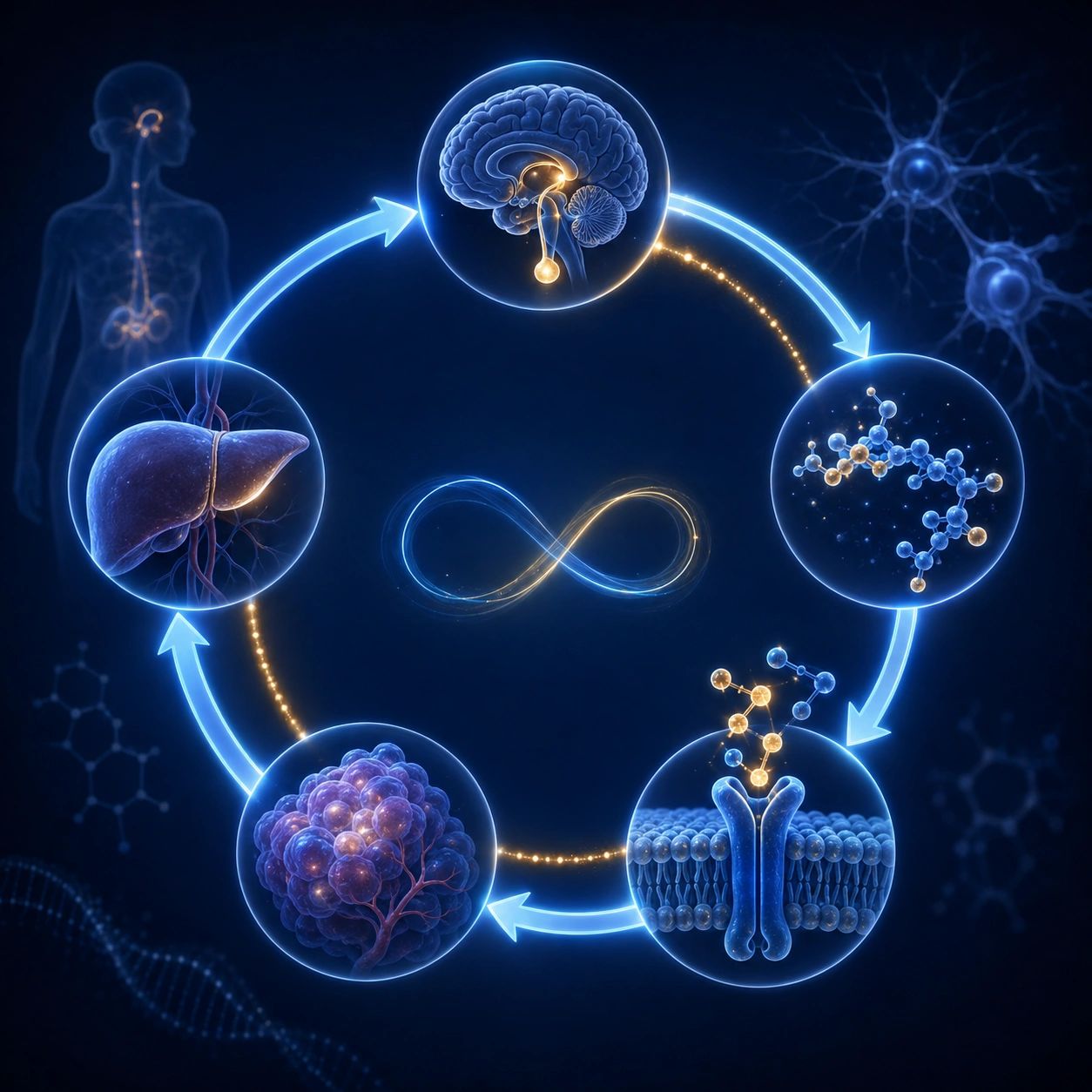
Peptide therapy does not escape these systems.
Changing one signal may cause the body to adjust somewhere else.

Local vs Systemic Signaling
Mechanism Does Not Equal Outcome
Mechanism Does Not Equal Outcome
Clinical peptide medicine becomes much easier to understand once you stop treating peptides as isolated compounds. Before diving into peptide fundamentals or studying individual molecules, it helps to grasp the biological language they operate within. This understanding involves concepts such as amino acids, peptide structure, receptors,
Clinical peptide medicine becomes much easier to understand once you stop treating peptides as isolated compounds. Before diving into peptide fundamentals or studying individual molecules, it helps to grasp the biological language they operate within. This understanding involves concepts such as amino acids, peptide structure, receptors, signaling pathways, agonists and antagonists, dose-response relationships, feedback loops, hormone signaling, tissue specificity, pharmacokinetics, biological adaptation, evidence, risk, and monitoring. These elements are crucial in understanding peptide signaling pathways and serve as the foundation for everything that follows. Once you comprehend the system, evaluating individual peptides in clinical peptide medicine becomes a more straightforward process. Conversely, without this foundational understanding, peptide medicine can quickly devolve into a mere list of names, claims, and protocols.
Mechanism Does Not Equal Outcome
Mechanism Does Not Equal Outcome
Mechanism Does Not Equal Outcome
A clinical peptide medicine may clearly influence a receptor. However, that does not automatically imply it improves a meaningful clinical outcome. This distinction is essential in understanding peptide fundamentals. A study might demonstrate receptor activation, increased gene expression, changes in inflammatory markers, or improved heal
A clinical peptide medicine may clearly influence a receptor. However, that does not automatically imply it improves a meaningful clinical outcome. This distinction is essential in understanding peptide fundamentals. A study might demonstrate receptor activation, increased gene expression, changes in inflammatory markers, or improved healing in an animal model. While those findings may be biologically interesting, they do not automatically establish effectiveness in humans, appropriate dosing, long-term safety, clinical superiority, or benefit for every patient. An understanding of peptide signaling pathways provides the beginning of the discussion, but it is not the end.
Evidence Exists on a Continuum
Mechanism Does Not Equal Outcome
Safety Is Part of the Mechanism
Evidence supporting clinical peptide medicine can originate from various sources, including molecular research, receptor studies, and cell-culture studies. Additional insights can be drawn from animal studies, case reports, observational studies, small human trials, randomized clinical trials, and regulatory studies, as well as clinical e
Evidence supporting clinical peptide medicine can originate from various sources, including molecular research, receptor studies, and cell-culture studies. Additional insights can be drawn from animal studies, case reports, observational studies, small human trials, randomized clinical trials, and regulatory studies, as well as clinical experience. Each of these levels contributes distinct information regarding the peptide fundamentals and peptide signaling pathways involved. However, it's important to note that each level addresses different questions. The strength of any claim made in clinical peptide medicine should correspond with the strength of the evidence that supports it.
Safety Is Part of the Mechanism
Mechanism Does Not Equal Outcome
Safety Is Part of the Mechanism
Safety should not be separated from biological reasoning in the context of clinical peptide medicine.
If a peptide influences:
- growth signaling
- glucose
- appetite
- immune activity
- blood vessels
- hormones
- neurotransmission
- blood pressure
- cellular proliferation
Then those same peptide signaling pathways may also
Safety should not be separated from biological reasoning in the context of clinical peptide medicine.
If a peptide influences:
- growth signaling
- glucose
- appetite
- immune activity
- blood vessels
- hormones
- neurotransmission
- blood pressure
- cellular proliferation
Then those same peptide signaling pathways may also help explain potential risks.
The mechanisms that create benefits in peptide fundamentals can sometimes also create harm.
That is why understanding the pathway matters.
Monitoring Turns Theory into Information
Monitoring Turns Theory into Information
Monitoring Turns Theory into Information
Without monitoring, it becomes difficult to assess whether a clinical peptide medicine intervention is producing the intended effect. Effective monitoring may include tracking various factors such as symptoms, laboratory markers, blood pressure, glucose levels, body composition, sleep quality, performance, appetite, recovery, and any adve
Without monitoring, it becomes difficult to assess whether a clinical peptide medicine intervention is producing the intended effect. Effective monitoring may include tracking various factors such as symptoms, laboratory markers, blood pressure, glucose levels, body composition, sleep quality, performance, appetite, recovery, and any adverse effects. The optimal monitoring strategy depends on the specific peptide fundamentals and the peptide signaling pathways being influenced.
The Foundational Questions
Monitoring Turns Theory into Information
Monitoring Turns Theory into Information
Before evaluating any aspect of clinical peptide medicine, ask yourself: 1. What is the molecule? 2. What receptor or peptide signaling pathways does it influence? 3. Where are those receptors located? 4. What downstream effects occur? 5. What evidence supports those effects? 6. What dose and route were studied? 7. What risks could arise
Before evaluating any aspect of clinical peptide medicine, ask yourself: 1. What is the molecule? 2. What receptor or peptide signaling pathways does it influence? 3. Where are those receptors located? 4. What downstream effects occur? 5. What evidence supports those effects? 6. What dose and route were studied? 7. What risks could arise from the same mechanism? 8. What should be monitored? 9. What remains uncertain? 10. Does the biological pattern actually justify the intervention? If you can answer these questions, you're no longer just memorizing peptide fundamentals; you are starting to develop a deeper understanding of peptide medicine.

The Learning Library allows you to explore individual concep
Want a Structured Learning Path?
For learners seeking a comprehensive pathway from peptide fundamentals to advanced clinical peptide medicine, Praxis Peptide Institute offers a structured educational program.
Patient Peptide Mastery
This robust educational system is designed to connect:
Physiology → Pattern → Mechanism → Evidence → Risk → Monitoring → Decision, while emphasizing the significance of peptide signaling pathways.