Clinical Peptide Medicine — Structured. Applied. Evolving.
Appetite, Glucose, Insulin, Energy Balance, and Body Composition
Metabolic health is often reduced to:
- weight
- blood sugar
- calories
But metabolism is much broader than any one number.
It is the coordinated process through which the body:
- senses energy availability
- regulates glucose
- stores and mobilizes fuel
- responds to insulin
- controls appetite
- adapts to feeding and fasting
- preserves or loses muscle
- communicates between the gut, pancreas, liver, brain, adipose tissue, and skeletal muscle
This is why metabolic peptide medicine cannot be understood by asking only:
“Which peptide causes the most weight loss?”
The better question is:
What metabolic signal are we changing, why are we changing it, and what happens to the rest of the system when we do?

GLUCOSE IS IMPORTANT — BUT IT IS NOT THE WHOLE STORY

Blood glucose is one of the most familiar metabolic measurements.
It matters.
But metabolic dysfunction can begin before fasting glucose or HbA1c becomes obviously abnormal.
A person can experience changes in:
insulin sensitivity
post-meal glucose handling
body composition
visceral fat
appetite regulation
triglycerides
fatty liver
metabolic flexibility
Before a single glucose marker tells the full story.
This is why:
Normal glucose does not automatically equal optimal metabolic physiology.
INSULIN IS NOT THE ENEMY
Insulin is frequently blamed for metabolic disease.
That oversimplifies its role.
Insulin is an essential hormone involved in nutrient storage and glucose regulation.
After food intake, insulin helps coordinate processes such as:
glucose uptake
glycogen synthesis
nutrient storage
suppression of excessive hepatic glucose production
The problem is not that insulin exists.
The more relevant question is whether tissues are responding appropriately to it.
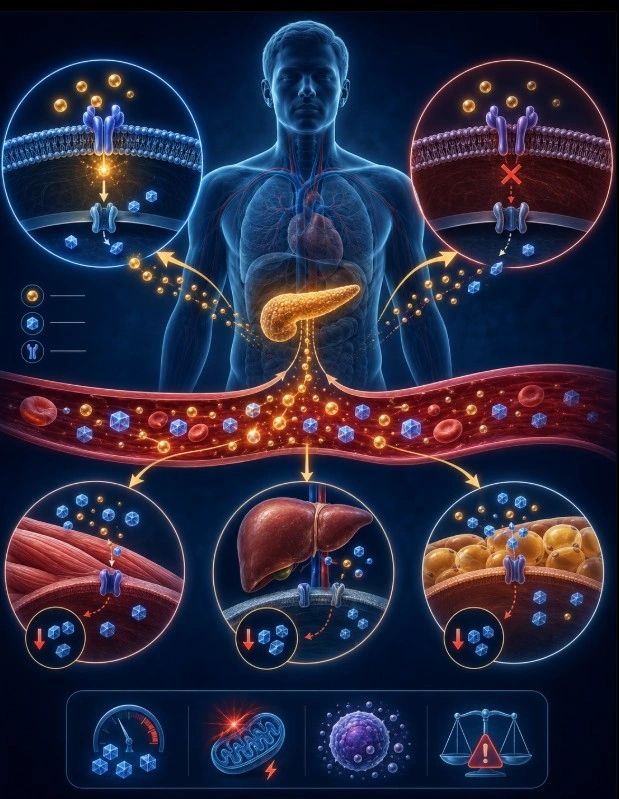
WHAT IS INSULIN RESISTANCE?
Insulin resistance generally refers to reduced biological responsiveness to insulin in insulin-sensitive tissues.
The pancreas may compensate by producing more insulin.
Early in that process, glucose can remain relatively normal.
A simplified sequence might look like:
Reduced Insulin Sensitivity → Greater Insulin Requirement → Compensatory Hyperinsulinemia → Progressive Metabolic Stress → Rising Glucose
That is why waiting for glucose to become markedly abnormal can miss earlier physiology.
KEY IDEA:
A normal glucose value does not always tell you how much insulin was required to keep it normal.
WHAT ARE INCRETINS?
GLP-1 IS MORE THAN A “WEIGHT-LOSS HORMONE”
GLP-1 IS MORE THAN A “WEIGHT-LOSS HORMONE”

Incretins are gut-derived hormones that influence the body's response to nutrient intake.
Two major incretin systems are:
GLP-1
and
GIP
These pathways influence metabolic physiology in different but overlapping ways.
Their biology helps explain why modern therapies targeting incretin receptors can have effects involving:
appetite
insulin secretion
glucose regulation
gastric function
body weight
This is where peptide medicine and metabolic physiology intersect directly.
GLP-1 IS MORE THAN A “WEIGHT-LOSS HORMONE”
GLP-1 IS MORE THAN A “WEIGHT-LOSS HORMONE”
GLP-1 IS MORE THAN A “WEIGHT-LOSS HORMONE”
GLP-1 is frequently discussed almost entirely in the context of weight loss.
That misses the physiology.
GLP-1 signaling participates in:
glucose-dependent insulin secretion
glucagon regulation
gastric emptying
appetite
satiety
gastrointestinal signaling
brain-gut communication
Weight change can emerge from those combined effects.
But:
Weight loss is the outcome.
GLP-1 signaling is the mechanism.
Keeping those two separate helps us understand both efficacy and adverse effects.
GIP IS NOT JUST “ANOTHER GLP-1”
GLP-1 IS MORE THAN A “WEIGHT-LOSS HORMONE”
GLUCAGON IS NOT SIMPLY THE OPPOSITE OF INSULIN
GIP also participates in nutrient signaling and insulin physiology.
But it is not biologically identical to GLP-1.
Different receptors mean different downstream biology.
This becomes important when comparing:
single-receptor therapies
with
dual-receptor therapies
and
multi-receptor therapies.
A useful model is:
Different Receptors → Different Signaling Profiles → Different Metabolic Effects
More receptor targets do not automatically mean better therapy.
They mean:
Different biology.
GLUCAGON IS NOT SIMPLY THE OPPOSITE OF INSULIN
WEIGHT LOSS IS NOT THE SAME AS METABOLIC HEALTH
GLUCAGON IS NOT SIMPLY THE OPPOSITE OF INSULIN
Glucagon is often taught as:
the hormone that raises blood glucose.
That is true, but incomplete.
Glucagon also participates in:
hepatic glucose production
fasting physiology
amino-acid metabolism
energy regulation
This becomes especially important as multi-receptor metabolic drugs increasingly target:
GLP-1 + GIP + Glucagon
Understanding those therapies requires understanding what each component contributes.
Otherwise, we reduce sophisticated receptor pharmacology to:
“This one is stronger.”
That is not enough.
WEIGHT LOSS IS NOT THE SAME AS METABOLIC HEALTH
WEIGHT LOSS IS NOT THE SAME AS METABOLIC HEALTH
WEIGHT LOSS IS NOT THE SAME AS METABOLIC HEALTH
This distinction should remain central throughout the Metabolic Health library.
A person can lose weight and improve metabolic health.
Those outcomes often overlap.
But they are not identical.
Two people can each lose 30 pounds and experience very different changes in:
fat mass
lean mass
insulin sensitivity
blood pressure
liver fat
strength
nutritional status
long-term weight maintenance
The scale measures: mass.
It does not tell us what tissue was lost or what physiology changed.
BODY COMPOSITION MATTERS
WEIGHT LOSS IS NOT THE SAME AS METABOLIC HEALTH
WEIGHT LOSS IS NOT THE SAME AS METABOLIC HEALTH
Body weight can be divided broadly into components including:
fat mass
lean mass
bone
water
During weight loss, the goal is usually not:
lose as much total mass as possible.
A better objective is often:
reduce excess adiposity while preserving as much healthy lean tissue and function as reasonably possible.
That requires attention to:
nutrition
protein intake
resistance training
rate of weight loss
metabolic status
individual context
Peptide therapy does not make those fundamentals irrelevant.
SKELETAL MUSCLE IS A METABOLIC ORGAN
GASTRIC EMPTYING MATTERS MORE THAN MOST PEOPLE REALIZE
SKELETAL MUSCLE IS A METABOLIC ORGAN
Muscle is often discussed only in terms of appearance or strength.
But skeletal muscle is a major metabolic tissue.
It contributes to:
glucose disposal
glycogen storage
insulin sensitivity
energy expenditure
physical resilience
functional independence
Losing weight while losing excessive muscle can therefore create a very different metabolic outcome from losing primarily adipose tissue.
This is why:
weight loss quality matters.
APPETITE IS BIOLOGY
GASTRIC EMPTYING MATTERS MORE THAN MOST PEOPLE REALIZE
SKELETAL MUSCLE IS A METABOLIC ORGAN
Appetite is frequently framed as a question of discipline.
That ignores physiology.
Hunger and satiety are influenced by:
gut peptides
hypothalamic signaling
blood glucose
insulin
leptin
ghrelin
sleep
stress
food environment
energy balance
This does not mean behavior is irrelevant.
It means behavior occurs inside a biological system.
KEY IDEA:
Appetite is not simply a decision. It is a regulated biological signal that influences decisions.
GASTRIC EMPTYING MATTERS MORE THAN MOST PEOPLE REALIZE
GASTRIC EMPTYING MATTERS MORE THAN MOST PEOPLE REALIZE
GASTRIC EMPTYING MATTERS MORE THAN MOST PEOPLE REALIZE
How quickly food leaves the stomach influences:
satiety
post-meal glucose
nutrient delivery
gastrointestinal symptoms
medication absorption
Some metabolic therapies can alter gastric emptying.
That may contribute to:
benefit
and also:
adverse effects.
Once again:
the same mechanism can explain both.
This is why nausea, fullness, appetite suppression, and changes in eating behavior should not be viewed as unrelated side effects.
They may emerge directly from the pharmacology.
ENERGY BALANCE IS REAL — BUT IT IS NOT SIMPLE
FAT LOSS AND WEIGHT LOSS ARE DIFFERENT OUTCOMES
GASTRIC EMPTYING MATTERS MORE THAN MOST PEOPLE REALIZE
Body weight is influenced by energy balance.
Energy entering the system versus energy leaving the system matters.
But the body is not a passive calorie container.
Changes in energy intake can influence:
hunger
energy expenditure
spontaneous movement
thyroid signaling
reproductive signaling
body composition
metabolic efficiency
So:
Energy Intake → Body Responds → Energy Expenditure and Appetite Adjust
This is metabolic adaptation.
It does not violate energy balance.
It explains why the variables inside energy balance change.
WHAT IS METABOLIC ADAPTATION?
FAT LOSS AND WEIGHT LOSS ARE DIFFERENT OUTCOMES
FAT LOSS AND WEIGHT LOSS ARE DIFFERENT OUTCOMES
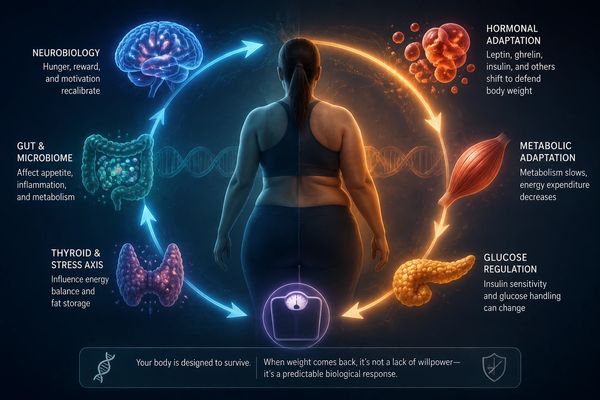
When body weight or caloric intake changes, the body can adjust.
Possible changes may include:
lower resting energy expenditure
reduced spontaneous activity
altered appetite
hormonal changes
increased drive to eat
This can make continued weight loss more difficult.
A simplified pathway is:
Weight Loss → Reduced Energy Stores → Compensatory Signals → Greater Hunger + Lower Expenditure → Resistance to Further Loss
This is not personal failure.
It is physiology.
Understanding that physiology allows us to build better long-term strategies.
FAT LOSS AND WEIGHT LOSS ARE DIFFERENT OUTCOMES
FAT LOSS AND WEIGHT LOSS ARE DIFFERENT OUTCOMES
FAT LOSS AND WEIGHT LOSS ARE DIFFERENT OUTCOMES
Imagine two people each lose 20 pounds.
PERSON A:
17 lb fat
3 lb lean tissue
PERSON B:
10 lb fat
10 lb lean tissue
The scale shows:
-20 lb
for both.
The biological outcome is very different.
That is why tracking:
body composition
strength
nutrition
functional performance
Can provide information the scale cannot.
METABOLIC HEALTH IS NOT JUST ABOUT OBESITY
Metabolic dysfunction can exist across body sizes.
A person with obesity may have relatively preserved metabolic markers.
A lean individual may have:
- insulin resistance
- fatty liver
- dyslipidemia
- poor glucose regulation
- low muscle mass
Body weight is useful information.
It is not a complete metabolic diagnosis.
The real question is:
How is the body handling energy and nutrients?
WEIGHT REGAIN AFTER TREATMENT IS A BIOLOGY QUESTION
Another important topic is what happens when therapy stops.
If a medication suppresses appetite or changes metabolic signaling, discontinuing that signal changes the biological environment again.
The body may experience:
returning appetite
altered energy intake
changing satiety
weight regain
That does not automatically mean:
The therapy failed.
It may mean the therapy was actively controlling a chronic biological process while it was present.
The correct question becomes:
What long-term strategy exists after the intervention changes or stops?
A CHRONIC CONDITION MAY REQUIRE CHRONIC MANAGEMENT
THE GOAL SHOULD NOT BE TO EAT AS LITTLE AS POSSIBLE
A CHRONIC CONDITION MAY REQUIRE CHRONIC MANAGEMENT
This becomes uncomfortable for people who think every treatment should permanently fix the biology after a short course.
But many areas of medicine already operate differently.
Hypertension medications often control blood pressure while being taken.
Insulin treats deficient insulin physiology while being used.
Lipid-lowering therapies change lipid risk while exposure continues.
That does not mean every metabolic peptide must be taken forever.
It means:
We should not assume that removing a therapeutic signal leaves the same biology behind.
METABOLIC PEPTIDES DO NOT REPLACE NUTRITION
THE GOAL SHOULD NOT BE TO EAT AS LITTLE AS POSSIBLE
A CHRONIC CONDITION MAY REQUIRE CHRONIC MANAGEMENT
A therapy can reduce appetite.
That does not tell the patient what foods to eat.
A therapy can improve glucose.
That does not guarantee adequate protein.
A therapy can produce substantial weight loss.
That does not guarantee preservation of muscle.
Nutrition still determines:
protein intake
micronutrients
dietary quality
energy intake
fiber
hydration
The intervention changes the signaling environment.
The body still requires raw materials.
THE GOAL SHOULD NOT BE TO EAT AS LITTLE AS POSSIBLE
THE GOAL SHOULD NOT BE TO EAT AS LITTLE AS POSSIBLE
THE GOAL SHOULD NOT BE TO EAT AS LITTLE AS POSSIBLE
This is particularly important with strong appetite suppression.
The goal of metabolic therapy is not:
maximum inability to eat.
A more appropriate goal is often:
sufficient appetite control to support an effective, nutritionally adequate, sustainable strategy.
Excessive appetite suppression can make it more difficult to consume:
adequate protein
sufficient calories
micronutrients
fluids
Again:
maximum effect is not always optimal effect.
EXERCISE CHANGES THE METABOLIC OUTCOME
EXERCISE CHANGES THE METABOLIC OUTCOME
THE GOAL SHOULD NOT BE TO EAT AS LITTLE AS POSSIBLE
Exercise—particularly resistance training—can influence:
skeletal muscle
insulin sensitivity
glucose disposal
functional capacity
energy expenditure
body composition
This means two people using the same metabolic therapy may experience different body-composition outcomes depending on training and nutrition.
The drug matters.
The environment around the drug matters too.
THE SCALE IS ONE DATA POINT
EXERCISE CHANGES THE METABOLIC OUTCOME
WHAT SHOULD WE ACTUALLY OPTIMIZE?
Useful metabolic monitoring may involve several dimensions.
Depending on the patient and intervention, these can include:
body weight
waist measurement
body composition
strength
glucose
HbA1c
fasting insulin where appropriate
lipids
blood pressure
nutrition
appetite
adverse effects
Not every person needs every measurement.
The point is:
Monitor the biology you are trying to change.
WHAT SHOULD WE ACTUALLY OPTIMIZE?
EXERCISE CHANGES THE METABOLIC OUTCOME
WHAT SHOULD WE ACTUALLY OPTIMIZE?
Instead of optimizing:
The lowest possible weight
Consider a broader set of goals:
improved glucose regulation
improved body composition
reduced excess adiposity
preserved muscle
improved cardiovascular risk
sustainable appetite
adequate nutrition
better physical function
That moves the objective from:
weight loss
Toward:
metabolic health.

THE DECISION PATHWAY
PRAXIS APPROACH TO METABOLIC HEALTH
The broader Praxis pathway remains:
PHYSIOLOGY → PATTERN → MECHANISM → EVIDENCE → RISK → MONITORING → DECISION
In metabolic medicine:
- PHYSIOLOGY - How should glucose, insulin, appetite, nutrient signaling, and energy balance normally work?
- PATTERN - What appears to be changing?
- MECHANISM - Which pathway might appropriately influence that pattern?
- EVIDENCE - What outcomes have actually been shown?
- RISK - What else could change when that pathway is modified?
- MONITORING - How will we know whether metabolic health—not simply body weight—is improving?
- DECISION - Does the strategy make sense in this individual?
METABOLIC DECISION PATHWAY
A useful framework is:
PHYSIOLOGY → METABOLIC PATTERN → TARGET PATHWAY → EVIDENCE → BENEFIT & RISK → MONITORING → LONG-TERM STRATEGY
That is how this section of the Learning Library will be organized.
We will not start with:
- Which drug is strongest?
We will start with:
- What does the system normally do?

MONITORING METABOLIC PEPTIDE THERAPY
HOW TO EVALUATE A METABOLIC PEPTIDE CLAIM
HOW TO EVALUATE A METABOLIC PEPTIDE CLAIM
What should actually be measured beyond body weight?
Explore:
body composition
metabolic markers
nutrition
muscle
symptoms
adverse effects
functional outcomes
HOW TO EVALUATE A METABOLIC PEPTIDE CLAIM
HOW TO EVALUATE A METABOLIC PEPTIDE CLAIM
HOW TO EVALUATE A METABOLIC PEPTIDE CLAIM
Bring the entire category together using:
Mechanism → Evidence → Risk → Monitoring → Patient Context
And learn how to evaluate new metabolic peptides as they emerge.
WHERE TO GO NEXT
NEW TO PEPTIDE MEDICINE?
READY TO BEGIN METABOLIC HEALTH?
READY TO BEGIN METABOLIC HEALTH?
Start with the concepts that make this category easier to understand
READY TO BEGIN METABOLIC HEALTH?
READY TO BEGIN METABOLIC HEALTH?
READY TO BEGIN METABOLIC HEALTH?
Start with the foundation
WANT TO EXPLORE ANOTHER BIOLOGICAL SYSTEM?
WANT TO EXPLORE ANOTHER BIOLOGICAL SYSTEM?
WANT TO EXPLORE ANOTHER BIOLOGICAL SYSTEM?
Return to the main Learning Library and explore:
Immune Regulation & Inflammation
Tissue Repair & Regeneration
GH & IGF-1
Brain & Neurobiology
Mitochondrial Health
Gut & Barrier Health
Hormones & Endocrine Signaling
Vascular Biology
Evidence & Research
Safety & Monitoring
WANT A COMPLETE STRUCTURED EDUCATION?
WANT TO EXPLORE ANOTHER BIOLOGICAL SYSTEM?
WANT TO EXPLORE ANOTHER BIOLOGICAL SYSTEM?
PATIENT PEPTIDE MASTERY
The public Learning Library allows you to explore individual questions.
Patient Peptide Mastery connects those concepts into a structured educational framework:
Physiology → Pattern → Mechanism → Evidence → Risk → Monitoring → Decision
Stop Memorizing Peptides. Start Understanding the System.