Clinical Peptide Medicine — Structured. Applied. Evolving.
New to Peptide Medicine? Start With the Biology, Not the Peptide.
Peptide medicine can become confusing very quickly.
Search online and you will find:
- hundreds of peptide names
- protocols
- dosing schedules
- before-and-after stories
- social-media claims
- research studies
- mechanistic explanations
- conflicting opinions
- promises of faster healing, better metabolism, improved recovery, more energy, better sleep, or slower aging
The problem is not a lack of information.
The problem is knowing how to interpret it.
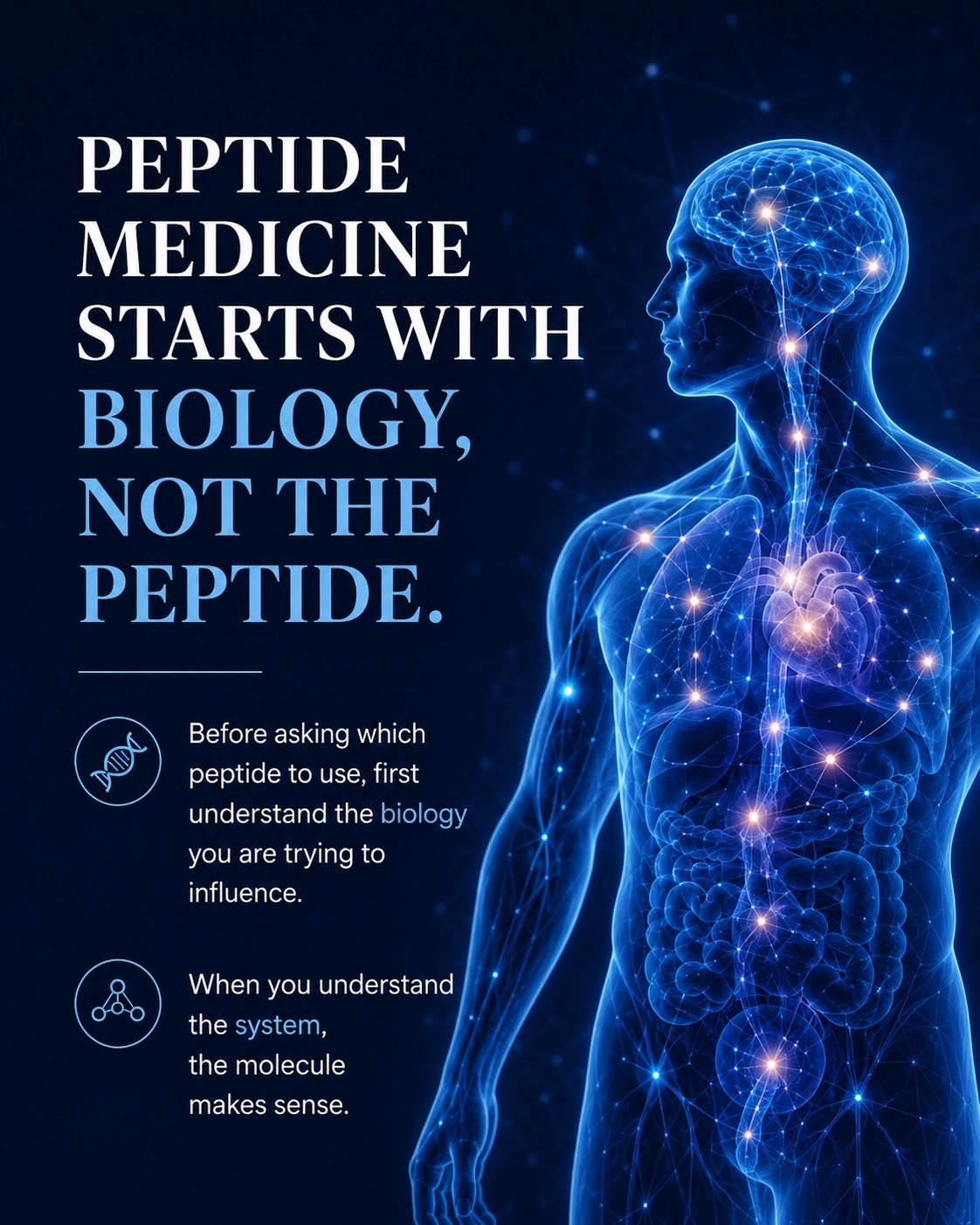
Praxis Peptide Institute was built around a different idea: Before asking which peptide to use, first understand the biology you are trying to influence.
That means learning how the body communicates, adapts, repairs, regulates inflammation, manages energy, responds to stress, maintains tissue, and coordinates thousands of signaling pathways simultaneously.
Only then does the molecule begin to make sense.

What is a Peptide?
Peptides are short chains of amino acids.
Inside the human body, peptides can function as biological signals.
Depending on the peptide, they may participate in processes involving:
- metabolism
- appetite
- glucose regulation
- inflammation
- immune signaling
- tissue repair
- collagen remodeling
- growth signaling
- gastrointestinal function
- vascular biology
- nervous-system signaling
- sleep
- reproduction
- stress response
- cellular communication
Some peptides occur naturally within the human body.
Others are pharmaceutical or investigational compounds designed to imitate, modify, amplify, block, or interact with biological signaling systems.
And that distinction matters.
The word peptide describes a type of molecule.
It does not automatically tell you:
- what the peptide does
- whether it works clinically
- whether it is appropriate for a particular person
- whether long-term safety is established
- whether the product is legally available
- whether the source is reliable
- what should be monitored
- what risks may exist
That is why peptide education should begin with reasoning, not memorization.

Rather than beginning with a molecule, we teach a structured
How Praxis Approaches Peptide Medicine
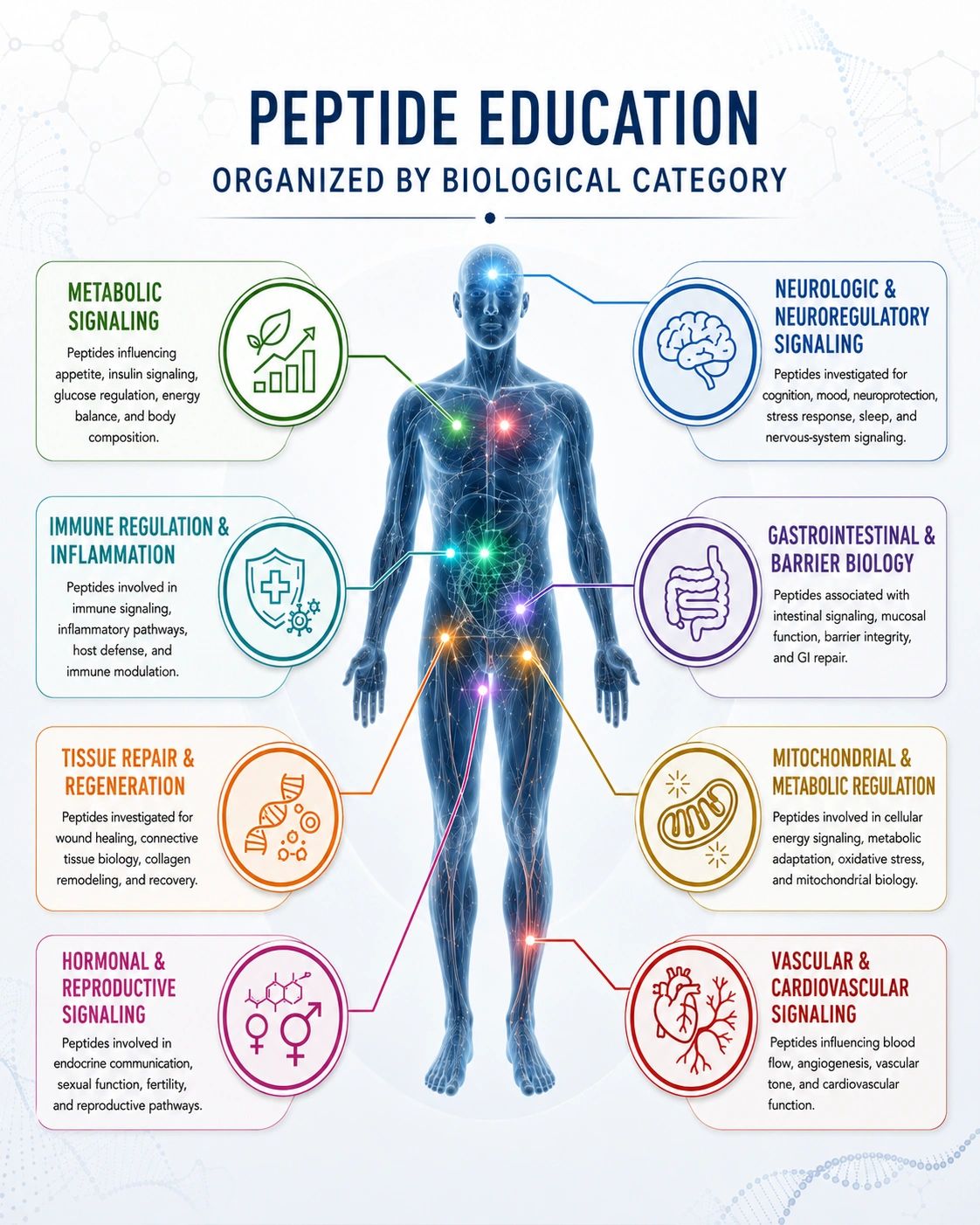
Peptide Categories Are More Useful Than Peptide Lists
Rather than trying to memorize dozens or hundreds of molecules, begin by understanding the biological systems they may influence.
At Praxis, peptide education is organized around broader categories

Mechanism Does Not Equal Proof
A peptide can have a fascinating mechanism and still have limited clinical evidence.
Evidence in peptide medicine may come from several levels:
molecular research
receptor studies
cell-culture research
animal models
observational studies
small human trials
randomized clinical trials
regulatory studies
clinical experience
Each level provides information.
But each level answers a different question.
Learning to separate biological plausibility from demonstrated clinical benefit is one of the most important skills in peptide medicine.
More Signaling Is Not Always Better
The human body is built around balance.
Growth signaling has a purpose.
Inflammation has a purpose.
Immune activation has a purpose.
Appetite has a purpose.
Stress signaling has a purpose.
Cellular proliferation has a purpose.
The goal is not necessarily to maximize or suppress these processes.
The goal is appropriate regulation.
That same reasoning applies throughout peptide medicine.
Peptides Do Not Replace Foundational Physiology
No peptide eliminates the importance of:
adequate sleep
nutrition
movement
hydration
metabolic health
micronutrient sufficiency
stress regulation
appropriate training
recovery
diagnosis
medical evaluation
A peptide may influence a biological signal.
It cannot make basic physiology irrelevant.
This is particularly important when peptides are marketed as shortcuts.
Sometimes the most important intervention is identifying what is creating the biological problem in the first place.
Want to Go Deeper?
Patient Peptide Mastery

Patient Peptide Mastery was created for people who want more than scattered online information.
It is a structured educational system designed to take you from foundational physiology into increasingly advanced peptide concepts.
The program covers:
foundational biology
peptide signaling
physiology
mechanisms
evidence interpretation
laboratory considerations
safety
monitoring
peptide categories
clinical reasoning concepts
case-based learning
real-world decision frameworks
Rather than teaching isolated peptide protocols, Patient Peptide Mastery teaches you how the pieces connect.
Stop Memorizing Peptides.
Start Understanding the System.
Are You a Clinician?
Praxis Peptide Institute also offers advanced education designed for clinicians and healthcare professionals seeking deeper training in peptide medicine.
Clinical education expands the discussion into:
mechanism-based reasoning
patient selection
contraindications
evidence interpretation
laboratory assessment
monitoring
clinical risk
therapeutic decision-making
complex patient patterns