Clinical Peptide Medicine — Structured. Applied. Evolving.
IMMUNE REGULATION AND INFLAMMATION
The Immune System Is Not a Switch. It Is a Signaling Network
The immune system is often described as something that needs to be “boosted.”
But biology is more complicated.
An immune system that is: too weak
can fail to defend.
An immune system that is: too active
Can contribute to:
chronic inflammation
autoimmunity
tissue damage
impaired repair
The goal is not maximum immune activity.
The goal is:
appropriate immune regulation.
IMMUNE FOUNDATIONS
What Is the Immune System Really Doing?
Inflammation: Friend, Enemy, or Misunderstood Signal?
Inflammation: Friend, Enemy, or Misunderstood Signal?
Topics:
immune surveillance
recognition
response
elimination
repair
adaptation
Core concept:
The immune system is not simply a defense system.
It is a:
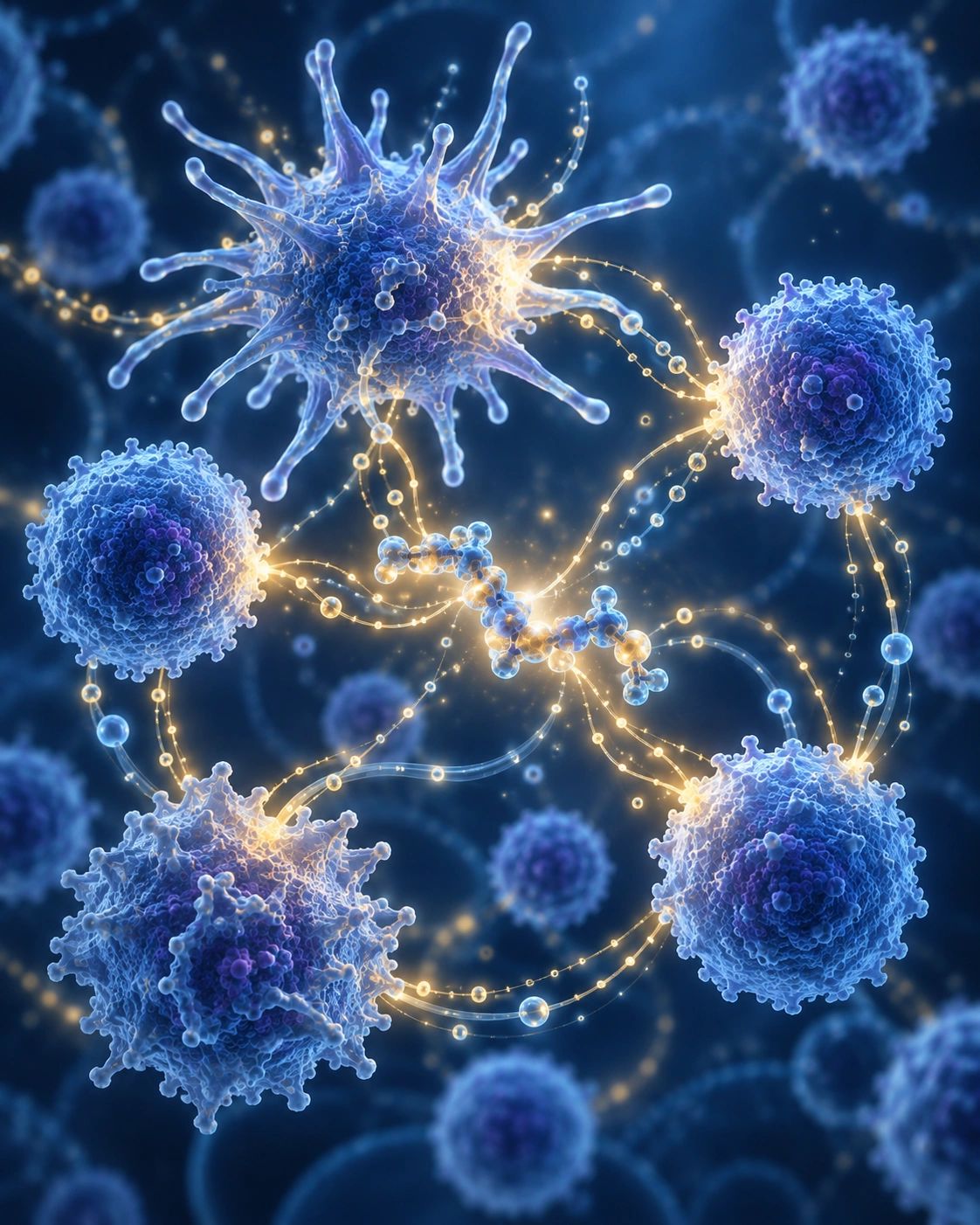
communication, decision-making, and repair network.
Inflammation: Friend, Enemy, or Misunderstood Signal?
Inflammation: Friend, Enemy, or Misunderstood Signal?
Inflammation: Friend, Enemy, or Misunderstood Signal?
Acute inflammation:
infection
injury
repair
vs
Chronic inflammation:
persistent signaling
tissue dysfunction
immune imbalance
Inflammation is not the enemy. Dysregulated inflammation is.
Acute vs Chronic Inflammation: Why Timing Matters
Inflammation: Friend, Enemy, or Misunderstood Signal?
Acute vs Chronic Inflammation: Why Timing Matters
Acute:
short duration
protective
coordinated
Chronic:
prolonged signaling
incomplete resolution
tissue consequences
Immune Activation vs Immune Regulation
Why More Immune Activity Is Not Always Better
Acute vs Chronic Inflammation: Why Timing Matters
Activation:
pathogen defense
cancer surveillance
injury response
Regulation:
preventing excess damage
tolerance
resolution
The healthiest immune system is not the strongest. It is the most adaptive.
Why More Immune Activity Is Not Always Better
Why More Immune Activity Is Not Always Better
Why More Immune Activity Is Not Always Better
“More growth is not always better.”
Too much:
cytokine signaling
inflammation
immune activation
Can create:
autoimmunity
fibrosis
tissue damage
IMMUNE COMMUNICATION
Cytokines: The Language of the Immune System
Cytokines: The Language of the Immune System
Cytokines: The Language of the Immune System
Topics:
IL-1
IL-6
TNF-alpha
interferons
chemokines
Explain:
Cytokines are not:
“good” or “bad.”
They are:
messages.
Context determines meaning.
Innate Immunity vs Adaptive Immunity
Cytokines: The Language of the Immune System
Cytokines: The Language of the Immune System
Topics:
Innate
Fast:
macrophages
neutrophils
NK cells
barriers
Adaptive
Specific:
T cells
B cells
antibodies
memory
The Immune System and the Concept of Balance
Cytokines: The Language of the Immune System
The Immune System and the Concept of Balance
Topics:
Th1 / Th2
Th17 / Treg
Inflammatory / regulatory pathways
Avoid oversimplifying immune responses into:
“one side good, one side bad.”
IMMUNE DYSREGULATION
Autoimmunity: When Protection Becomes Self-Attack
Immune Tolerance: The Biology of Knowing When Not to Attack
Immune Tolerance: The Biology of Knowing When Not to Attack
Topics:
tolerance failure
molecular mimicry
genetic susceptibility
environmental triggers
Framework
Immune system asks:
“Is this dangerous?”
Sometimes the answer becomes:
incorrect.
Immune Tolerance: The Biology of Knowing When Not to Attack
Immune Tolerance: The Biology of Knowing When Not to Attack
Immune Tolerance: The Biology of Knowing When Not to Attack
Topics:
central tolerance
peripheral tolerance
T regulatory cells
immune checkpoints
Immune Exhaustion: When the System Cannot Sustain the Signal
Immune Exhaustion: When the System Cannot Sustain the Signal
Immune Exhaustion: When the System Cannot Sustain the Signal
Topics:
chronic infection
cancer
persistent activation
Concept:
Too much activation can eventually reduce effectiveness.
Resolution Biology: The Missing Piece of Inflammation
Immune Exhaustion: When the System Cannot Sustain the Signal
Immune Exhaustion: When the System Cannot Sustain the Signal
Many people understand:
activation.
Few understand:
resolution.
Topics:
resolvins
macrophage phenotype changes
tissue restoration
Key message:
The end of inflammation is an active biological process.
PEPTIDES AND IMMUNE REGULATION
Thymosin Alpha-1: Immune Modulation Rather Than Immune Stimulation
Thymosin Alpha-1: Immune Modulation Rather Than Immune Stimulation
Thymosin Alpha-1: Immune Modulation Rather Than Immune Stimulation
Topics:
thymic biology
T-cell function
innate/adaptive interaction
immune education
Framework
TA-1 does not simply:
“boost immunity.”
It influences:
immune coordination.
LL-37: Host Defense, Antimicrobial Activity, and Immune Signaling
Thymosin Alpha-1: Immune Modulation Rather Than Immune Stimulation
Thymosin Alpha-1: Immune Modulation Rather Than Immune Stimulation
Topics:
antimicrobial peptides
innate immunity
barrier defense
inflammatory signaling
Important nuance
LL-37 is not simply:
“an antibiotic peptide.”
It is a signaling molecule.
KPV: Inflammatory Signaling and Immune Regulation
VIP: Neuroimmune Communication and Inflammatory Balance
VIP: Neuroimmune Communication and Inflammatory Balance
Topics:
alpha-MSH relationship
inflammatory pathways
gut inflammation concepts
Focus:
regulation rather than suppression.
VIP: Neuroimmune Communication and Inflammatory Balance
VIP: Neuroimmune Communication and Inflammatory Balance
VIP: Neuroimmune Communication and Inflammatory Balance
Topics:
neuropeptides
immune signaling
cytokine modulation
nervous system interaction
Great opportunity to introduce:
the immune system does not operate alone.
CLINICAL REASONING
Immune Modulation vs Immune Suppression
Immune Modulation vs Immune Suppression
Immune Modulation vs Immune Suppression
Differentiate
Suppression:
↓
Reduce immune activity broadly
Examples:
steroids
immunosuppressants
Modulation:
↓
Change immune behavior toward balance
How to Evaluate an Immune Peptide Claim
Immune Modulation vs Immune Suppression
Immune Modulation vs Immune Suppression
Framework:
Claim
↓
Mechanism
↓
Evidence
↓
Risk
↓
Monitoring
↓
Patient Context
Examples:
“This peptide strengthens immunity.”
Ask:
What does strengthen mean?
more cytokines?
better pathogen defense?
improved immune regulation?
The Future of Immune Medicine Is Regulation
The future is likely not:
“more immune.”
It is:
precision immune signaling.
This website uses cookies.
We use cookies to analyze website traffic and optimize your website experience. By accepting our use of cookies, your data will be aggregated with all other user data.