Clinical Peptide Medicine — Structured. Applied. Evolving.
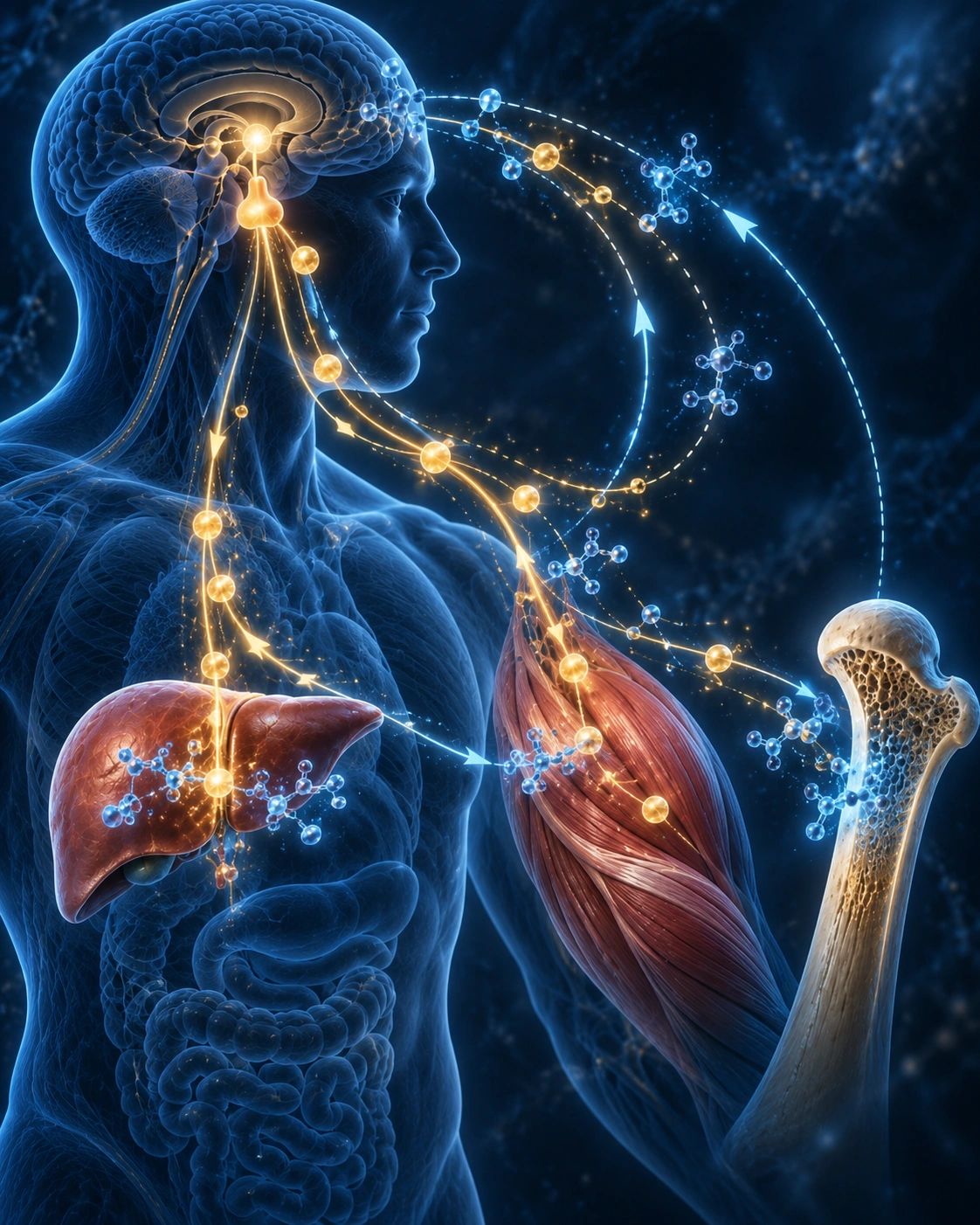
Growth Hormone Is Not Simply a “Growth” Hormone — It Is Part of a Dynamic Endocrine Signaling Network
Growth Hormone (GH)
Operates inside a regulated endocrine network involving:
- the hypothalamus
- pituitary gland
- GHRH
- somatostatin
- ghrelin signaling
- growth hormone receptors
- the liver
- IGF-1
- metabolic feedback
- sleep
- nutrition
- tissue-specific responses
GH is also released:
- Pulsatilely.
That matters.
The biological effect of the GH–IGF-1 axis depends not only on:
- how much signal exists
but also:
- when it appears, how long it lasts, which tissue receives it, and how the feedback system responds.
Key Idea
The GH–IGF-1 axis is not a switch for growth. It is a regulated endocrine network whose effects depend on pulsatility, timing, feedback, tissue sensitivity, metabolic state, and exposure.

THE AXIS AT A GLANCE
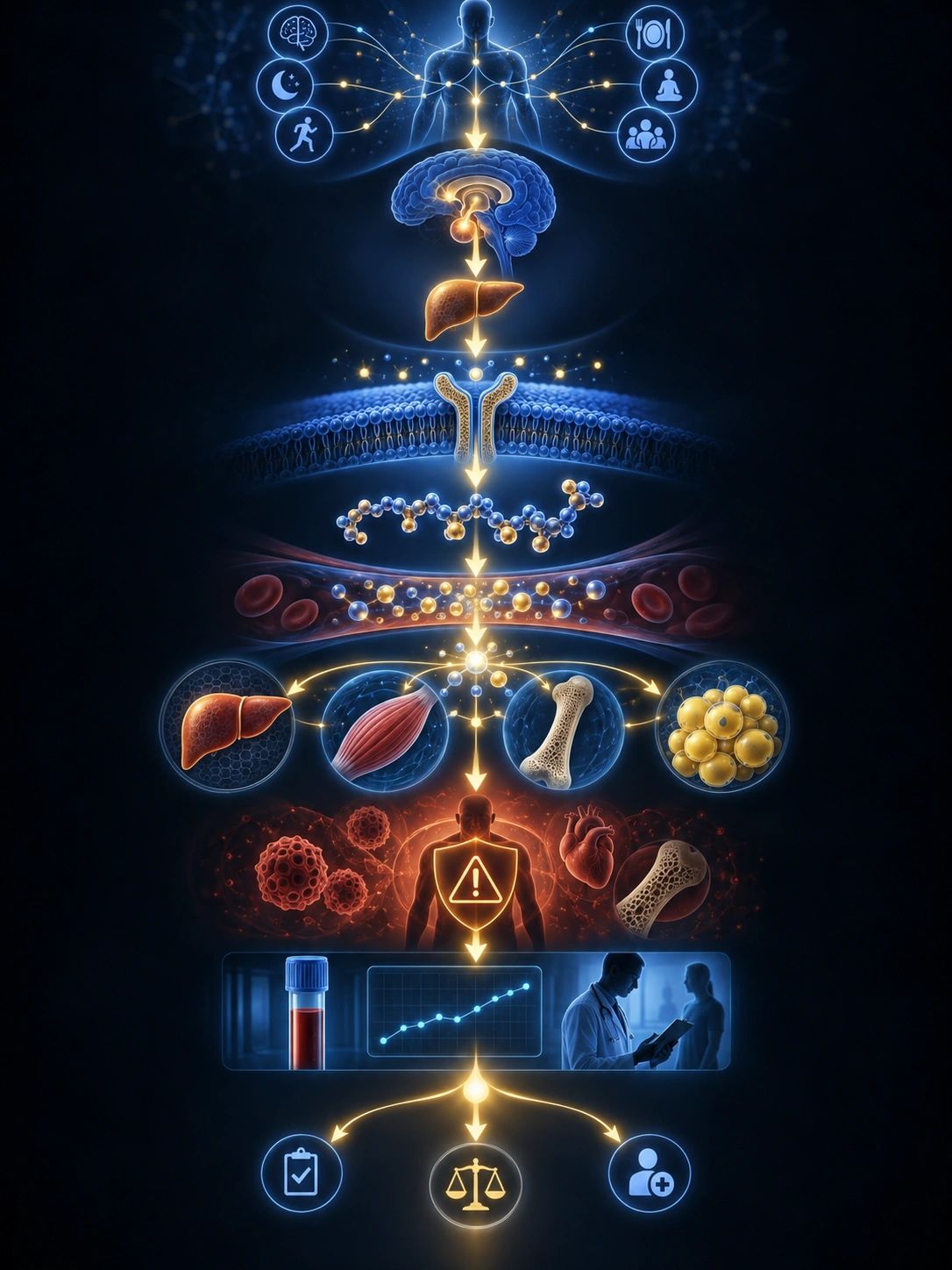
HYPOTHALAMUS → PITUITARY → GH → LIVER / PERIPHERAL TISSUES → IGF-1 → TISSUE RESPONSE
The axis begins with signals from the:
- Hypothalamus
Two of the most important are:
- GHRH - which promotes GH release
- Somatostatin - which restrains it.
Another major signal comes through the:
- Ghrelin receptor (or GHS-R)
These signals converge on the:
- Anterior pituitary - where somatotroph cells release growth hormone.
GH then acts directly on tissues and also stimulates production of:
- IGF-1 - particularly from the liver.
GHRH / Ghrelin Signaling → Pituitary GH → GH Receptor Signaling → IGF-1 + Direct GH Effects → Tissue
But the system is controlled by:
- Feedback
IGF-1 and GH themselves influence upstream signaling so the axis does not simply remain:
- On
PULSATILITY CHANGES EVERYTHING
We believe in creating meaningful experiences that inspire and connect. Let us help you bring your vision to life.
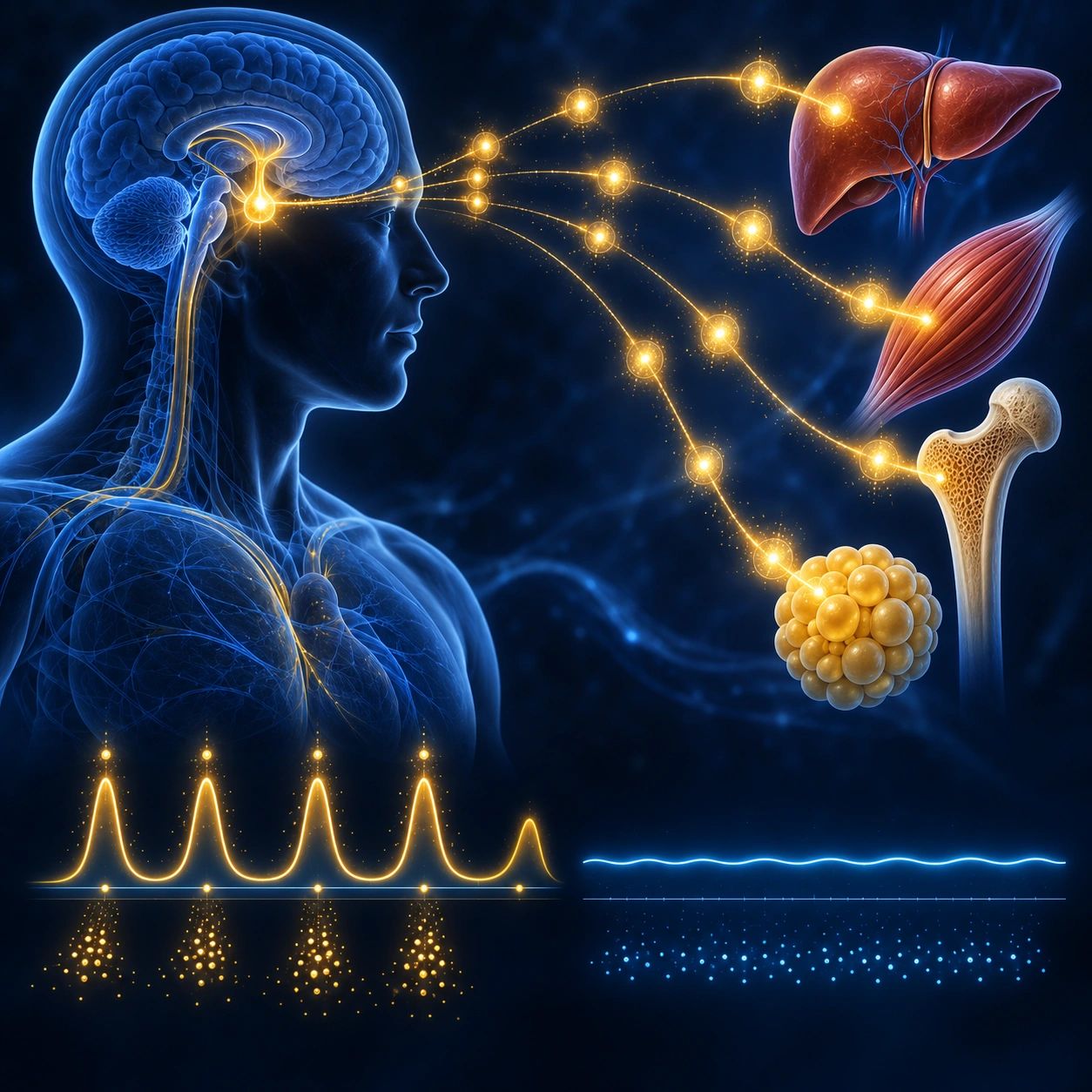
GH IS PULSATILE
Growth hormone is not normally released at a constant rate.
It is secreted in:
- pulses.
These pulses vary according to:
- sleep
- age
- sex
- nutritional state
- exercise
- metabolic health
Some of the largest GH pulses occur during:
- deep sleep.
This means two people could potentially have similar total GH production while experiencing very different:
- signaling patterns.
That makes GH fundamentally different from a hormone that remains relatively steady throughout the day.
WHY THIS MATTERS
A constant pharmacologic signal may not reproduce:
- normal physiology.
Changing:
- amplitude
- frequency
- duration
can change the biological result.
GH DOES MUCH MORE THAN BUILD MUSCLE
THE GH AXIS TOUCHES MULTIPLE SYSTEMS
BODY FAT
GH can increase:
- lipolytic signaling - influence how stored energy is mobilized.
SKELETAL MUSCLE
GH and IGF-1 participate in:
- protein metabolism
- tissue maintenance
- recovery
But GH is not simply: a muscle-building switch.
BONE
The GH–IGF-1 axis contributes to:
- skeletal development
- bone turnover
- tissue maintenance
CONNECTIVE TISSUE
The axis interacts with:
- collagen
- tendon
- extracellular matrix
- tissue repair
GLUCOSE METABOLISM
GH can oppose some insulin actions.
This means more GH signaling can influence:
- glucose control.
RECOVERY
Sleep, training, nutrition, and endocrine signaling all interact with:
- repair.
GH is a systems hormone.
Increasing one desired effect may alter several other systems at the same time.
Peptides

SERMORELIN
SERMORELIN
SERMORELIN
GHRH-Receptor Signaling With a Shorter Physiologic-Style Signal
Sermorelin is a GHRH-related peptide that stimulates pituitary:
GHRH receptors.
The conceptual goal is:
stimulate the patient’s pituitary rather than directly administer GH.
Important questions include:
pituitary reserve
pulse pattern
dose
duration
downstream IGF-1 response
CJC-1295
SERMORELIN
SERMORELIN
Extending GHRH Signaling
CJC-1295 was developed to modify the duration of:
GHRH-like signaling.
That raises a central pharmacologic question:
What happens when a naturally pulsatile signal is extended?
Formulation matters, including whether the product contains:
DAC.
IPAMORELIN
TESAMORELIN
TESAMORELIN
Stimulating GH Through the Ghrelin Receptor
Ipamorelin works through:
GHS-R1a
rather than the GHRH receptor.
This provides a different route into:
pituitary GH release.
Its biology should therefore be understood through:
ghrelin-receptor signaling, not simply as another GHRH analog.
TESAMORELIN
TESAMORELIN
TESAMORELIN
GH-Axis Pharmacology With a Specific Clinical Context
Tesamorelin is a GHRH analog with established human clinical use in a defined setting involving:
visceral adipose tissue.
This makes it particularly useful for understanding the difference between:
molecule
mechanism
indication
evidence
PATTERN → AXIS → RECEPTOR → PEPTIDE → EXPOSURE → IGF-1 / TISSUE RESPONSE → RISK → MONITORING → DECISION
THE GH-AXIS DECISION FRAMEWORK
Before asking:
“Which GH peptide should I use?”
ask:
- What physiological problem exists?
- Is GH-axis signaling actually involved?
- Which receptor pathway is relevant?
- Is the goal metabolic, anabolic, body-composition related, or something else?
- What human evidence exists for that exact indication?
- What could excessive signaling do?
- What should be monitored?
This transforms:
- peptide selection
into:
- clinical reasoning