Clinical Peptide Medicine — Structured. Applied. Evolving.
UNDERSTAND THE PEPTIDE
Vasoactive intestinal peptide — VIP — is a naturally occurring 28-amino-acid neuropeptide with broad effects across the nervous, immune, gastrointestinal, cardiovascular, and respiratory systems.
Its name can be misleading.
VIP was first identified in the gastrointestinal system, but it is not simply:
- AN INTESTINAL PEPTIDE.
VIP is distributed throughout:
- central nervous system
- peripheral nerves
- autonomic nervous system
- gastrointestinal tract
- airway
- vascular tissue
- immune cells
- endocrine tissues
Its major biological effects include:
- vasodilation
- smooth-muscle relaxation
- intestinal secretion
- bronchodilation
- immune regulation
- barrier signaling
- circadian and neuroendocrine communication
- neuroprotection
- anti-inflammatory signaling
VIP is therefore best understood as:
- A NEUROIMMUNE AND AUTONOMIC SIGNAL THAT HELPS COORDINATE BLOOD FLOW, SMOOTH-MUSCLE TONE, SECRETORY FUNCTION, BARRIER PHYSIOLOGY, AND IMMUNE RESPONSE.
That is a much better description than:
- “VIP IS AN ANTI-INFLAMMATORY PEPTIDE.”
Because VIP does far more than reduce inflammatory signaling.
It helps connect:
NERVOUS SYSTEM
↓
IMMUNE SYSTEM
↓
VASCULATURE
↓
EPITHELIAL / BARRIER TISSUES
This makes VIP one of the most important examples of:
- SYSTEMS-LEVEL PEPTIDE SIGNALING.
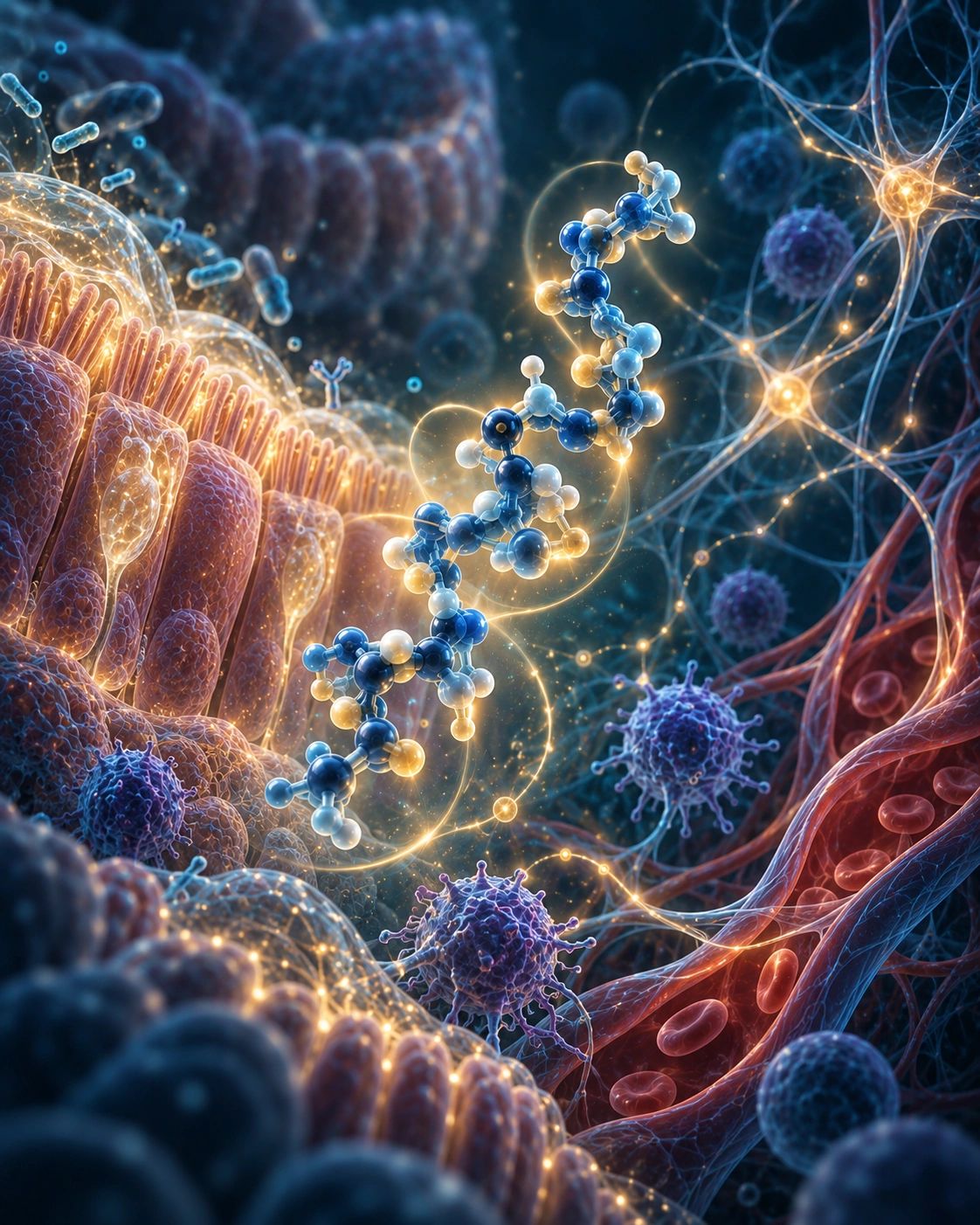
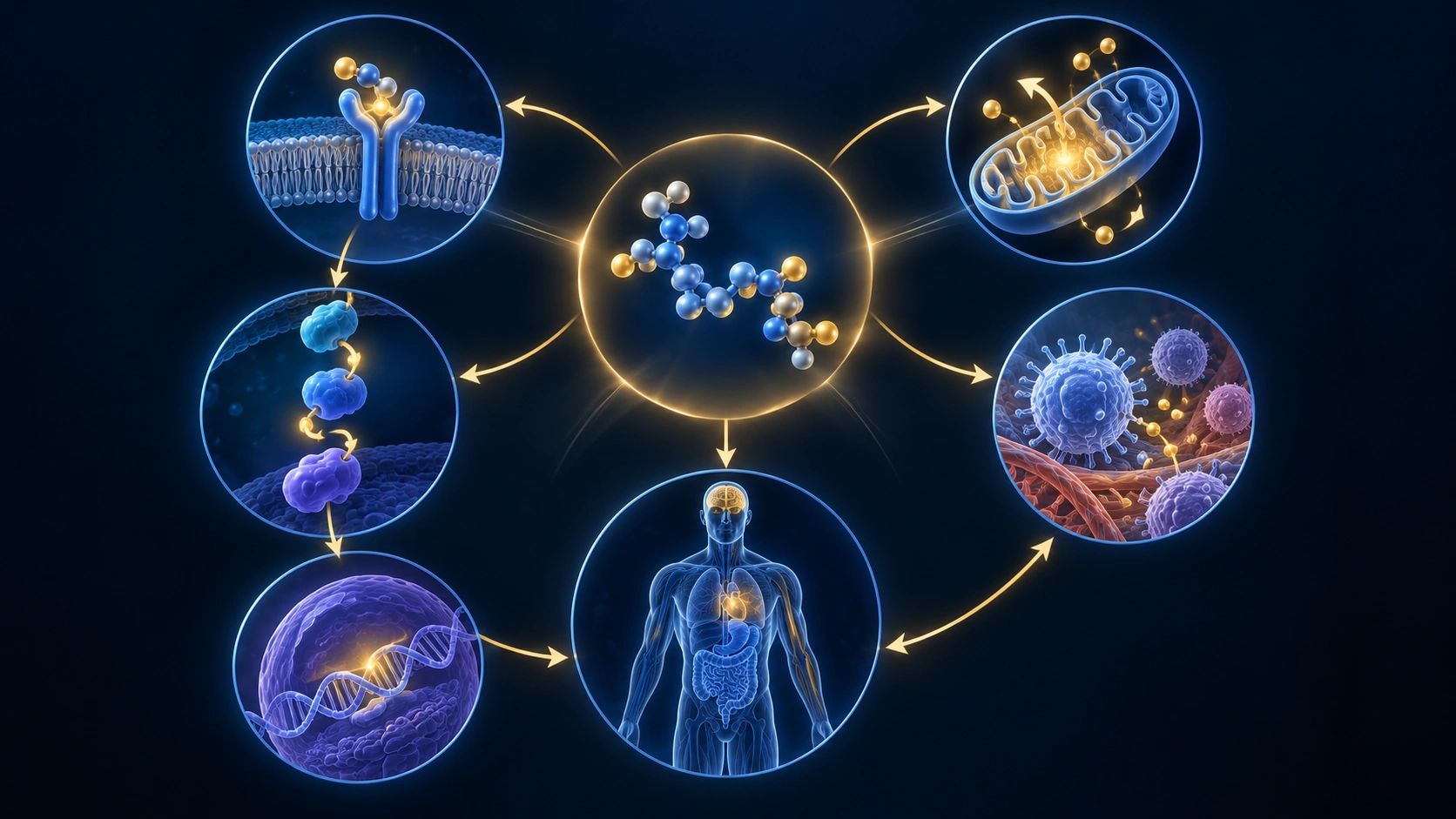
THE CORE MECHANISM MAP
VIP
↓
VPAC1 / VPAC2
↓
cAMP ↑
↓
Potential effects on:
- VASCULAR SMOOTH MUSCLE
- AIRWAY SMOOTH MUSCLE
- IMMUNE CELLS
- GI EPITHELIUM
- NEURONS
↓
Potential:
- VASODILATION
- BRONCHODILATION
- SECRETORY REGULATION
- IMMUNE MODULATION
- BARRIER SIGNALING
- NEURAL COORDINATION
The core idea is:
- VIP IS A MULTISYSTEM HOMEOSTATIC SIGNAL.
WHAT THIS MECHANISM MAY SUGGEST
Mechanistically, VIP deserves research interest in:
- inflammatory pulmonary disease
- pulmonary vascular dysfunction
- selected autoimmune disease
- neuroinflammation
- mucosal inflammation
- barrier dysfunction
- autonomic dysregulation
- circadian dysfunction
- neuroprotective applications
Its strongest conceptual niche may be:
- DISORDERS WHERE NERVOUS, IMMUNE, VASCULAR, AND BARRIER SIGNALING OVERLAP.
WHAT THIS MECHANISM DOES NOT PROVE
VIP biology does not prove that it:
- treats every inflammatory disease
- treats every autoimmune condition
- repairs every “leaky gut”
- cures asthma
- corrects every autonomic disorder
- treats every neuroinflammatory condition
- should be used whenever VIP is “low”
- is universally beneficial because it is endogenous
Again:
- A NORMAL HUMAN PEPTIDE CAN STILL BE PATHOLOGICAL WHEN SIGNALING IS EXCESSIVE OR MISAPPLIED.
VIPoma proves that clearly.

PRECLINICAL EVIDENCE
SUBSTANTIAL
Research includes:
- autoimmune disease models
- inflammatory disease
- pulmonary disease
- neuroinflammation
- vascular signaling
- barrier biology
- neuroprotection
HUMAN BIOLOGICAL EVIDENCE
STRONG
- VIP is measurable in humans.
- Its receptor biology is well characterized.
Disease states involving excessive endogenous VIP, especially:
- VIPOMA,
demonstrate clear human physiological effects.
DIRECT THERAPEUTIC HUMAN EVIDENCE
APPLICATION-DEPENDENT
VIP and VIP-pathway therapeutics have been evaluated clinically in selected areas, particularly:
- pulmonary disease
- pulmonary vascular disease
- respiratory failure contexts
But the evidence should be interpreted by:
- FORMULATION + ROUTE + DISEASE + ENDPOINT.
Again:
- REAL HUMAN PHYSIOLOGY
does not mean:
- EVERY EXOGENOUS APPLICATION IS EQUIVALENT.
DO NOT BEGIN WITH VIP
Begin with: WHICH SYSTEM IS ACTUALLY DYSREGULATED — AND WHAT IS VIP EXPECTED TO CHANGE?
Then:
PHYSIOLOGY
↓
PATTERN
↓
MECHANISM
↓
EVIDENCE
↓
RISK
↓
MONITORING
↓
DECISION
PHYSIOLOGY
Normal VIP signaling helps regulate:
- vascular tone
- airway tone
- GI secretion
- immune signaling
- barrier function
- autonomic communication
- circadian coordination
Again:
that means VIP should never be evaluated through:
- ONE ORGAN ALONE.
EVIDENCE
Ask:
- WHAT VIP APPLICATION IS BEING DISCUSSED?
- Pulmonary?
- Gut?
- Autoimmune?
- Neuroinflammatory?
- Circadian?
Again:
these have:
- DIFFERENT EVIDENCE BASES.
And:
- ENDOGENOUS VIP PHYSIOLOGY
should not be conflated with:
- THERAPEUTIC VIP ADMINISTRATION.
PATTERN
What is actually present?
- pulmonary vascular dysfunction?
- airway hyperreactivity?
- mucosal inflammation?
- autoimmune disease?
- neuroinflammatory pattern?
- autonomic dysfunction?
- secretory diarrhea?
- circadian dysregulation?
Again:
- “LOW VIP” IS NOT A CLINICAL PATTERN BY ITSELF.
RISK
Potential considerations include:
- hypotension
- flushing
- tachycardia
- headache
- diarrhea
- electrolyte loss
- altered smooth-muscle tone
- excessive immunoregulation in selected infectious settings
- interaction with antihypertensive or vasodilator therapy
Again:
the physiology of:
- VIPOMA
shows us exactly why:
- MORE VIP IS NOT ALWAYS BETTER.
MECHANISM
Does VIP biology match:
- THE DOMINANT BOTTLENECK?
If shortness of breath is caused by:
- IRON-DEFICIENCY ANEMIA,
VIP is not correcting:
- THE OXYGEN-CARRYING PROBLEM.
If diarrhea is already severe:
VIP-mediated intestinal secretion may be:
- COUNTERPRODUCTIVE.
If the problem is:
- EXCESSIVE IMMUNE SIGNALING + VASCULAR DYSFUNCTION,
VIP becomes:
- MUCH MORE MECHANISTICALLY INTERESTING.
Again:
the peptide needs:
- A REASON TO FIT.
MONITORING
Monitoring should follow:
- THE TARGET SYSTEM.
CARDIOVASCULAR
- blood pressure
- heart rate
- dizziness
- perfusion symptoms
PULMONARY
- oxygenation where relevant
- dyspnea
- exercise tolerance
- pulmonary function
- disease-specific imaging or hemodynamics
GASTROINTESTINAL
- stool frequency
- hydration
- electrolytes
- abdominal symptoms
IMMUNE / INFLAMMATORY
- disease-specific symptoms
- inflammatory activity
- infection burden where relevant
AUTONOMIC
- blood pressure response
- heart-rate response
- orthostatic symptoms
- GI motility patterns
Again:
monitor:
- THE SYSTEM VIP IS ACTUALLY MOVING.

THE PRAXIS 5

MECHANISM
VIP acts primarily through:
- VPAC1 + VPAC2 → cAMP SIGNALING.
Major biological effects involve:
- VASODILATION + SMOOTH-MUSCLE RELAXATION + IMMUNE REGULATION + NEURAL SIGNALING.
EVIDENCE
Endogenous physiology:
- STRONG.
Human disease biology:
- STRONG.
Preclinical therapeutic biology:
- SUBSTANTIAL.
Direct therapeutic evidence:
- APPLICATION-DEPENDENT.
Again:
- VIP is a deeply established human peptide system.
RISK
The same mechanisms producing benefit can produce:
- SIDE EFFECTS.
Vasodilation can improve perfusion.
Too much can produce:
- HYPOTENSION.
Intestinal secretion is normal physiology.
Too much can produce:
- SEVERE DIARRHEA.
Immune regulation may reduce pathological inflammation.
Too much or mistimed regulation may potentially impair:
- HOST DEFENSE.
MONITORING
Monitor:
- VASCULAR + GI + PULMONARY + IMMUNE OUTCOMES
according to why VIP is being used.
The measurement should follow:
- THE HYPOTHESIS.
PATIENT CONTEXT
A patient with:
- PULMONARY VASCULAR DISEASE
is not identical to:
someone with:
- CHRONIC DIARRHEA.
A patient with:
- AUTOIMMUNE INFLAMMATION
is not identical to:
someone who is:
- SEVERELY IMMUNOCOMPROMISED.
A patient with:
- NORMAL BLOOD PRESSURE
is not identical to:
someone prone to:
- ORTHOSTATIC HYPOTENSION.
Same peptide.
Completely different:
- PHYSIOLOGICAL ENVIRONMENT.
SEVEN QUESTIONS TO ASK BEFORE VIP
1. WHICH SYSTEM ARE WE ACTUALLY TRYING TO CHANGE?
- pulmonary?
- immune?
- gut?
- vascular?
- neurologic?
- autonomic?
2. WHAT IS THE DOMINANT PHYSIOLOGICAL PROBLEM?
- excessive smooth-muscle tone?
- inflammation?
- vascular resistance?
- barrier dysfunction?
- immune dysregulation?
3. DOES VIP'S VPAC / cAMP BIOLOGY MATCH THAT PROBLEM?
- The mechanism has to fit.
4. IS THE PATIENT ALREADY SHOWING A PHYSIOLOGY THAT VIP COULD AMPLIFY TOO FAR?
- low blood pressure?
- diarrhea?
- tachycardia?
- volume depletion?
5. WHAT TYPE OF EVIDENCE SUPPORTS THIS PARTICULAR USE?
- endogenous human?
- disease biology?
- preclinical?
- direct human therapeutic?
6. WHAT WILL WE MONITOR?
- blood pressure?
- respiratory function?
- stool output?
- immune activity?
- symptoms?
7. WHAT WOULD DEFINE SUCCESS?
Not:
- “VIP WENT UP.”
But:
- THE TARGETED SYSTEM BECAME MORE FUNCTIONAL WITHOUT DESTABILIZING THE OTHER SYSTEMS VIP ALSO CONTROLS.


VIP
KEY TAKEAWAYS
- VIP is a naturally occurring 28-amino-acid neuropeptide.
- It belongs to the secretin/glucagon peptide family.
- VIP acts primarily through VPAC1 and VPAC2 receptors.
- These receptors are GPCRs that strongly activate cAMP signaling.
- VIP is distributed throughout the nervous, gastrointestinal, immune, respiratory, and cardiovascular systems.
- It is a potent vasodilator.
- It relaxes smooth muscle.
- It can influence airway tone and pulmonary circulation.
- VIP strongly influences intestinal secretion.
- It participates in mucosal and epithelial barrier physiology.
- It is also an important immunomodulatory peptide.
- VIP can alter macrophage, dendritic-cell, and T-cell signaling.
- Its immune biology often favors regulatory and resolution-oriented responses.
- This makes VIP interesting in inflammatory and autoimmune research.
- VIP should not be reduced to a simple anti-inflammatory peptide.
- Its biology is fundamentally neuroimmune and homeostatic.
- VIP also participates in central nervous system signaling.
- Within the suprachiasmatic nucleus, VIP helps synchronize circadian clock neurons.
- This makes VIP an important peptide in network timing and circadian coordination.
- VIP is relevant to pulmonary biology because it can affect both airway smooth muscle and pulmonary vasculature.
- It is relevant to gut biology because it regulates secretion, motility, blood flow, and mucosal immunity.
- Excess endogenous VIP produces a well-characterized human syndrome.
- VIPoma can cause profound watery diarrhea, potassium loss, dehydration, and vascular symptoms.
- This demonstrates that physiologic peptides can become pathological when signaling becomes excessive.
- More endogenous signaling is not automatically better.
- A plasma VIP level should not automatically be treated as a complete measurement of whole-body VIP biology.
- Local tissue release, receptor expression, degradation, and downstream response also matter.
- VIP's therapeutic relevance is highly dependent on the tissue and physiological pattern.
- A patient with hypotension and diarrhea has a very different VIP risk profile from a patient with pulmonary vascular constriction and inflammatory disease.
- The best question is not “is VIP low?”
- The better question is “which VIP-regulated system is dysfunctional, does VPAC signaling match the dominant bottleneck, what other systems will move when VIP signaling changes, and what functional outcome will prove that the intervention improved physiology rather than simply changing a peptide level?”
THE BOTTOM LINE
VIP may be one of the best peptides in the entire PPI library for demonstrating:
- WHY THE BODY CANNOT BE DIVIDED INTO ISOLATED ORGAN SYSTEMS.
The same peptide can influence:
BLOOD VESSELS
↓
AIRWAY
↓
INTESTINE
↓
IMMUNE CELLS
↓
BRAIN
↓
CIRCADIAN CLOCK
Why?
Because the body's systems need:
- COORDINATION.
VIP appears to be one of the signals used to create that coordination.
The central pathway is relatively straightforward:
VIP
↓
VPAC1 / VPAC2
↓
cAMP
But the response is not.
Because:
- THE CELL RECEIVING THE SIGNAL DETERMINES WHAT HAPPENS NEXT.
In vascular smooth muscle:
- RELAXATION.
In airway smooth muscle:
- RELAXATION.
In intestinal epithelium:
- SECRETION.
In an immune cell:
- CYTOKINE AND PHENOTYPE CHANGE.
In the SCN:
- NETWORK SYNCHRONIZATION.
Same peptide.
Same general receptor family.
Different:
- PHYSIOLOGICAL OUTPUT.
That is systems biology.
And it also explains the danger of reducing VIP to:
- “AN ANTI-INFLAMMATORY PEPTIDE.”
That misses most of the story.
The better Praxis question is:
- “WHICH SYSTEM IS FAILING, what is the dominant physiological pattern, does VPAC signaling address that bottleneck, what other tissues are likely to respond at the same time, and can we improve the target system without producing too much vasodilation, secretion, immune regulation, or smooth-muscle relaxation somewhere else?”
That is the difference between:
- TREATING A PEPTIDE LEVEL
and:
- UNDERSTANDING A SIGNALING NETWORK.
STOP MEMORIZING PEPTIDES. START UNDERSTANDING THE SYSTEM.