Clinical Peptide Medicine — Structured. Applied. Evolving.

Praxis Peptide Institute
  • HOME
  • START HERE
  • LEARN
  • PEPTIDE GUIDES
  • PEP EXPERIENCE REGISTRY
  • EXPLORE REGISTRY
  • ADVANCED LEARNER TRAINING
  • CLINICIAN TRAINING
  • ABOUT
  • More
    • HOME
    • START HERE
    • LEARN
    • PEPTIDE GUIDES
    • PEP EXPERIENCE REGISTRY
    • EXPLORE REGISTRY
    • ADVANCED LEARNER TRAINING
    • CLINICIAN TRAINING
    • ABOUT
  • Sign In
  • Create Account

  • My Account
  • Signed in as:

  • filler@godaddy.com


  • My Account
  • Sign out

Signed in as:

filler@godaddy.com

  • HOME
  • START HERE
  • LEARN
  • PEPTIDE GUIDES
  • PEP EXPERIENCE REGISTRY
  • EXPLORE REGISTRY
  • ADVANCED LEARNER TRAINING
  • CLINICIAN TRAINING
  • ABOUT

Account

  • My Account
  • Sign out

  • Sign In
  • My Account

Tuftsin Peptide Guide: Innate Immunity, Macrophages, Phagocytosis, Host Defense, and the Praxis Lens

   A comprehensive Tuftsin guide covering its immunoglobulin-derived biology, macrophage and neutrophil activation, phagocytosis, host-defense signaling, immune coordination, infection research, evidence, monitoring, and the Praxis clinical reasoning framework. 

UNDERSTAND THE PEPTIDE

Tuftsin is a naturally occurring four-amino-acid immunomodulatory peptide with the sequence threonine-lysine-proline-arginine — Thr-Lys-Pro-Arg — generated from the Fc region of immunoglobulin G.

That makes Tuftsin immediately different from many other peptides in this library.

It is not primarily:

  • a hormone 
  • a growth factor 
  • a neuropeptide 
  • a mitochondrial peptide 

It is best understood as:

  • AN IMMUNE-DERIVED SIGNAL EMBEDDED WITHIN AN ANTIBODY PROTEIN.

Tuftsin is associated especially with:

  • macrophage activation 
  • neutrophil function 
  • phagocytosis 
  • chemotaxis 
  • innate host defense 
  • microbial clearance 
  • immune-cell signaling 

The central concept is:

  • RECOGNITION IS NOT ENOUGH.

The immune system also has to:

MOVE TOWARD THE THREAT

↓

ENGULF THE THREAT

↓

DESTROY THE THREAT

↓

CLEAR THE DAMAGE

Tuftsin appears to participate in that:

  • EFFECTOR PHASE OF INNATE IMMUNITY.

So the best way to understand Tuftsin is not simply:

  • “AN IMMUNE-BOOSTING PEPTIDE.”

That phrase is far too imprecise.

A better description is:

  • A NATURALLY OCCURRING IMMUNOMODULATORY TETRAPEPTIDE THAT ENHANCES PHAGOCYTE RECOGNITION, MIGRATION, ENGULFMENT, AND MICROBICIDAL ACTIVITY.

That gives us a much more useful biological model.
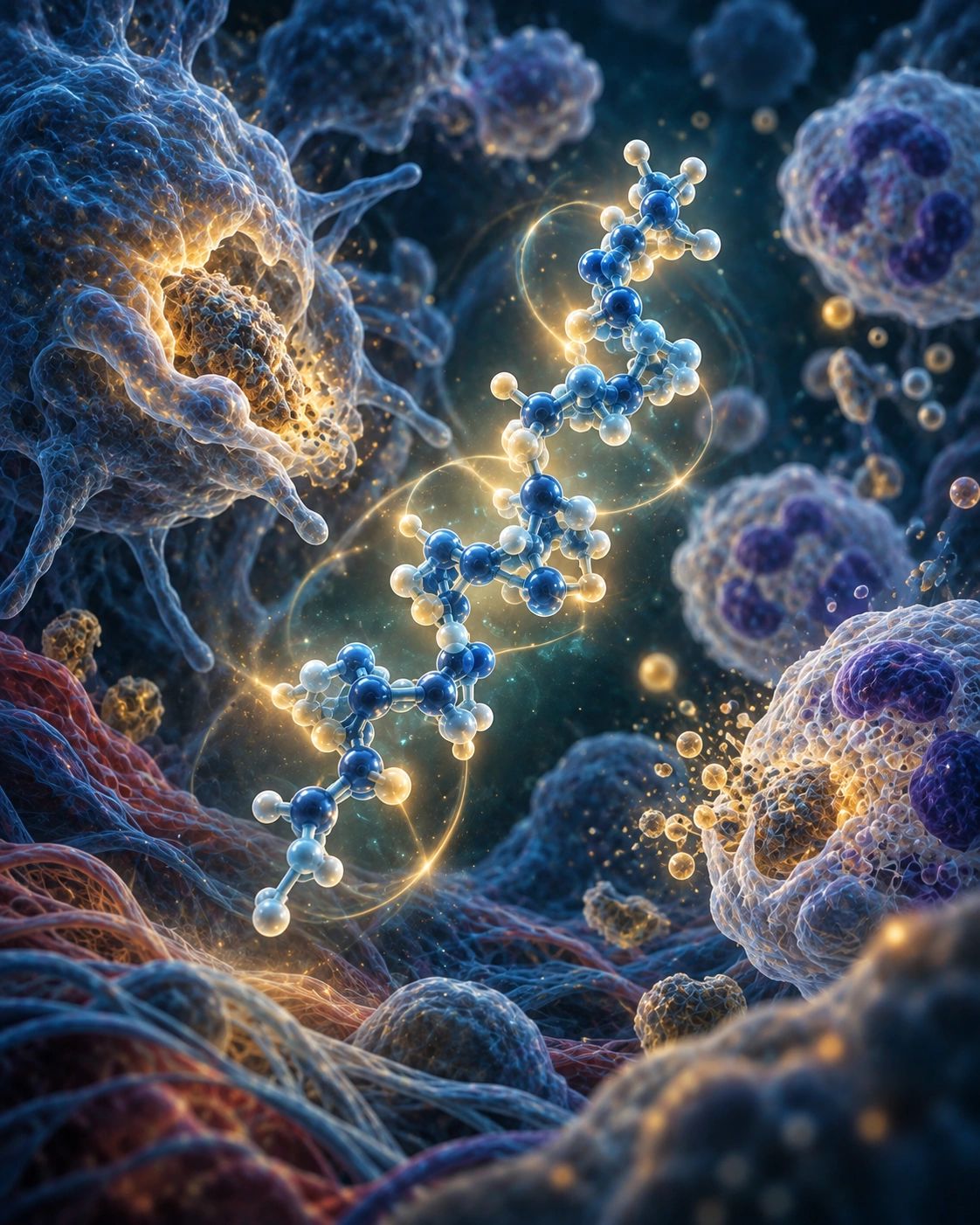
WHAT IS TUFTSIN?

TUFTSIN

WHY THE SPLEEN MATTERS

THE IDENTITY MODEL

Tuftsin is the tetrapeptide:

THREONINE — LYSINE — PROLINE — ARGININE

or:

TKPR.


It is generated from:

IMMUNOGLOBULIN G — IgG

through enzymatic processing.


The peptide corresponds to a sequence within the:

Fc REGION OF THE IgG HEAVY CHAIN.


That is important because the Fc region already participates in:

IMMUNE EFFECTOR FUNCTION.


Antibodies do not merely bind antigens.

Their Fc regions help recruit:

macrophages 

neutrophils 

complement 

Fc-receptor-bearing immune cells 


Tuftsin adds another layer to that story.

THE IDENTITY MODEL

WHY THE SPLEEN MATTERS

THE IDENTITY MODEL

IgG

↓

Fc-region proteolytic processing

↓

TUFTSIN — TKPR

↓

Interaction with:

PHAGOCYTIC IMMUNE CELLS

↓

Potential:

CHEMOTAXIS

PHAGOCYTOSIS

MICROBICIDAL ACTIVITY

IMMUNE-CELL ACTIVATION

↓

Potential:

IMPROVED INNATE HOST DEFENSE


Again:

Tuftsin connects:

ANTIBODY BIOLOGY

with:

PHAGOCYTE FUNCTION.

WHY THE SPLEEN MATTERS

WHY THE SPLEEN MATTERS

WHY THE SPLEEN MATTERS

Tuftsin biology has historically been closely linked to:

THE SPLEEN.


That matters because the spleen plays major roles in:

filtering blood 

clearing damaged cells 

removing opsonized microorganisms 

supporting phagocyte function 

coordinating immune responses 


Patients without normal splenic function are especially vulnerable to certain infections.


Tuftsin helped researchers appreciate that the spleen may participate not only through:

CELLULAR FILTERING

but also through:

PEPTIDE-GENERATING IMMUNE BIOLOGY.


This does not mean:

TUFTSIN REPLACEMENT CORRECTS ASPLENIA.


But it illustrates how deeply peptide signaling can be embedded in:

ORGAN-LEVEL IMMUNITY.

HOW TUFTSIN MAY WORK

THE PHAGOCYTOSIS MODEL

WHY THE SPLEEN MATTERS

The major mechanistic themes include:

  • phagocyte activation 
  • chemotaxis 
  • phagocytosis 
  • intracellular microbial killing 
  • macrophage signaling 
  • neutrophil signaling 
  • immune-cell migration 
  • host-defense coordination 


Its biology is therefore centered on:

WHAT THE INNATE IMMUNE SYSTEM DOES AFTER A THREAT HAS BEEN IDENTIFIED.

PHAGOCYTOSIS

THE PHAGOCYTOSIS MODEL

THE PHAGOCYTOSIS MODEL

Phagocytosis means:

CELLULAR ENGULFMENT.


Phagocytes include:

macrophages 

neutrophils 

monocytes 


They identify:

MICROBES OR DAMAGED MATERIAL

↓

surround the target

↓

internalize it

↓

destroy or process it

This is one of the oldest and most important immune functions in biology.


Tuftsin is strongly associated with:

ENHANCEMENT OF PHAGOCYTIC ACTIVITY.

THE PHAGOCYTOSIS MODEL

THE PHAGOCYTOSIS MODEL

THE PHAGOCYTOSIS MODEL

PATHOGEN

↓

Recognition

↓

TUFTSIN-RESPONSIVE PHAGOCYTE

↓

Cell migration

↓

Engulfment

↓

Phagosome formation

↓

Intracellular killing

↓

Potential:

MICROBIAL CLEARANCE


Again:

the peptide does not necessarily:

KILL THE MICROBE DIRECTLY.


It may help the immune cell:

DO ITS JOB BETTER.


That distinguishes Tuftsin from:

LL-37.

TUFTSIN VS LL-37

MACROPHAGE BIOLOGY

TUFTSIN VS LL-37

 This comparison is especially useful.

LL-37

Can directly:

DISRUPT MICROBIAL MEMBRANES.

It also modifies immune signaling.


TUFTSIN

Primarily enhances:

PHAGOCYTE FUNCTION.

So one can think of:

LL-37 = DIRECT HOST-DEFENSE WEAPON

while:

TUFTSIN = PHAGOCYTE-ACTIVATION / COORDINATION SIGNAL


That is oversimplified, but directionally useful.


Again:

different innate immune peptides may solve:

DIFFERENT PARTS OF THE SAME HOST-DEFENSE PROBLEM.

CHEMOTAXIS

MACROPHAGE BIOLOGY

TUFTSIN VS LL-37

Phagocytes must first:

REACH THE THREAT.


Chemotaxis is:

DIRECTED CELL MOVEMENT TOWARD A CHEMICAL SIGNAL.


Tuftsin has been associated with increased:

MIGRATION OF PHAGOCYTIC CELLS.


That makes the sequence:

DETECT

↓

MOVE

↓

ENGULF

↓

DESTROY

more efficient.

MACROPHAGE BIOLOGY

MACROPHAGE BIOLOGY

MACROPHAGE BIOLOGY

Macrophages are among the major target cells associated with Tuftsin.


Macrophages perform several tasks:

engulf microorganisms 

remove damaged cells 

present antigens 

release cytokines 

coordinate tissue repair 

interact with lymphocytes 


They sit at the intersection of:

INNATE IMMUNITY

and:

ADAPTIVE IMMUNITY.


Tuftsin can increase macrophage activity related to:

PHAGOCYTOSIS + MICROBICIDAL FUNCTION.


Again

this is not simply:

“MORE MACROPHAGES.”


The important variable is:

WHAT THE MACROPHAGES ARE DOING.

NEUTROPHIL BIOLOGY

INTRACELLULAR KILLING

MACROPHAGE BIOLOGY

Neutrophils are the body's rapid-response phagocytes.


They:

migrate quickly 

engulf microorganisms 

produce reactive oxygen species 

release antimicrobial enzymes 

form extracellular traps


Tuftsin has been associated with enhancement of:

NEUTROPHIL PHAGOCYTIC AND MICROBICIDAL FUNCTION.


That makes it especially relevant conceptually to:

ACUTE HOST DEFENSE.

INTRACELLULAR KILLING

INTRACELLULAR KILLING

INTRACELLULAR KILLING

Engulfment alone is not enough.


A macrophage or neutrophil must:

DESTROY WHAT IT ENGULFS.


This can involve:

reactive oxygen species 

lysosomal enzymes 

antimicrobial molecules 

acidic compartments 


Tuftsin-related signaling has been associated with increased:

MICROBICIDAL ACTIVITY.


Again:

the relevant endpoint is not merely:

PHAGOCYTOSIS OCCURRED.


It is:

THE THREAT WAS CLEARED.

RECEPTOR BIOLOGY

INTRACELLULAR KILLING

INTRACELLULAR KILLING

Tuftsin has been reported to interact with receptors on:

PHAGOCYTIC CELLS.


The exact receptor biology has evolved over time, and several candidate binding systems have been proposed.


One of the best-known modern connections is with:

NEUROPILIN-1 — NRP1.


This is interesting because NRP1 participates in:

immune-cell signaling 

vascular biology 

neuronal guidance 

growth-factor signaling


Tuftsin and tuftsin-like peptides have shown affinity for:

NRP1-RELATED BINDING SYSTEMS.


That adds another layer to its biological complexity.


Again

the peptide may not be operating through:

ONE SIMPLE CLASSIC HORMONE RECEPTOR.

IMMUNE ACTIVATION VS IMMUNE AMPLIFICATION

This distinction is crucial.

If Tuftsin enhances:

PHAGOCYTE ACTIVITY

then its usefulness depends on:

WHETHER PHAGOCYTE ACTIVITY IS ACTUALLY THE BOTTLENECK.


For example:

A patient may have recurrent infection because of:

neutropenia 

impaired antibody production 

structural obstruction 

poor circulation 

uncontrolled diabetes 

biofilm 

immune-suppressive medication 


Tuftsin-related biology would not correct all of those.


Again:

HOST DEFENSE IS A NETWORK.

THE CORE MECHANISM MAP

IgG

↓

Proteolytic processing

↓

TUFTSIN — TKPR

↓

Potential action on:

  • MACROPHAGES
  • MONOCYTES
  • NEUTROPHILS

↓

CHEMOTAXIS

PHAGOCYTOSIS

MICROBICIDAL ACTIVITY

↓

Potential:

  • IMPROVED PATHOGEN CLEARANCE

The core concept is:

  • TUFTSIN SUPPORTS THE CELLULAR EFFECTOR ARM OF INNATE IMMUNITY.


WHAT THIS MECHANISM MAY SUGGEST

Mechanistically, Tuftsin deserves research interest in:

  • impaired phagocytic function 
  • recurrent infection 
  • selected immunodeficiency states 
  • macrophage dysfunction 
  • neutrophil dysfunction 
  • impaired microbial clearance 
  • chronic infection 
  • host-defense support 
  • vaccine / antigen-response research 
  • immune-delivery systems 

Its strongest conceptual niche is:

  • PHAGOCYTE-DEPENDENT HOST DEFENSE.

WHAT THIS MECHANISM DOES NOT PROVE

Tuftsin biology does not prove that it:

  • treats every infection 
  • replaces antibiotics 
  • corrects severe neutropenia 
  • replaces splenic function 
  • treats every immune deficiency 
  • should be used whenever someone “gets sick often” 
  • clears every intracellular pathogen 
  • is appropriate in every inflammatory disease 
  • improves immunity simply by increasing inflammation 

Again:

  • IMMUNE ACTIVATION IS NOT THE SAME AS IMMUNE COMPETENCE.

The system has to:

RECOGNIZE

↓

TARGET

↓

CLEAR

↓

RESOLVE.

THE EVIDENCE, POTENTIAL APPLICATIONS, AND LIMITATIONS

ENDOGENOUS / PHYSIOLOGICAL BIOLOGY

MEANINGFUL

Tuftsin is an endogenous:

IMMUNOGLOBULIN-DERIVED PEPTIDE.

Its relationship to:

phagocytosis 

macrophages 

neutrophils 

host defense 

has been studied for decades.


This gives it a legitimate physiological foundation.

PRECLINICAL EVIDENCE

MEANINGFUL

Tuftsin research includes:

  • phagocyte activation 
  • microbial clearance 
  • tumor-immunity models 
  • infectious disease models 
  • vaccine delivery 
  • immune-targeted drug delivery 

Its biological effects are particularly well established in:

  • IMMUNE-CELL AND ANIMAL MODELS.

HUMAN BIOLOGICAL RELEVANCE

REAL BUT LESS DEVELOPED THERAPEUTICALLY

Tuftsin biology is based on:

  • HUMAN IMMUNOGLOBULIN PHYSIOLOGY.

But direct modern therapeutic use of exogenous Tuftsin remains much less developed than:

  • TA1

or established immune therapies.

Again:

the correct conclusion is not:

  • “THE PEPTIDE HAS NO HUMAN RELEVANCE.”

It clearly does.

The better conclusion is:

  • THE ENDOGENOUS IMMUNE BIOLOGY IS STRONGER THAN THE DIRECT HUMAN THERAPEUTIC EVIDENCE BASE.

Research

BACTERIAL INFECTION

INTRACELLULAR PATHOGENS

INTRACELLULAR PATHOGENS

Because Tuftsin improves:

PHAGOCYTIC FUNCTION,

bacterial infection has been a major area of interest.


The peptide may theoretically be most useful where:

THE PHAGOCYTE IS PRESENT BUT FUNCTIONALLY UNDERPERFORMING.


That is different from:

ABSENCE OF THE CELL.


If the patient has:

PROFOUND NEUTROPENIA,

stimulating phagocyte activity cannot compensate for:

TOO FEW PHAGOCYTES.


Again

quantity and function are:

DIFFERENT PROBLEMS.

INTRACELLULAR PATHOGENS

INTRACELLULAR PATHOGENS

INTRACELLULAR PATHOGENS

Macrophages are especially important in control of:

INTRACELLULAR ORGANISMS.


Potential relevance includes pathogens that survive within:

PHAGOCYTIC CELLS.


This makes Tuftsin mechanistically interesting where the challenge is not merely:

ENGULFMENT

but:

INTRACELLULAR KILLING.


Again:

that does not make Tuftsin a stand-alone antimicrobial therapy.


The underlying organism still matters.

IMMUNE DEFICIENCY

INTRACELLULAR PATHOGENS

SPLENECTOMY AND ASPLENIA

Tuftsin has historically attracted interest in:

IMMUNODEFICIENCY.


But that term is too broad.

Immune deficiency may involve:

antibodies 

complement 

neutrophils 

macrophages 

T cells 

NK cells 

splenic function 


Tuftsin most logically fits:

PHAGOCYTE-RELATED DYSFUNCTION.


Again

the phenotype has to match:

THE MECHANISM.


SPLENECTOMY AND ASPLENIA

TUFTSIN-BASED DRUG DELIVERY

SPLENECTOMY AND ASPLENIA

The historical relationship between Tuftsin and the spleen created interest in:

POST-SPLENECTOMY IMMUNITY.


But asplenia produces broad vulnerability involving:

altered bacterial clearance 

loss of splenic macrophage function 

impaired response to encapsulated organisms 


A single peptide cannot recreate:

THE ENTIRE SPLEEN.


The better interpretation is:

TUFTSIN BIOLOGY HELPS EXPLAIN ONE COMPONENT OF SPLENIC IMMUNE FUNCTION.

CANCER IMMUNOLOGY

TUFTSIN-BASED DRUG DELIVERY

TUFTSIN-BASED DRUG DELIVERY

Tuftsin has also been investigated in:

TUMOR IMMUNOLOGY.


Why?

Because macrophages and other phagocytes influence:

antigen processing 

tumor microenvironment 

immune-cell recruitment 


Tuftsin-related compounds and conjugates have therefore been studied for:

immune activation 

tumor targeting 

drug delivery 

macrophage modulation 


But cancer immunity is highly context dependent.


Macrophages can be:

ANTITUMOR

or:

PROTUMOR

depending on phenotype and tissue environment.


Again:

MORE MACROPHAGE ACTIVITY IS NOT AUTOMATICALLY BETTER.

TUFTSIN-BASED DRUG DELIVERY

TUFTSIN-BASED DRUG DELIVERY

TUFTSIN-BASED DRUG DELIVERY

One of the most interesting modern uses of Tuftsin biology is:

TARGETED DELIVERY.


Because Tuftsin interacts with:

PHAGOCYTIC CELLS,

researchers have explored Tuftsin-containing:

liposomes 

nanoparticles 

drug conjugates 

to preferentially deliver agents into:

MACROPHAGES.


This is especially interesting for:

intracellular infection 

inflammatory disease 

targeted immune therapy 


The important idea is:

THE PEPTIDE CAN FUNCTION AS A BIOLOGICAL ADDRESS LABEL.


Not only:

A SIGNAL.

VACCINE / ANTIGEN DELIVERY

VACCINE / ANTIGEN DELIVERY

VACCINE / ANTIGEN DELIVERY

Tuftsin has also been explored as:

AN IMMUNOADJUVANT OR DELIVERY MOTIF

because improved macrophage interaction may enhance:

ANTIGEN PROCESSING.


Again

this reflects its position at the interface of:

INNATE EFFECTOR CELLS

and:

ADAPTIVE IMMUNITY.

INFLAMMATORY DISEASE

VACCINE / ANTIGEN DELIVERY

VACCINE / ANTIGEN DELIVERY

Tuftsin is sometimes described purely as:

IMMUNE STIMULATING.


That is too simple.

Macrophages are not one-dimensional.


They can promote:

INFLAMMATION

or:

RESOLUTION / REPAIR.


Therefore, the outcome of Tuftsin signaling depends on:

macrophage phenotype 

tissue 

pathogen 

cytokine environment 

disease stage 


Again:

CELL TYPE IS NOT ENOUGH.


We also need:

CELL STATE.

WHAT WE KNOW

VACCINE / ANTIGEN DELIVERY

WHAT WE THINK MAY BE HAPPENING

Tuftsin is an endogenous tetrapeptide with the sequence Thr-Lys-Pro-Arg.


It is derived from the Fc region of IgG.


It is closely associated with phagocyte biology.


Macrophages, monocytes, and neutrophils are major functional targets.


Tuftsin can enhance chemotaxis.


It can increase phagocytosis.

It can enhance intracellular microbial killing.

It therefore participates in the effector arm of innate host defense.


Its biology is closely linked historically to splenic immune function.


Tuftsin-related ligands can interact with neuropilin-associated signaling systems.


Tuftsin has also been used experimentally as a targeting peptide for macrophage-directed drug delivery.

WHAT WE THINK MAY BE HAPPENING

WHAT WE THINK MAY BE HAPPENING

WHAT WE THINK MAY BE HAPPENING

Tuftsin may function as:

A PHAGOCYTE-READINESS SIGNAL.


The immune system identifies:

A THREAT.

↓

Phagocytes must mobilize.

↓

Tuftsin-related signaling may increase:

CHEMOTAXIS

↓

The cell reaches the target.

↓

PHAGOCYTOSIS

↓

The threat is internalized.

↓

MICROBICIDAL ACTIVITY

↓

Potential:

CLEARANCE.


In this model:

Tuftsin does not primarily:

ATTACK THE MICROBE ITSELF.


It may help:

THE IMMUNE CELL BECOME A MORE EFFECTIVE ATTACKER.


That is a very different therapeutic concept.

WHAT REMAINS CONTEXT-DEPENDENT

WHAT WE THINK MAY BE HAPPENING

WHAT REMAINS CONTEXT-DEPENDENT

Important questions include:

Which human phagocyte defects are most responsive? 

How important is neuropilin-1 in Tuftsin's full biological effect? 

Which receptor system dominates in macrophages? 

Does exogenous Tuftsin improve meaningful infection outcomes in humans? 

Which intracellular pathogens are most relevant? 

Does Tuftsin alter macrophage phenotype as well as phagocytosis? 

Could excessive activation worsen inflammatory tissue damage? 

How much does splenic function influence endogenous Tuftsin availability? 

Can Tuftsin improve targeted drug delivery in clinical practice? 

Which route provides useful exposure? 

How rapidly is Tuftsin degraded? 

Can longer-acting analogs preserve phagocyte targeting while improving pharmacokinetics? 

When would immune activation be undesirable?


Again:


these are:

TRANSLATIONAL QUESTIONS.


The physiology gives us the map.


Clinical medicine still has to determine:

WHERE THAT MAP IS USEFUL.

THE PRAXIS LENS

DO NOT BEGIN WITH TUFTSIN

Begin with: WHAT PART OF HOST DEFENSE IS ACTUALLY FAILING?       

Then:

PHYSIOLOGY

↓

PATTERN

↓

MECHANISM

↓

EVIDENCE

↓

RISK

↓

MONITORING

↓

DECISION

PHYSIOLOGY

Effective microbial defense requires:

RECOGNITION

↓

CHEMOTAXIS

↓

PHAGOCYTOSIS

↓

INTRACELLULAR KILLING

↓

CLEARANCE

↓

RESOLUTION

Tuftsin appears particularly relevant to:

  • THE MIDDLE OF THAT SEQUENCE.

EVIDENCE

Ask:

WHAT EVIDENCE SUPPORTS THIS PARTICULAR IMMUNE PROBLEM?

  • endogenous biology? 
  • macrophage assay? 
  • infection model? 
  • human study? 
  • targeted-delivery research? 

Again

do not take:

  • PHAGOCYTOSIS DATA

and turn it automatically into:

  • CLINICAL INFECTION CURE.

PATTERN

What is actually present?

  • recurrent bacterial infection? 
  • impaired phagocytosis? 
  • macrophage dysfunction? 
  • neutrophil dysfunction? 
  • asplenia? 
  • intracellular infection? 
  • immunosuppression? 
  • chronic inflammatory disease? 

Again:

  • “WEAK IMMUNITY” IS NOT A PHENOTYPE.

RISK

Potential considerations include:

  • excessive inflammatory activation 
  • worsening tissue damage in hyperinflammatory states 
  • inappropriate use when the problem is not phagocyte function 
  • product-quality issues 
  • injection-related complications 
  • delayed treatment of serious infection 

Again:

the immune system can fail through:

  • UNDERACTIVITY

or:

  • OVERACTIVITY.

MECHANISM

Does Tuftsin biology match:

  • THE DOMINANT BOTTLENECK?

If recurrent infection results from:

  • LOW IMMUNOGLOBULIN PRODUCTION,

the central problem may be:

  • HUMORAL IMMUNITY.

If there is:

  • SEVERE NEUTROPENIA,

there may not be enough cells to activate.

If infection is driven by:

  • A RETAINED FOREIGN BODY OR ABSCESS,

source control matters.

If phagocyte function is impaired despite adequate cell numbers:

Tuftsin becomes:

  • MUCH MORE MECHANISTICALLY COHERENT.

MONITORING

Monitoring should follow:

  • THE HOST-DEFENSE PROBLEM.

INFECTION

  • frequency 
  • severity 
  • recurrence 
  • cultures when appropriate 
  • organism-specific response 

PHAGOCYTE FUNCTION

Where clinically available:

  • neutrophil count 
  • oxidative burst testing 
  • functional immune evaluation 
  • macrophage-related research assays 

SYSTEMIC RESPONSE

  • fever 
  • inflammatory markers 
  • tissue damage 
  • recovery 

Again

monitor:

  • THE ACTUAL IMMUNE FAILURE.

THE PRAXIS 5

MECHANISM

Tuftsin primarily intersects with:

  • PHAGOCYTE ACTIVATION + CHEMOTAXIS + PHAGOCYTOSIS + MICROBICIDAL FUNCTION.

EVIDENCE

Endogenous immune biology:

  • MEANINGFUL.

Cellular and preclinical evidence:

  • MEANINGFUL.

Direct modern human therapeutic evidence:

  • LESS DEVELOPED.

Again:

  • this is a real immune peptide with a clear physiological story.

RISK

The biggest mistake is:

  • ASSUMING ALL RECURRENT INFECTION MEANS PHAGOCYTE FAILURE.

Host-defense defects can occur at many levels.

MONITORING

Monitor:

  • INFECTION FREQUENCY + SEVERITY + CELL FUNCTION + UNDERLYING DRIVER.

If the hypothesis is:

  • PHAGOCYTE FUNCTION IMPROVED,

then the clinically meaningful outcome should be:

  • BETTER PATHOGEN CLEARANCE.

PATIENT CONTEXT

A patient with:

  • NORMAL NEUTROPHIL NUMBERS BUT IMPAIRED FUNCTION

is not the same as:

someone with:

  • SEVERE NEUTROPENIA.

A patient with:

  • RECURRENT BACTERIAL INFECTION

is not identical to:

someone with:

  • AUTOIMMUNE INFLAMMATION.

A patient without a spleen is not identical to:

a patient with:

  • NORMAL SPLENIC FUNCTION.

Same peptide.

Different:

  • IMMUNOLOGICAL ENVIRONMENT.

SEVEN QUESTIONS TO ASK BEFORE TUFTSIN

1. WHAT PART OF HOST DEFENSE IS FAILING?

  • recognition? 
  • antibody? 
  • phagocyte migration? 
  • engulfment? 
  • intracellular killing? 
  • T-cell function? 

2. ARE THERE ENOUGH FUNCTIONAL PHAGOCYTES PRESENT?

  • neutropenia? 
  • macrophage dysfunction? 
  • medication suppression? 

3. DOES TUFTSIN'S BIOLOGY MATCH THE BOTTLENECK?

  • chemotaxis? 
  • phagocytosis? 
  • microbial killing? 

4. IS AN ACTIVE STRUCTURAL OR INFECTIOUS DRIVER STILL PRESENT?

  • abscess? 
  • foreign body? 
  • obstruction? 
  • biofilm? 
  • uncontrolled diabetes? 

5. WHAT TYPE OF EVIDENCE SUPPORTS THIS USE?

  • cellular? 
  • animal? 
  • endogenous human? 
  • direct therapeutic? 

6. WHAT WILL WE MONITOR?

  • infection rate? 
  • pathogen clearance? 
  • neutrophil function? 
  • inflammatory damage? 

7. WHAT WOULD DEFINE SUCCESS?

Not:

  • “IMMUNITY FELT STRONGER.”

But:

  • THE HOST CLEARED THREATS MORE EFFECTIVELY WITHOUT CREATING EXCESSIVE COLLATERAL INFLAMMATION.

TUFTSIN

KEY TAKEAWAYS

  • Tuftsin is a naturally occurring four-amino-acid peptide.
  • Its sequence is Thr-Lys-Pro-Arg — TKPR.
  • It is derived from the Fc region of IgG.
  • Tuftsin is closely associated with innate phagocyte biology.
  • Macrophages, monocytes, and neutrophils are major functional targets.
  • Tuftsin can enhance chemotaxis.
  • It can enhance phagocytosis.
  • It can support intracellular microbial killing.
  • Its strongest conceptual role is therefore phagocyte activation and coordination.
  • Tuftsin differs from LL-37.
  • LL-37 can directly disrupt microbial membranes.
  • Tuftsin primarily strengthens the immune cell responsible for clearing the threat.
  • That makes the two peptides complementary conceptually but not pharmacologically identical.
  • Tuftsin biology is historically linked to splenic immune function.
  • This does not mean Tuftsin replaces the spleen.
  • It illustrates one peptide-mediated component of splenic host-defense physiology.
  • Tuftsin has also been studied as a macrophage-targeting sequence for drug delivery.
  • This means the peptide may function both as a biological signal and as a targeting motif.
  • Its direct modern human therapeutic evidence is less developed than its endogenous immune biology.
  • Immune activation is not automatically beneficial.
  • Macrophages can contribute to microbial clearance, inflammation, tissue repair, or pathological remodeling depending on context.
  • Recurrent infection does not automatically mean Tuftsin deficiency or phagocyte dysfunction.
  • Antibody deficiency, neutropenia, structural disease, metabolic dysfunction, medication suppression, and biofilm may all produce similar clinical patterns.
  • The best question is not “does Tuftsin boost immunity?”
  • The better question is “which step of innate host defense is failing, are functional phagocytes present, is chemotaxis or microbial clearance actually the bottleneck, and will increasing phagocyte activity improve host defense without worsening inflammatory injury?”

THE BOTTOM LINE

Tuftsin is one of the cleanest examples of:

  • IMMUNE EFFECTOR BIOLOGY.

The immune system can know exactly:

  • WHAT THE THREAT IS

and still fail if the effector cells cannot:

  • REACH IT.
  • ENGULF IT.
  • DESTROY IT.

Tuftsin appears to operate right in that space.

Its core model is:

THREAT IDENTIFIED

↓

PHAGOCYTE RECRUITED

↓

TUFTSIN-RELATED ACTIVATION

↓

PHAGOCYTOSIS

↓

INTRACELLULAR KILLING

↓

CLEARANCE

That makes Tuftsin very different from a peptide like:

  • TA1

which is broader in adaptive/innate coordination,

or:

  • LL-37

which can directly attack microbial membranes,

or:

  • KPV

which is more focused on inflammatory regulation.

Tuftsin's niche is:

  • MAKE THE PHAGOCYTE MORE EFFECTIVE.

But even that is not enough by itself.

If there are:

  • TOO FEW NEUTROPHILS,

activation is not the whole solution.

If there is:

  • AN ABSCESS,

the source still has to be controlled.

If antibodies cannot properly recognize the pathogen:

the problem may occur:

  • UPSTREAM.

If the immune response is already causing destructive inflammation:

more phagocyte activation may become:

  • COUNTERPRODUCTIVE.

So the Praxis question becomes:

  • “WHERE IS HOST DEFENSE FAILING — recognition, recruitment, phagocytosis, intracellular killing, or resolution — and is Tuftsin actually positioned at that failed step?”

Then:

  • “DO WE HAVE ENOUGH FUNCTIONAL PHAGOCYTES TO RESPOND, IS THE THREAT STILL PRESENT, AND WHAT measurable evidence would demonstrate that pathogen clearance improved rather than inflammation simply increasing?”

That is the difference between:

  • BOOSTING IMMUNITY

and:

  • UNDERSTANDING HOST DEFENSE.


STOP MEMORIZING PEPTIDES. START UNDERSTANDING THE SYSTEM.

  Praxis Peptide Institute provides educational information and is not a substitute for individualized medical diagnosis or treatment. Tuftsin is an endogenous IgG-derived tetrapeptide associated primarily with macrophage, neutrophil, and phagocytic host-defense biology. Its relevance depends on the specific immune defect, presence and number of functional phagocytes, pathogen type, splenic and immune status, inflammatory environment, structural source of infection, concurrent antimicrobial therapy, route and product identity, and the measurable host-defense outcome being targeted. It should be evaluated as one component of a larger immune network rather than as a nonspecific immune stimulant. 

Copyright © 2026 Praxis Peptide Institute - All Rights Reserved.

Powered by

This website uses cookies.

We use cookies to analyze website traffic and optimize your website experience. By accepting our use of cookies, your data will be aggregated with all other user data.

Accept