Clinical Peptide Medicine — Structured. Applied. Evolving.
Thymosin Alpha-1: Comprehensive Guide and Insights
Thymosin alpha-1 is a 28-amino-acid peptide with one of the more substantial human clinical histories among peptides commonly discussed in integrative and peptide medicine.
Its biology centers on:
- T-cell function
- dendritic-cell signaling
- innate immune recognition
- natural-killer-cell activity
- interferon-related pathways
- Toll-like receptor signaling
- antigen presentation
- immune restoration during dysfunctional immune states
- coordination between innate and adaptive immunity
That distinction matters.
TA1 is often described online as:
- AN IMMUNE BOOSTER.
But that is not the best way to understand it.
A more accurate description is:
- AN IMMUNOMODULATORY PEPTIDE THAT CAN ALTER HOW IMMUNE CELLS RECOGNIZE, COORDINATE, AND RESPOND TO THREAT.
Sometimes the relevant problem is:
- INSUFFICIENT IMMUNE RESPONSE.
Sometimes it is:
- IMMUNE EXHAUSTION.
Sometimes:
- POOR ANTIGEN PRESENTATION.
Sometimes:
- DYSREGULATED INFLAMMATION.
And sometimes the immune system is already:
- OVERACTIVE.
Again:
those are not the same pattern.
This is why the Praxis question is not:
- “DOES TA1 STIMULATE THE IMMUNE SYSTEM?”
It is:
- “WHAT PART OF IMMUNE COORDINATION IS DYSFUNCTIONAL, AND DOES TA1'S BIOLOGY MATCH THAT PATTERN?”
Unlike many experimental peptides, TA1 also has a considerable human literature extending across chronic viral disease, oncology, sepsis, immune dysfunction, and other settings. A 2024 narrative review summarized clinical experience involving more than 11,000 participants across more than 30 human trials, although the strength of evidence differs considerably by indication.
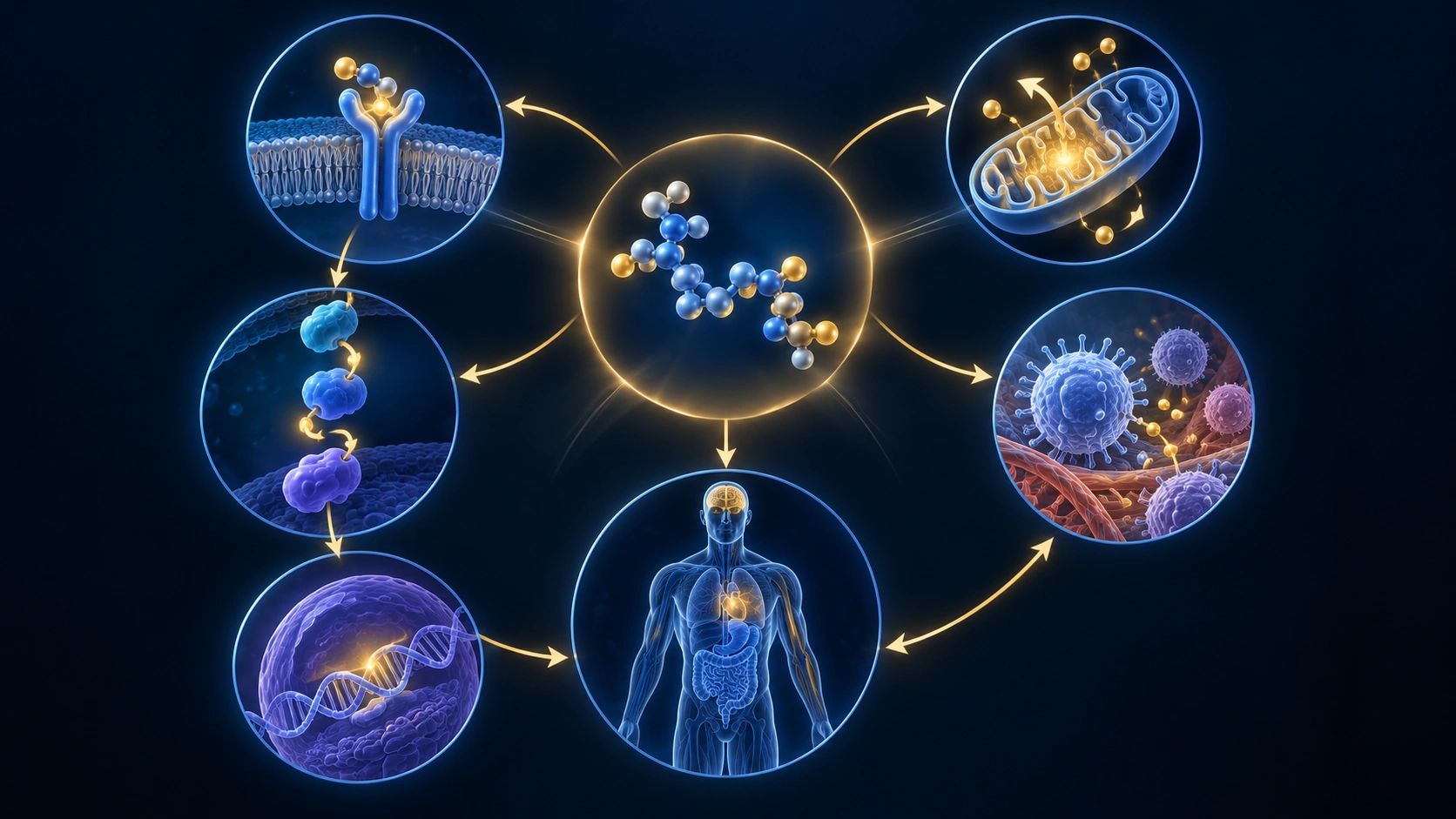
THE CORE MECHANISM MAP
THYMOSIN ALPHA-1
↓
Modulation of:
T-CELL FUNCTION
DENDRITIC-CELL MATURATION
ANTIGEN PRESENTATION
TLR SIGNALING
NK-CELL ACTIVITY
INTERFERON-RELATED SIGNALING
↓
Potential:
IMPROVED INNATE–ADAPTIVE IMMUNE COORDINATION
↓
Potential:
BETTER HOST-DEFENSE RESPONSE
Again:
- the important word is COORDINATION.
INFLAMMATORY SIGNALING
TA1 may also influence inflammatory signaling.
But again:
- the goal should not be described as SUPPRESS INFLAMMATION
or:
- INCREASE INFLAMMATION.
Both can be wrong.
A functional immune response requires:
INITIATION
↓
AMPLIFICATION
↓
TARGET ELIMINATION
↓
RESOLUTION
TA1 is interesting partly because its biology appears to interact with:
- THE ORGANIZATION OF THIS RESPONSE.
WHAT THIS MECHANISM MAY SUGGEST
Mechanistically, TA1 may deserve consideration or continued investigation in contexts involving:
- impaired cellular immunity
- chronic viral infection
- sepsis-associated immune dysfunction
- immunocompromised states
- selected oncology settings
- vaccine-response modulation
- recurrent or difficult host-defense states
- immune recovery after physiological stress
The relevance depends heavily on:
- THE IMMUNE PHENOTYPE.
WHAT THIS MECHANISM DOES NOT PROVE
TA1 biology does not mean that it:
- prevents every infection
- treats every viral illness
- should be used whenever someone “gets sick often”
- universally improves autoimmune disease
- eliminates cancer
- replaces antimicrobial therapy
- replaces cancer-directed treatment
- should be used indiscriminately to “boost immunity”
IMMUNE MECHANISM MUST MATCH IMMUNE PATTERN.

HUMAN CLINICAL EVIDENCE
It is a:
28-AMINO-ACID PEPTIDE.
TA1 originates from the processing of:
PROTHYMOSIN ALPHA.
It was originally identified in association with:
THYMIC BIOLOGY.
That history contributed to its name.
However, TA1 should not be viewed simply as:
“A THYMUS HORMONE.”
Its effects extend beyond this classification, playing a significant role in immune modulation and influencing multiple immune-cell populations and T-cell signaling networks.
HUMAN SAFETY EVIDENCE
PROTHYMOSIN ALPHA
↓
Proteolytic processing
↓
THYMOSIN ALPHA-1
↓
Potential effects on:
DENDRITIC CELLS
T LYMPHOCYTES
NATURAL KILLER CELLS
TOLL-LIKE RECEPTOR SIGNALING
ANTIGEN PRESENTATION
INTERFERON-RELATED RESPONSES
↓
IMMUNE COORDINATION
Again:
the central concept is not simply:
MORE IMMUNITY.
It is:
BETTER ORGANIZATION OF THE RESPONSE facilitated by immune modulation and enhanced T-cell signaling through thymosin peptide.
DO NOT BEGIN WITH THYMOSIN ALPHA-1
Begin with: WHAT IS THE IMMUNE SYSTEM ACTUALLY DOING WRONG?
Then:
PHYSIOLOGY
↓
PATTERN
↓
MECHANISM
↓
EVIDENCE
↓
RISK
↓
MONITORING
↓
DECISION
PHYSIOLOGY
Healthy host defense requires:
- pathogen recognition
- intact barriers
- dendritic-cell function
- antigen presentation
- T-cell activation
- NK-cell activity
- antibody responses
- inflammatory signaling
- immune resolution
Again:
- no single peptide replaces THE IMMUNE SYSTEM.
EVIDENCE
WHAT EVIDENCE EXISTS FOR TA1 IN THIS SPECIFIC IMMUNE STATE?
This is where TA1 deserves a more nuanced discussion than many peptides.
There are:
HUMAN RANDOMIZED TRIALS.
There are:
LARGE HUMAN DATA SETS.
There are:
MIXED RESULTS.
And there are:
INDICATION-SPECIFIC DIFFERENCES.
That is useful evidence.
It tells us:
PATIENT SELECTION MATTERS.
PATTERN
What is actually happening?
- recurrent infection?
- prolonged infection?
- severe infection?
- lymphopenia?
- immune exhaustion?
- poor vaccine response?
- malignancy-associated immune dysfunction?
- autoimmune inflammation?
Again:
- “LOW IMMUNITY” IS NOT A DIAGNOSIS.
RISK
Potential considerations include:
- inappropriate immune activation in selected disease states
- autoimmune context
- transplant context
- interaction with immunosuppressive strategies
- injection reactions
- product-quality issues
- delayed diagnosis of underlying immune deficiency
- using immunomodulation when a structural or infectious source has not been corrected
Again:
the largest risk may sometimes be:
TREATING “IMMUNITY” WITHOUT IDENTIFYING WHY THE PATIENT IS GETTING SICK.
MECHANISM
Does TA1's biology match:
- THE DOMINANT IMMUNE BOTTLENECK?
For example:
A patient with recurrent pneumonia from:
- UNTREATED ASPIRATION
does not primarily have:
- A TA1 DEFICIENCY.
A patient with recurrent sinus infection from:
- STRUCTURAL OBSTRUCTION
still has:
- A STRUCTURAL PROBLEM.
A patient receiving immunosuppressive therapy may have:
- A VERY DIFFERENT HOST-DEFENSE PROBLEM.
Again:
the peptide should target:
- THE BOTTLENECK.
MONITORING
Monitoring should depend on:
- WHY TA1 IS BEING USED.
Not simply:
- “THE PATIENT FEELS MORE IMMUNE.”
Potential domains include:
CLINICAL
- infection frequency
- infection duration
- fever pattern
- symptom burden
- hospitalization
- recovery time
IMMUNOLOGICAL
Depending on indication:
- CBC with differential
- lymphocyte pattern
- disease-specific immune markers
- immunoglobulins where relevant
- selected T-cell / HLA-DR measures in specialized contexts
DISEASE-SPECIFIC
- viral load
- tumor response
- infectious burden
- vaccine response
- inflammatory markers
Again:
monitor the ACTUAL DISEASE OUTCOME.

THE PRAXIS 5
MECHANISM
It is a:
28-AMINO-ACID PEPTIDE.
TA1 originates from the processing of:
PROTHYMOSIN ALPHA.
It was originally identified in association with:
THYMIC BIOLOGY.
That history contributed to its name.
However, TA1 should not be viewed simply as:
“A THYMUS HORMONE.”
Its effects extend beyond this classification, playing a significant role in immune modulation and influencing multiple immune-cell populations and T-cell signaling networks.
EVIDENCE
PROTHYMOSIN ALPHA
↓
Proteolytic processing
↓
THYMOSIN ALPHA-1
↓
Potential effects on:
DENDRITIC CELLS
T LYMPHOCYTES
NATURAL KILLER CELLS
TOLL-LIKE RECEPTOR SIGNALING
ANTIGEN PRESENTATION
INTERFERON-RELATED RESPONSES
↓
IMMUNE COORDINATION
Again:
the central concept is not simply:
MORE IMMUNITY.
It is:
BETTER ORGANIZATION OF THE RESPONSE facilitated by immune modulation and enhanced T-cell signaling through thymosin peptide.
RISK
Sometimes its effects can appear stimulatory. But: IMMUNOMODULATOR is more useful. Why? Because immune function is not measured simply by HOW AGGRESSIVE THE RESPONSE BECOMES. Effective immunity, including immune modulation, requires: detecting the threat, presenting antigens, activating the appropriate T-cell signaling, coordinating innate and adaptive responses, eliminating infected or abnormal cells, limiting collateral tissue damage, and resolving the response afterward. Again: MORE CYTOKINES ≠ BETTER IMMUNITY. MORE T CELLS ≠ BETTER IMMUNITY. The important question is: IS THE RESPONSE APPROPRIATE TO THE THREAT? Additionally, thymosin peptide plays a crucial role in ensuring the immune response is appropriately calibrated to the threat at hand.
MONITORING
TA1 is not best understood as a single-receptor peptide like GLP-1 interacting with GLP-1R or GHRELIN with GHSR. Instead, its role in immune modulation involves several interconnected systems.
Much of the mechanistic literature highlights interactions that include TOLL-LIKE RECEPTORS, particularly the immune signaling associated with TLR2 and TLR9 in selected experimental contexts.
TA1 has also been linked with changes in key processes such as dendritic-cell maturation, antigen presentation, cytokine signaling, interferon pathways, T-cell differentiation and function, and NK-cell responses. This illustrates the concept of multiple immune nodes rather than one simple ON/OFF receptor. In this context, thymosin peptide is crucial for understanding how TA1 affects T-cell signaling and overall immune response.
PATIENT CONTEXT
T-CELL FUNCTION
T cells are central to adaptive immunity, playing crucial roles in immune modulation.
Different subsets perform various functions, including:
- helper T cells
- cytotoxic T cells
- regulatory T cells
- memory T cells
Thymosin peptide TA1 has been studied for its ability to support T-cell maturation, differentiation, and function, particularly through T-cell signaling.
Earlier pharmacologic reviews described effects involving thymocyte differentiation and enhancement of T-cell function.
Again, this does not mean:
"TA1 MAKES MORE T CELLS."
The more important concept is:
TA1 MAY HELP IMPROVE FUNCTIONAL T-CELL RESPONSE IN SELECTED IMMUNE STATES.
SEVEN QUESTIONS TO ASK BEFORE THYMOSIN ALPHA-1
1. WHAT IMMUNE PROBLEM ARE WE ACTUALLY TRYING TO CHANGE?
recurrent infection?
immune exhaustion?
poor T-cell signaling response?
oncology-related immune dysfunction?
another pattern?
2. DOES TA1'S MECHANISM MATCH THAT PROBLEM?
dendritic-cell function?
T-cell coordination?
innate recognition?
NK activity?
3. WHAT LEVEL OF HUMAN EVIDENCE SUPPORTS THIS SPECIFIC USE?
TA1 has substantial human experience in immune modulation.
But: USE THE EVIDENCE FOR THE INDICATION BEING CONSIDERED.
4. IS THE IMMUNE DYSFUNCTION PRIMARY OR SECONDARY TO SOMETHING ELSE?
structural disease?
medication?
malnutrition?
malignancy?
chronic infection?
sleep deprivation?
metabolic disease?
5. WHAT COULD GO WRONG IF WE CHANGE IMMUNE SIGNALING?
autoimmune activation?
mismatch with immunosuppressive therapy?
inflammatory worsening?
delayed diagnosis?
6. WHAT WILL WE MONITOR?
infections?
viral burden?
tumor response?
immune markers?
adverse effects?
7. WHAT WOULD DEFINE SUCCESS OR FAILURE?
Not: “THE PATIENT TOOK TA1.”
But: THE TARGETED IMMUNE PROBLEM ACTUALLY IMPROVED WITH THYMOSIN PEPTIDE.


Thymosin Alpha-1
KEY TAKEAWAYS
1. WHAT IMMUNE PROBLEM ARE WE ACTUALLY TRYING TO CHANGE?
recurrent infection?
immune exhaustion?
poor T-cell signaling response?
oncology-related immune dysfunction?
another pattern?
2. DOES TA1'S MECHANISM MATCH THAT PROBLEM?
dendritic-cell function?
T-cell coordination?
innate recognition?
NK activity?
3. WHAT LEVEL OF HUMAN EVIDENCE SUPPORTS THIS SPECIFIC USE?
TA1 has substantial human experience in immune modulation.
But: USE THE EVIDENCE FOR THE INDICATION BEING CONSIDERED.
4. IS THE IMMUNE DYSFUNCTION PRIMARY OR SECONDARY TO SOMETHING ELSE?
structural disease?
medication?
malnutrition?
malignancy?
chronic infection?
sleep deprivation?
metabolic disease?
5. WHAT COULD GO WRONG IF WE CHANGE IMMUNE SIGNALING?
autoimmune activation?
mismatch with immunosuppressive therapy?
inflammatory worsening?
delayed diagnosis?
6. WHAT WILL WE MONITOR?
infections?
viral burden?
tumor response?
immune markers?
adverse effects?
7. WHAT WOULD DEFINE SUCCESS OR FAILURE?
Not: “THE PATIENT TOOK TA1.”
But: THE TARGETED IMMUNE PROBLEM ACTUALLY IMPROVED WITH THYMOSIN PEPTIDE.
THE BOTTOM LINE
Thymosin alpha-1 is one of the more important peptides to understand correctly because it demonstrates why:
IMMUNOLOGY CANNOT BE REDUCED TO “BOOST” OR “SUPPRESS.”
The immune system is:
A COORDINATED NETWORK.
- A pathogen must be recognized.
- An antigen must be processed.
- A dendritic cell must communicate.
- T cells must respond.
- Cytotoxic cells must identify targets.
- Natural killer cells must participate where appropriate.
Inflammation must become strong enough to:
- CONTROL THE THREAT.
But not so disorganized that:
- THE HOST BECOMES THE COLLATERAL DAMAGE.
TA1 appears to operate within several parts of this network.
That is why it has attracted interest in:
- VIRAL DISEASE.
- SEPSIS.
- IMMUNOCOMPROMISED STATES.
- ONCOLOGY.
- VACCINE RESPONSE.
And broader disorders of:
- HOST DEFENSE.
Importantly, this is also a peptide with:
- REAL HUMAN CLINICAL HISTORY.
The evidence is not uniform.
Some studies are encouraging.
Some are neutral.
Some conditions have much stronger support than others.
That should not force us into either extreme:
- “TA1 WORKS FOR EVERYTHING.”
or:
- “THE DATA ARE MIXED, SO TA1 DOES NOTHING.”
A much more interesting interpretation is:
- THE IMMUNE SYSTEM ITSELF IS HETEROGENEOUS.
The patient whose immune system is:
- FUNCTIONALLY SUPPRESSED
may not respond like the patient whose immune system is:
- HYPERINFLAMMATORY.
The patient with poor antigen presentation may not respond like:
- THE PATIENT WITH A STRUCTURAL SOURCE OF RECURRENT INFECTION.
And the patient with cancer-associated immune dysfunction is not the same biological problem as:
THE HEALTHY PERSON WHO SIMPLY WANTS TO “BOOST IMMUNITY.”
That is exactly where the Praxis framework belongs.
Instead of asking:
“IS THYMOSIN ALPHA-1 GOOD FOR THE IMMUNE SYSTEM?”
ask:
“WHAT PART OF IMMUNE FUNCTION IS FAILING, WHAT EVIDENCE DEMONSTRATES THAT FAILURE, DOES TA1'S IMMUNOBIOLOGY MATCH THE BOTTLENECK, WHAT OTHER immune pathways may move when we change it, and what measurable outcome would show that host defense actually became more effective rather than simply more active?”
That is the distinction between:
IMMUNE STIMULATION
and:
IMMUNE MEDICINE.