Clinical Peptide Medicine — Structured. Applied. Evolving.
UNDERSTAND THE PEPTIDE
Semax is a synthetic seven-amino-acid neuropeptide derived from the ACTH (4-7) sequence and extended with a Pro-Gly-Pro tail.
Its sequence is:
- MET — GLU — HIS — PHE — PRO — GLY — PRO
or:
- MEHFPGP.
Semax is especially interesting because it was designed to preserve selected:
- NEUROTROPIC AND NEUROPROTECTIVE FEATURES
of an ACTH-derived peptide fragment without reproducing the full endocrine effects of:
- ACTH.
That distinction is central.
Semax is associated with research involving:
- BDNF
- TrkB signaling
- learning and memory
- attention
- ischemic brain injury
- neuronal survival
- glutamate toxicity
- dopaminergic signaling
- gene expression
- neuroinflammation
- cognitive resilience
The most useful way to understand Semax is not simply:
- “A NOOTROPIC PEPTIDE.”
That phrase reduces a complex neurobiological signal to:
- BETTER FOCUS.
A better description is:
- AN ACTH-DERIVED NEUROREGULATORY PEPTIDE THAT APPEARS TO MODULATE NEUROTROPHIC, SYNAPTIC, METABOLIC, AND STRESS-RESPONSE PATHWAYS INVOLVED IN BRAIN ADAPTATION AND RECOVERY.
That is much closer to the real biology.
THE CORE MECHANISM MAP
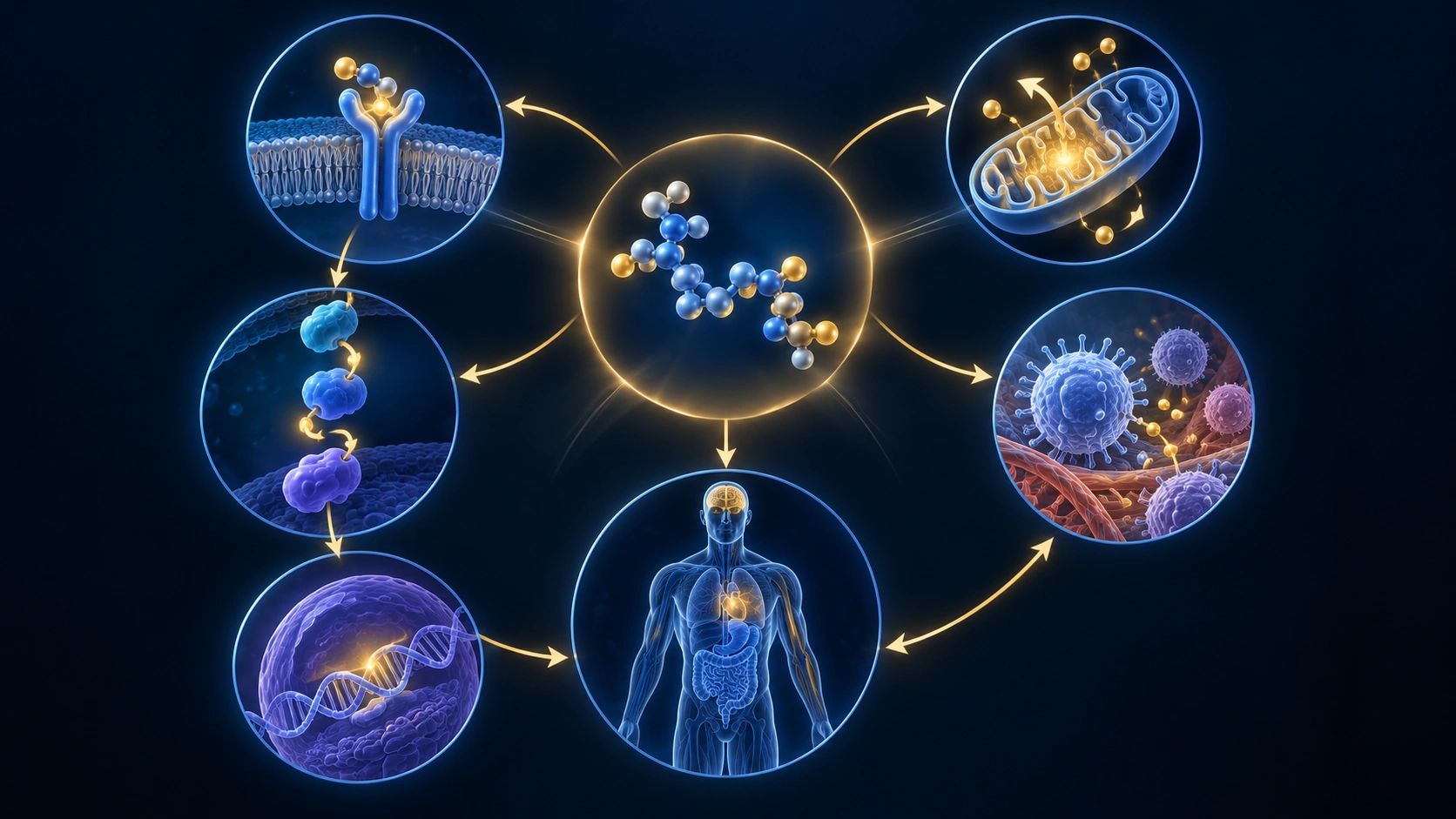
ACTH-DERIVED SEQUENCE
↓
SEMAX — MEHFPGP
↓
Potential modulation of:
- BDNF / TrkB
- GENE EXPRESSION
- GLUTAMATE / Ca²⁺ STRESS
- MITOCHONDRIAL STABILITY
- DOPAMINERGIC SIGNALING
- NEUROINFLAMMATORY RESPONSE
↓
Potential:
- NEURONAL SURVIVAL
- SYNAPTIC PLASTICITY
- COGNITIVE FUNCTION
- POST-INJURY RECOVERY
The core concept is:
- SEMAX APPEARS TO MODIFY THE BRAIN'S CAPACITY TO ADAPT TO STRESS AND INJURY.
WHAT THIS MECHANISM MAY SUGGEST
Mechanistically, Semax deserves research interest in:
- ischemic brain injury
- stroke recovery
- cognitive dysfunction
- learning and memory
- attention
- neuroinflammation
- traumatic or metabolic neuronal stress
- selected neurodegenerative contexts
- recovery after hypoxic stress
- cognitive performance under extreme stress
Its strongest conceptual niche may be:
- NEURAL RESILIENCE + ADAPTIVE RECOVERY.
WHAT THIS MECHANISM DOES NOT PROVE
Semax biology does not prove that it:
- permanently increases intelligence
- treats every form of brain fog
- reverses every stroke
- prevents all neurodegeneration
- treats ADHD simply because attention is involved
- repairs every traumatic brain injury
- increases BDNF enough to solve every cognitive disorder
- should be used whenever someone wants more focus
- replaces rehabilitation after neurological injury
Again:
- COGNITIVE SYMPTOMS ARE NOT A SINGLE MECHANISM.
Brain fog may be caused by:
- sleep deprivation
- anemia
- thyroid disease
- medication
- depression
- anxiety
- infection
- neuroinflammation
- metabolic dysfunction
- sleep apnea
- neurological disease
Same symptom.
Different:
- BIOLOGY.

PRECLINICAL EVIDENCE
SUBSTANTIAL
Animal and cellular research includes:
- ischemia
- memory
- dopaminergic injury
- glutamate toxicity
- heavy-metal stress
- neurodegenerative models
This is where much of Semax's strongest mechanistic work resides.
HUMAN CLINICAL EVIDENCE
REAL, BUT GEOGRAPHICALLY AND METHODOLOGICALLY CONCENTRATED
Semax has human clinical experience, particularly in:
- ischemic stroke
- cognitive performance
- neurological applications
Older controlled clinical reports in ischemic stroke described faster recovery of neurological functions when Semax was added to intensive therapy.
However, much of the clinical literature originates from:
- RUSSIAN RESEARCH AND CLINICAL PROGRAMS
and is not as broadly replicated internationally as many established neurologic therapeutics.
That distinction is important.
The correct interpretation is:
- HUMAN CLINICAL SIGNAL EXISTS.
But:
- THE EVIDENCE BASE IS NOT UNIFORMLY DISTRIBUTED OR VALIDATED ACROSS MODERN MULTINATIONAL TRIAL NETWORKS.
DO NOT BEGIN WITH SEMAX
Begin with: WHAT PART OF BRAIN FUNCTION IS ACTUALLY FAILING — AND WHY?
Then:
PHYSIOLOGY
↓
PATTERN
↓
MECHANISM
↓
EVIDENCE
↓
RISK
↓
MONITORING
↓
DECISION
PHYSIOLOGY
Healthy cognition requires:
- cerebral blood flow
- oxygen
- glucose
- mitochondrial ATP
- neurotransmission
- BDNF / neurotrophic signaling
- sleep
- synaptic plasticity
- appropriate inflammatory regulation
Semax may influence:
- SEVERAL OF THESE ADAPTATION PATHWAYS.
But it cannot replace:
- THE FOUNDATIONAL SYSTEM.
EVIDENCE
Ask:
WHAT EXACT OUTCOME ARE WE TRYING TO SUPPORT?
- attention?
- working memory?
- stroke recovery?
- neuronal survival?
- learning?
- cognitive fatigue?
Then:
- WHAT EVIDENCE EXISTS FOR THAT OUTCOME?
Again:
do not combine every cognition study into:
- “SEMAX MAKES THE BRAIN BETTER.”
PATTERN
What is actually present?
- impaired attention?
- memory dysfunction?
- post-stroke recovery?
- post-hypoxic injury?
- cognitive fatigue?
- neuroinflammatory disease?
- sleep-related cognitive impairment?
- mood-related cognitive dysfunction?
Again:
- “BRAIN FOG” IS NOT A DIAGNOSIS.
RISK
Potential considerations include:
- headache or local nasal irritation with intranasal formulations
- altered arousal or sleep in susceptible individuals
- product-quality uncertainty
- assuming subjective stimulation equals neurological recovery
- delaying investigation of reversible cognitive pathology
- using a neuroprotective strategy in place of emergency stroke treatment
Again
the biggest risk may sometimes be:
- TREATING THE SYMPTOM BEFORE IDENTIFYING THE SYSTEM FAILURE.
MECHANISM
Does Semax biology match:
- THE DOMINANT BOTTLENECK?
If cognition is impaired because of:
- UNTREATED SLEEP APNEA,
correct:
- OXYGENATION + SLEEP FRAGMENTATION.
If the problem is:
- B12 DEFICIENCY,
correct:
- THE DEFICIENCY.
If the patient has:
- ACUTE STROKE,
restore blood flow and initiate:
- STANDARD EMERGENCY CARE.
If the pattern involves:
- POST-INJURY NEUROPLASTICITY + SECONDARY NEURAL STRESS,
Semax becomes:
- MUCH MORE MECHANISTICALLY INTERESTING.
MONITORING
Monitoring should follow:
- THE NEUROLOGICAL TARGET.
COGNITION
- attention
- working memory
- processing speed
- task performance
- cognitive fatigue
- standardized cognitive testing when useful
STROKE / NEUROLOGICAL RECOVERY
- neurological examination
- functional status
- speech
- motor function
- activities of daily living
- rehabilitation progress
FOUNDATIONAL DRIVERS
- sleep
- oxygenation
- glucose
- nutritional status
- medication burden
- vascular risk
SYMPTOMS
- headache
- sleep
- anxiety / arousal
- concentration
- tolerability
Again
monitor:
- THE FUNCTION THE PEPTIDE IS SUPPOSED TO CHANGE.

THE PRAXIS 5
MECHANISM
Semax appears to influence:
- BDNF / TrkB + NEURAL PLASTICITY + CELL-STRESS RESPONSE + NEUROINFLAMMATORY SIGNALING.
Its biology is broader than:
- STIMULATION.
EVIDENCE
Mechanistic evidence:
- MEANINGFUL.
Preclinical neuroprotection:
- SUBSTANTIAL.
Human cognitive and stroke experience:
- REAL.
Broad independent international replication:
- LESS DEVELOPED.
That is the appropriate evidence calibration.
RISK
The biggest conceptual error is:
- USING A NEUROPLASTICITY PEPTIDE TO AVOID IDENTIFYING WHY THE BRAIN IS UNDERPERFORMING.
Sleep.
Perfusion.
Glucose.
Anemia.
Medication.
Inflammation.
All may dominate the outcome.
MONITORING
Monitor:
- COGNITION + FUNCTION + UNDERLYING DRIVER.
If the hypothesis is:
- BETTER NEURAL RECOVERY,
then:
- NEURAL FUNCTION SHOULD IMPROVE.
PATIENT CONTEXT
A healthy person seeking:
- MORE FOCUS
is not identical to:
someone recovering from:
- ISCHEMIC STROKE.
A patient with:
- SLEEP-DEPRIVATION BRAIN FOG
is not identical to:
someone with:
- POST-HYPOXIC NEURAL INJURY.
A patient with:
- ANXIETY-DRIVEN DISTRACTIBILITY
is not identical to:
someone with:
- NEUROLOGICAL ATTENTION DEFICIT.
Same peptide.
Different:
- NEURAL ENVIRONMENT.
SEVEN QUESTIONS TO ASK BEFORE SEMAX
1. WHAT NEUROLOGICAL PROBLEM ARE WE ACTUALLY TRYING TO CHANGE?
- attention?
- memory?
- stroke recovery?
- neuroprotection?
- cognitive fatigue?
2. WHAT IS CAUSING THE PROBLEM?
- sleep?
- vascular disease?
- neuroinflammation?
- nutrient deficiency?
- medication?
- neuronal injury?
- stress?
3. DOES SEMAX'S NEUROTROPHIC / NEUROPROTECTIVE BIOLOGY MATCH THE BOTTLENECK?
- BDNF?
- plasticity?
- ischemic stress?
- excitotoxicity?
- recovery?
4. WHAT TYPE OF EVIDENCE SUPPORTS THIS PARTICULAR USE?
- cellular?
- animal?
- human cognition?
- human stroke?
- mechanistic?
5. IS THERE A MORE IMPORTANT TREATMENT THAT MUST OCCUR FIRST?
Especially:
- ACUTE STROKE OR REVERSIBLE MEDICAL CAUSES OF COGNITIVE DYSFUNCTION.
6. WHAT WILL WE MONITOR?
- attention?
- memory?
- neurological function?
- rehabilitation?
- sleep?
- tolerability?
7. WHAT WOULD DEFINE SUCCESS?
Not:
- “I FELT MORE STIMULATED.”
But:
- THE SPECIFIC COGNITIVE OR NEUROLOGICAL FUNCTION IMPROVED IN A REPRODUCIBLE, MEASURABLE WAY.


SEMAX
KEY TAKEAWAYS
- Semax is a synthetic seven-amino-acid neuropeptide.
- Its sequence is Met-Glu-His-Phe-Pro-Gly-Pro.
- It is derived from the neuroactive N-terminal region of ACTH.
- Semax is not pharmacologically equivalent to full ACTH.
- It is primarily studied as a neuroregulatory and neuroprotective peptide.
- Semax has repeatedly been associated with BDNF and TrkB regulation in experimental brain research.
- BDNF is one of the major molecular systems involved in synaptic plasticity and neuronal survival.
- Semax has demonstrated learning and memory effects in experimental models.
- It has also been studied in healthy humans under demanding cognitive conditions.
- Semax has substantial experimental research in cerebral ischemia.
- Animal studies have demonstrated reduced ischemic injury and improved memory after cortical infarction.
- Semax can influence glutamate-related calcium dysregulation and mitochondrial membrane potential in neuronal models.
- This provides a plausible cellular mechanism for neuroprotection during excitotoxic stress.
- Semax also modifies immune-response gene expression after experimental ischemic brain injury.
- Its neuroprotective biology therefore spans neurotrophic, metabolic, and inflammatory systems.
- Human stroke literature exists and has reported improved neurological recovery in selected clinical studies.
- The human evidence base is more geographically concentrated than that of many internationally established neurologic therapies.
- That should affect evidence weighting without erasing the clinical signal.
- Semax has also been investigated in dopaminergic injury models.
- It should not be reduced to a dopamine enhancer.
- Its better conceptual identity is a neural adaptation and resilience peptide.
- Semax should not be reduced to a generic nootropic.
- Attention, memory, processing speed, neuroprotection, and stroke recovery are different outcomes.
- Brain fog should not automatically be treated as a neuropeptide deficiency.
- Sleep deprivation, sleep apnea, anemia, thyroid dysfunction, metabolic disease, medication effects, anxiety, depression, infection, and neurological disease can all produce cognitive symptoms.
- A neuroplasticity signal works inside the biological environment the brain is given.
- The best question is not “does Semax improve cognition?”
- The better question is “what neural function is failing, what is driving that failure, is impaired neuroplasticity or injury-related neuronal stress actually the bottleneck, does Semax biology match that mechanism, and what objective cognitive or neurological outcome would demonstrate meaningful recovery?”
THE BOTTOM LINE
Semax is one of the best peptides for understanding the difference between:
- STIMULATING THE BRAIN
and:
- HELPING THE BRAIN ADAPT.
Those are not the same thing.
A stimulant may increase:
- NEURAL ACTIVITY.
Semax appears more interesting because its research points toward:
- NEUROTROPHIC SIGNALING
- PLASTICITY
- CELLULAR STRESS RESILIENCE
- POST-INJURY ADAPTATION.
Its conceptual pathway looks something like:
NEURAL STRESS / INJURY
↓
SEMAX
↓
BDNF / TrkB
CELLULAR STRESS RESPONSE
MITOCHONDRIAL RESILIENCE
INFLAMMATORY GENE REGULATION
↓
Potential:
MORE VIABLE NEURONS
BETTER PLASTICITY
↓
Potential:
BETTER FUNCTION
That is a very different therapeutic philosophy from:
- “MAKE THE BRAIN FIRE HARDER.”
And it explains why Semax research spans seemingly different subjects:
- MEMORY
- ATTENTION
- STROKE
- HYPOXIA
- DOPAMINERGIC INJURY
- NEURODEGENERATION.
The common thread may be:
- HOW WELL DOES THE BRAIN ADAPT WHEN IT IS CHALLENGED?
But neuroplasticity is not automatically:
- GOOD.
The brain can also reinforce:
- chronic pain
- anxiety
- addiction
- maladaptive circuitry
Plasticity needs:
- DIRECTION.
That is why rehabilitation, sleep, learning, physical activity, metabolic health, and the surrounding environment still matter.
So the Praxis question becomes:
- “WHAT IS THE BRAIN TRYING TO ADAPT TO, what is limiting that adaptation, is the problem insufficient neurotrophic support, ischemic or excitotoxic stress, inflammation, or something entirely upstream, does Semax actually intersect with the failed node, and what measurable neurological or cognitive function will tell us whether the network became more resilient rather than simply more activated?”
That is the difference between:
- NOOTROPICS
and:
- NEUROBIOLOGY.
STOP MEMORIZING PEPTIDES. START UNDERSTANDING THE SYSTEM.