Clinical Peptide Medicine — Structured. Applied. Evolving.
UNDERSTAND THE PEPTIDE
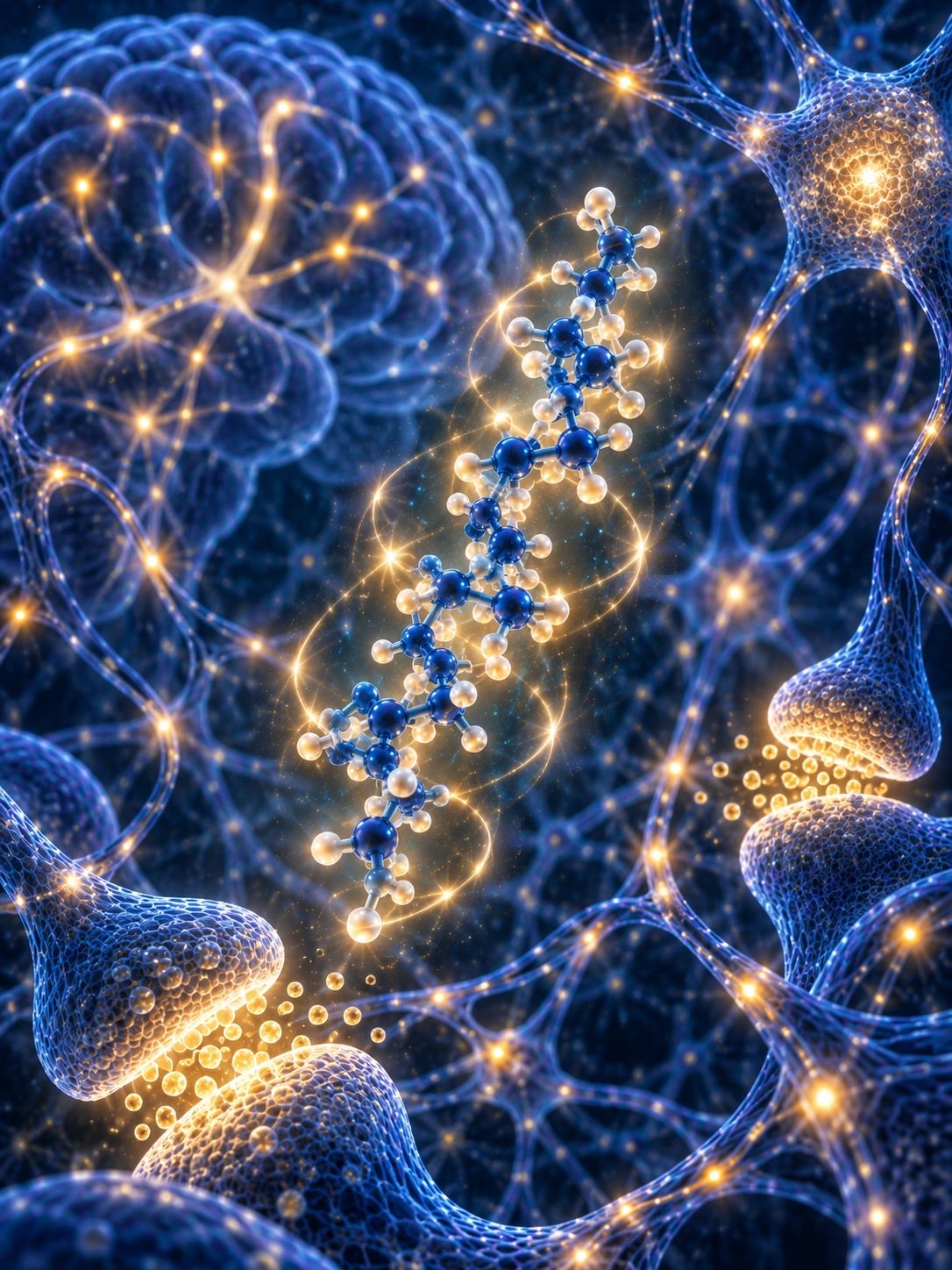
Pinealon is a three-amino-acid peptide with the sequence glutamic acid–aspartic acid–arginine — Glu-Asp-Arg, or EDR — developed within the short-peptide bioregulator research tradition.
Its sequence is:
- GLU — ASP — ARG
or:
- EDR.
Pinealon is especially interesting because its proposed biology is not centered on:
- one membrane receptor
- one neurotransmitter
- one ion channel
Instead, its research has focused on:
- gene-expression regulation
- neuronal survival
- oxidative stress
- apoptosis
- MAPK / ERK signaling
- cognitive aging
- memory
- attention
- neurodegenerative disease models
The most useful way to understand Pinealon is not simply:
- “A BRAIN ANTI-AGING PEPTIDE.”
That phrase is too broad.
A better description is:
- A SHORT NEUROREGULATORY TRIPEPTIDE STUDIED FOR ITS ABILITY TO MODIFY CELLULAR STRESS, GENE-EXPRESSION, AND SURVIVAL PROGRAMS IN AGING AND INJURED NEURAL TISSUE.
That distinction matters.
Because cognitive aging is not simply:
- LOW NEUROTRANSMITTERS.
It may involve:
- oxidative stress
- mitochondrial dysfunction
- impaired synaptic plasticity
- altered gene expression
- protein dysregulation
- apoptosis
- inflammation
- vascular disease
Pinealon is interesting precisely because its research sits:
- UPSTREAM OF SOME OF THOSE OUTPUTS.
THE CORE MECHANISM MAP
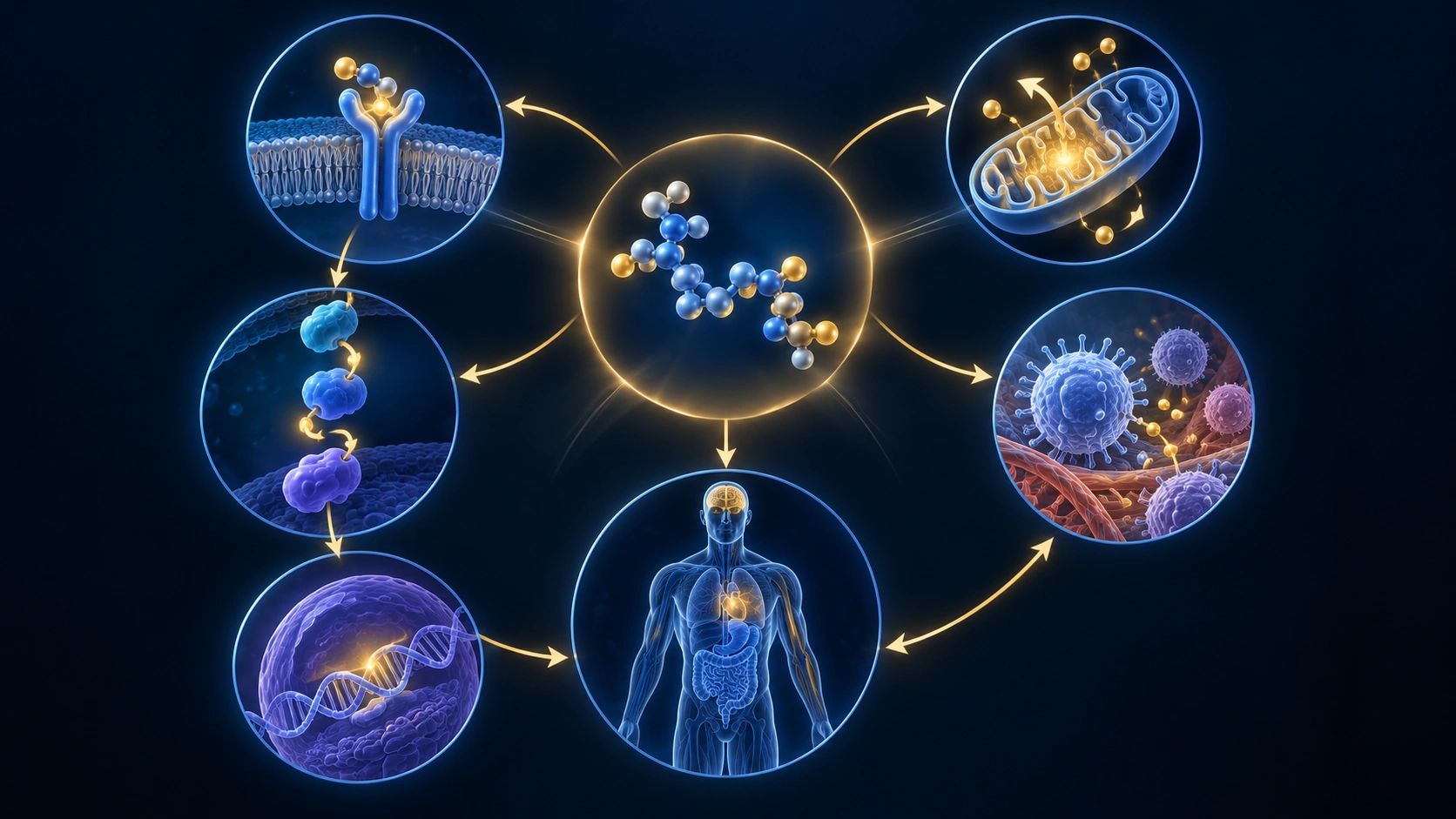
PINEALON — EDR
↓
Potential intracellular interaction
↓
Possible modulation of:
- GENE EXPRESSION
↓
Effects involving:
- ERK1/2
- SOD2 / GPX1
- p53 / CASPASE-3
- CELL-CYCLE / SURVIVAL SIGNALS
↓
Potential:
- OXIDATIVE STRESS CONTROL
- APOPTOSIS REDUCTION
- SYNAPTIC PRESERVATION
↓
Potential:
- NEUROPROTECTION + COGNITIVE RESILIENCE
The core concept is:
- PINEALON MAY MODIFY THE CELLULAR PROGRAM THROUGH WHICH NEURONS RESPOND TO AGE-RELATED OR INJURY-RELATED STRESS.
WHAT THIS MECHANISM MAY SUGGEST
Mechanistically, Pinealon deserves research interest in:
- cognitive aging
- age-related memory decline
- oxidative neuronal stress
- post-traumatic neurological dysfunction
- neurodegenerative disease research
- synaptic preservation
- cognitive recovery after neurological injury
- neuronal stress resilience
Its strongest conceptual niche may be:
- AGING OR INJURED NEURAL TISSUE WITH IMPAIRED CELLULAR STRESS ADAPTATION.
WHAT THIS MECHANISM DOES NOT PROVE
Pinealon biology does not prove that it:
- reverses Alzheimer's disease
- prevents dementia
- permanently slows human brain aging
- improves memory in every healthy adult
- replaces rehabilitation after brain injury
- repairs every damaged neuron
- is equivalent to Epitalon
- works because of melatonin
- corrects every cause of brain fog
- should be used solely because a patient is older
Again:
- COGNITIVE AGING IS NOT ONE PATHWAY.
And:
- AGING ≠ DISEASE.

PRECLINICAL EVIDENCE
MEANINGFUL
Cellular and animal research includes:
- oxidative injury
- neuronal survival
- neurodegenerative models
- behavioral outcomes
- dendritic-spine preservation
This is the strongest evidence layer.
HUMAN CLINICAL EVIDENCE
REAL BUT LIMITED AND CONCENTRATED
Human reports exist involving:
- elderly patients
- cognitive dysfunction
- consequences of traumatic brain injury
- organic brain syndromes
A small 2015 human study involving 32 participants with chronic polymorbidity and organic brain syndrome reported improved CNS activity with Pinealon, although the study was small and regionally concentrated.
The appropriate conclusion is:
- THERE IS HUMAN SIGNAL.
But the clinical evidence does not yet have the breadth of:
- LARGE, MODERN, INDEPENDENT MULTICENTER NEUROLOGY TRIALS.
That is the correct calibration.
DO NOT BEGIN WITH PINEALON
Begin with: WHY IS COGNITIVE OR NEURAL FUNCTION DECLINING?
Then:
PHYSIOLOGY
↓
PATTERN
↓
MECHANISM
↓
EVIDENCE
↓
RISK
↓
MONITORING
↓
DECISION
PHYSIOLOGY
Healthy cognition requires:
- cerebral perfusion
- oxygen
- glucose
- mitochondrial function
- synaptic connectivity
- neurotransmission
- sleep
- antioxidant defense
- appropriate gene expression
Pinealon appears most relevant to:
- CELLULAR STRESS + SURVIVAL + REGULATORY BIOLOGY.
EVIDENCE
Ask:
WHAT EVIDENCE EXISTS FOR THIS PARTICULAR APPLICATION?
- cellular oxidative-stress model?
- animal model?
- elderly cognitive study?
- TBI report?
- neurodegenerative model?
Again:
do not combine all of these into:
- “PINEALON REJUVENATES THE BRAIN.”
That loses evidence calibration.
PATTERN
What is actually present?
- normal age-related slowing?
- mild cognitive impairment?
- post-TBI dysfunction?
- early neurodegenerative disease?
- vascular cognitive impairment?
- sleep-related cognitive dysfunction?
- mood-related cognitive impairment?
Again:
- “MEMORY PROBLEMS” IS NOT A MECHANISM.
RISK
Potential considerations include:
- product-quality uncertainty
- route-related issues
- unknown long-term pharmacology
- relying on a peptide while missing reversible cognitive disease
- interpreting improved subjective cognition as proof of slowed neurodegeneration
Again:
- COGNITION CAN IMPROVE WITHOUT DISEASE PROGRESSION CHANGING.
Those are different outcomes.
MECHANISM
Does Pinealon biology match:
- THE DOMINANT BOTTLENECK?
If cognition is impaired because of:
- UNTREATED SLEEP APNEA,
correct:
- THE HYPOXIA + SLEEP FRAGMENTATION.
If the problem is:
- B12 DEFICIENCY,
correct:
- THE DEFICIENCY.
If there is:
- CEREBROVASCULAR DISEASE,
vascular risk management matters.
If the pattern involves:
- AGE-RELATED CELLULAR STRESS + SYNAPTIC VULNERABILITY,
Pinealon becomes:
- MUCH MORE MECHANISTICALLY INTERESTING.
MONITORING
Monitoring should follow:
- THE NEURAL PROBLEM.
COGNITION
- memory
- attention
- processing speed
- executive function
- standardized testing where useful
FUNCTION
- medication management
- daily tasks
- work capacity
- independence
- navigation / organization
FOUNDATIONAL DRIVERS
- sleep
- blood pressure
- glucose
- B12 / nutritional status
- thyroid function
- hearing / vision
- medication burden
NEUROLOGICAL DISEASE
Where appropriate:
- neurological examination
- imaging
- disease-specific cognitive testing
- progression over time
Again
monitor:
- FUNCTION + TRAJECTORY.
THE PRAXIS 5
MECHANISM
Pinealon appears to influence:
- GENE REGULATION + OXIDATIVE-STRESS RESPONSE + ERK SIGNALING + CELL SURVIVAL.
Its biology is better described as:
- CELLULAR NEUROREGULATION
than:
- ACUTE NOOTROPIC STIMULATION.
EVIDENCE
Mechanistic:
- MEANINGFUL.
Cellular / preclinical:
- MEANINGFUL.
Human clinical signal:
- PRESENT.
Large independent modern replication:
- LESS DEVELOPED.
That is the appropriate calibration.
RISK
The major conceptual mistake is:
- CALLING EVERY AGE-RELATED MEMORY PROBLEM “BRAIN AGING” AND TREATING IT WITHOUT IDENTIFYING THE DRIVER.
Vascular disease.
Sleep.
Medication.
Sensory loss.
Depression.
Endocrine disease.
All matter.
MONITORING
Monitor:
- COGNITION + DAILY FUNCTION + DISEASE TRAJECTORY + FOUNDATIONAL DRIVERS.
If the hypothesis is:
- NEURAL RESILIENCE IMPROVED,
then:
- FUNCTION SHOULD BE PRESERVED OR IMPROVE OVER TIME.
PATIENT CONTEXT
A healthy 55-year-old with:
- MILD SUBJECTIVE MEMORY CONCERNS
is not identical to
someone with:
- MILD COGNITIVE IMPAIRMENT.
A patient with:
- POST-CONCUSSIVE COGNITIVE DYSFUNCTION
is not identical to
someone with:
- PROGRESSIVE ALZHEIMER-TYPE DEMENTIA.
A person who sleeps four hours per night is not identical to:
someone with:
- NORMAL SLEEP AND PERSISTENT COGNITIVE DECLINE.
Same peptide.
Different:
- NEURAL ENVIRONMENT.
SEVEN QUESTIONS TO ASK BEFORE PINEALON
1. WHAT COGNITIVE OR NEURAL PROBLEM ARE WE ACTUALLY TRYING TO CHANGE?
- memory?
- attention?
- post-injury recovery?
- age-related decline?
- neurodegenerative progression?
2. WHAT IS DRIVING THAT PROBLEM?
- vascular disease?
- sleep?
- oxidative stress?
- injury?
- neurodegeneration?
- endocrine?
- medication?
3. DOES PINEALON'S CELLULAR-REGULATION BIOLOGY MATCH THE BOTTLENECK?
- oxidative stress?
- apoptosis?
- synaptic vulnerability?
- gene-expression dysregulation?
4. WHAT TYPE OF EVIDENCE SUPPORTS THIS SPECIFIC APPLICATION?
- cellular?
- animal?
- human?
- aging?
- TBI?
5. IS THERE A MORE IMPORTANT REVERSIBLE DRIVER TO ADDRESS FIRST?
- That question is essential.
6. WHAT WILL WE MONITOR?
- memory?
- attention?
- function?
- progression?
- objective cognitive testing?
7. WHAT WOULD DEFINE SUCCESS?
Not:
- “I FELT SHARPER.”
But ideally:
- COGNITIVE FUNCTION, DAILY PERFORMANCE, OR THE TRAJECTORY OF DECLINE IMPROVED IN A MEASURABLE AND REPRODUCIBLE WAY.


PINEALON
KEY TAKEAWAYS
- Pinealon is a three-amino-acid peptide.
- Its sequence is Glu-Asp-Arg — EDR.
- It belongs to the short-peptide bioregulator research tradition.
- Its dominant identity is neuroprotective rather than pineal-endocrine.
- Pinealon should not be confused with Epitalon / Epithalon.
- Its proposed biology includes gene-expression regulation.
- Some mechanistic models propose intracellular interactions involving histones or nucleic-acid-related systems.
- The exact molecular mechanism remains incompletely defined.
- Pinealon has demonstrated effects on oxidative-stress biology.
- It has reduced ROS accumulation in experimental cellular systems.
- It has also been associated with altered ERK1/2 signaling.
- Antioxidant proteins such as SOD2 and GPX1 appear relevant to its proposed mechanism.
- Apoptosis-related proteins including p53 and caspase-3 have also been implicated.
- Experimental EDR research has reported preservation of dendritic spines in Alzheimer's- and Huntington's-related neuronal models.
- That suggests potential relevance to synaptic preservation, not merely cell survival.
- Human clinical reports exist in elderly cognitive dysfunction and consequences of traumatic brain injury.
- The human evidence is relatively small and regionally concentrated.
- That should affect evidence weighting without erasing the human signal.
- Pinealon should not be reduced to a generic memory peptide.
- Its deeper conceptual identity is cellular neuroprotection and regulation of stress-response biology.
- Cognitive decline should not automatically be interpreted as peptide deficiency or unavoidable aging.
- Sleep disorders, vascular disease, endocrine disease, medication effects, nutritional deficiency, depression, hearing loss, and neurodegeneration can all produce cognitive symptoms.
- The best question is not “does Pinealon improve memory?”
- The better question is “why is neural function declining, is oxidative stress, apoptosis, synaptic vulnerability, or altered cellular regulation actually part of the bottleneck, does Pinealon intersect with that biology, and can we demonstrate preservation or improvement in meaningful cognitive function?”
THE BOTTOM LINE
Pinealon may be one of the clearest peptides in this section for understanding the difference between:
- NEUROTRANSMITTER PHARMACOLOGY
and:
- CELLULAR REGULATION.
A classic cognitive drug might ask:
- HOW DO WE CHANGE ACETYLCHOLINE?
or:
- HOW DO WE CHANGE DOPAMINE?
Pinealon asks a more upstream question:
- WHAT STATE IS THE NEURON ITSELF IN?
Is it:
- OXIDATIVELY STRESSED?
Is it activating:
- APOPTOSIS?
Is its:
- GENE-EXPRESSION PROGRAM CHANGING?
Are synapses being:
- LOST?
That gives us a different model:
AGE / INJURY / CELLULAR STRESS
↓
TRANSCRIPTIONAL + METABOLIC CHANGE
↓
OXIDATIVE DAMAGE
↓
SYNAPTIC / CELLULAR LOSS
↓
COGNITIVE DECLINE
Pinealon-related biology may potentially intervene at:
- THE CELLULAR RESPONSE LEVEL.
That is why its research touches:
- AGING
- TRAUMATIC BRAIN INJURY
- OXIDATIVE STRESS
- MEMORY
- NEURODEGENERATION.
The common denominator may be:
- NEURONAL RESILIENCE.
But that still does not mean:
- EVERY OLDER BRAIN NEEDS PINEALON.
A brain starved of:
- SLEEP
cannot peptide its way around:
- SLEEP DEPRIVATION.
A brain damaged by:
- UNCONTROLLED HYPERTENSION
still needs:
- VASCULAR CONTROL.
A patient deficient in:
- B12
needs:
- B12.
So the Praxis question becomes:
- “WHAT is actually driving the decline, is the neuron under a cellular stress pattern that Pinealon plausibly modifies, is gene-expression or oxidative-stress regulation truly part of the bottleneck, and what objective change in memory, attention, daily function, or disease trajectory would demonstrate that neural resilience actually improved?”
That is the difference between:
- CALLING SOMETHING A BRAIN-AGING PEPTIDE
and:
- UNDERSTANDING CELLULAR NEUROBIOLOGY.
STOP MEMORIZING PEPTIDES. START UNDERSTANDING THE SYSTEM.