Clinical Peptide Medicine — Structured. Applied. Evolving.
UNDERSTAND THE PEPTIDE
MOTS-c is a 16-amino-acid mitochondrial-derived peptide encoded within the mitochondrial 12S rRNA region.
That alone makes it unusual.
Most people learn mitochondria as:
- THE POWERHOUSES OF THE CELL.
They produce ATP.
They oxidize fuels.
They help regulate:
- cellular energy
- oxidative stress
- apoptosis
- metabolic adaptation
But mitochondria do something else that is increasingly important:
- THEY COMMUNICATE.
MOTS-c is part of that communication system.
It belongs to a growing class of molecules known as:
- MITOCHONDRIAL-DERIVED PEPTIDES — MDPs.
These peptides suggest that mitochondrial DNA is not simply an energy-production blueprint.
Mitochondria can generate:
- SIGNALS THAT REPORT METABOLIC AND CELLULAR STRESS TO THE REST OF THE CELL — AND POTENTIALLY TO THE REST OF THE BODY.
MOTS-c has attracted substantial research interest because of effects involving:
- AMPK signaling
- glucose metabolism
- insulin sensitivity
- skeletal muscle
- metabolic flexibility
- exercise adaptation
- cellular stress resistance
- inflammation
- aging biology
- mitochondrial–nuclear communication
The best way to understand MOTS-c is not:
- “A MITOCHONDRIAL ENERGY PEPTIDE.”
And not simply:
- “AN EXERCISE MIMETIC.”
A better description is:
- A MITOCHONDRIAL-DERIVED METABOLIC STRESS SIGNAL THAT HELPS CELLS ADAPT WHEN ENERGY HANDLING BECOMES CHALLENGING.
That difference matters.
Because MOTS-c does not appear to simply:
- MAKE MORE ATP.
Its biology is closer to:
- SENSING METABOLIC PRESSURE → ALTERING CELLULAR SIGNALING → CHANGING HOW CELLS HANDLE ENERGY.
Reviews of MOTS-c biology consistently describe a 16-amino-acid peptide encoded in the mitochondrial 12S rRNA region, capable of translocating to the nucleus during metabolic stress and influencing nuclear gene expression involved in metabolic adaptation.

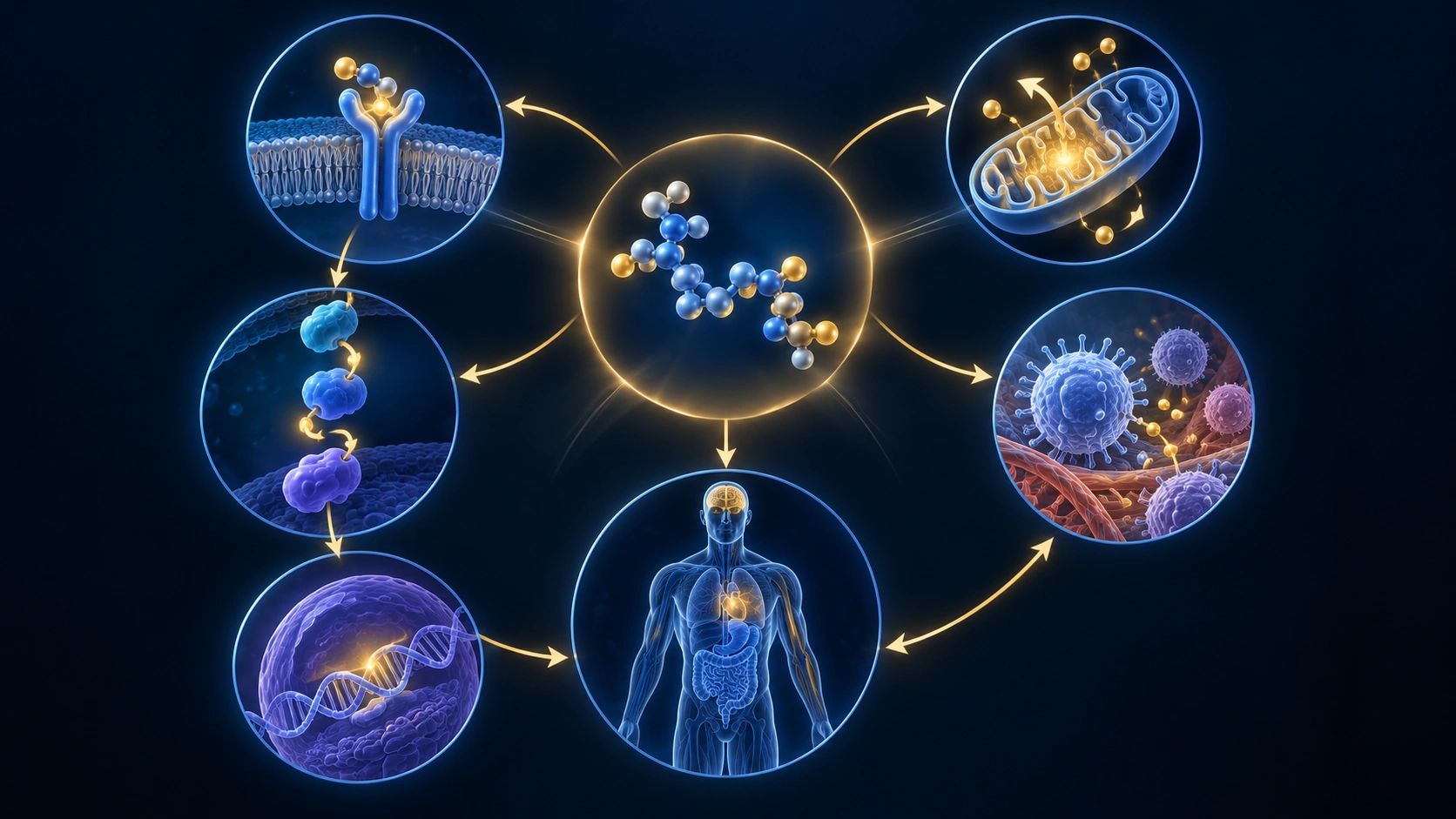
THE CORE MECHANISM MAP
MOTS-c
↓
Modulation of:
FOLATE / PURINE METABOLISM
↓
AICAR
↓
AMPK
MITOCHONDRIAL → NUCLEAR RETROGRADE SIGNALING
SKELETAL-MUSCLE METABOLISM
STRESS-RESPONSE PATHWAYS
↓
Potential:
GLUCOSE UTILIZATION
INSULIN SENSITIVITY
METABOLIC FLEXIBILITY
EXERCISE ADAPTATION
CELLULAR STRESS RESILIENCE
Again:
- MOTS-c is best understood as A METABOLIC ADAPTATION SIGNAL.
WHAT THIS MECHANISM MAY SUGGEST
Mechanistically, MOTS-c deserves investigation in areas involving:
- insulin resistance
- metabolic dysfunction
- skeletal-muscle glucose utilization
- obesity
- age-related metabolic decline
- exercise capacity
- mitochondrial dysfunction
- metabolic flexibility
- cardiovascular aging
- bone metabolism
- stress resilience
WHAT THIS MECHANISM DOES NOT PROVE
It does not prove that MOTS-c:
- replaces exercise
- reverses aging
- treats every mitochondrial disorder
- automatically causes fat loss
- directly builds muscle
- cures type 2 diabetes
- restores every form of fatigue
- is beneficial simply because a patient has “low energy”
- should be used whenever mitochondrial dysfunction is suspected
Again:
- “MITOCHONDRIAL” IS NOT A DIAGNOSIS.
And:
MECHANISM SHOULD DEFINE THE QUESTION — NOT END THE QUESTION.

PRECLINICAL EVIDENCE
SUBSTANTIAL
This remains the strongest therapeutic evidence base.
Animal and cellular models have investigated:
- glucose metabolism
- insulin resistance
- obesity
- exercise performance
- aging
- cardiovascular disease
- bone metabolism
- inflammation
- mitochondrial stress
HUMAN BIOLOGICAL EVIDENCE
MEANINGFUL
Humans produce MOTS-c.
Exercise changes MOTS-c.
MOTS-c concentrations are associated with:
- age
- insulin resistance
- obesity
- metabolic phenotype
But:
- ENDOGENOUS ASSOCIATION
is different from:
- THERAPEUTIC ADMINISTRATION.
That distinction should stay visible.
HUMAN THERAPEUTIC EVIDENCE
EARLY
Compared with the amount of preclinical enthusiasm, direct clinical evidence for exogenous MOTS-c therapy remains much smaller.
This means we can say:
- MOTS-c IS A REAL HUMAN BIOLOGICAL SIGNAL.
But therapeutic questions regarding:
- dose
- duration
- patient selection
- clinical outcomes
remain much less mature than the endogenous physiology.
That is an important distinction without dismissing the peptide.
DO NOT BEGIN WITH MOTS-c
Begin with: WHAT METABOLIC CAPACITY IS ACTUALLY FAILING?
Then:
PHYSIOLOGY
↓
PATTERN
↓
MECHANISM
↓
EVIDENCE
↓
RISK
↓
MONITORING
↓
DECISION
PHYSIOLOGY
Healthy mitochondrial and metabolic function requires:
- nutrient availability
- oxygen delivery
- mitochondrial substrate oxidation
- ATP generation
- insulin sensitivity
- skeletal-muscle glucose uptake
- stress adaptation
- mitochondrial turnover
- physical activity
Again:
MOTS-c is:
- ONE SIGNAL WITHIN THIS NETWORK.
EVIDENCE
Ask:
WHAT TYPE OF EVIDENCE SUPPORTS MOTS-c FOR THIS EXACT GOAL?
- Human endogenous physiology?
- Human biomarker association?
- Human exercise response?
- Animal therapeutic intervention?
These are:
- DIFFERENT EVIDENCE CLASSES.
Do not collapse them into:
- “MOTS-c HAS HUMAN STUDIES.”
And do not collapse them into:
- “THERE ARE NO HUMAN DATA.”
Both would lose important information.
PATTERN
What is actually present?
- insulin resistance?
- poor metabolic flexibility?
- age-related decline?
- loss of exercise tolerance?
- metabolic syndrome?
- obesity?
- mitochondrial disease?
- under-recovery?
- simple deconditioning?
Again:
- “LOW ENERGY” IS NOT A MITOCHONDRIAL DIAGNOSIS.
RISK
The better question is:
- WHAT ELSE COULD CHANGE WHEN WE AMPLIFY METABOLIC STRESS SIGNALING?
Potential considerations include:
- glucose changes
- exercise tolerance
- metabolic interactions
- unknown chronic signaling effects
- product quality
- injection-related issues
- masking an underlying disease
- using metabolic stimulation in an under-fueled patient
Again:
a patient who needs:
- MORE METABOLIC FLEXIBILITY
is different from a patient whose cells simply need:
- MORE SUBSTRATE AND RECOVERY.
MECHANISM
Does MOTS-c biology match:
- THE DOMINANT BOTTLENECK?
For example:
If a patient cannot exercise because of:
- UNTREATED IRON-DEFICIENCY ANEMIA,
the primary problem is not:
- LOW MOTS-c.
If exercise capacity is poor because of:
- SEVERE SLEEP APNEA,
more metabolic signaling does not correct:
- THE OXYGEN / SLEEP BOTTLENECK.
If insulin resistance is largely driven by:
- PHYSICAL INACTIVITY + EXCESS ENERGY + LOSS OF MUSCLE,
MOTS-c might intersect with the pathway.
But it does not eliminate:
- THE FOUNDATIONAL DRIVER.
MONITORING
Monitoring should follow:
- THE REASON MOTS-c IS BEING CONSIDERED.
Potential areas include:
METABOLIC
- fasting glucose
- fasting insulin
- HOMA-IR where useful
- A1c
- CGM patterns when appropriate
- triglycerides
- waist circumference
BODY COMPOSITION
- fat mass
- lean mass
- waist
- weight trend
PERFORMANCE
- exercise tolerance
- VO₂-related metrics where available
- work capacity
- recovery
- strength
FOUNDATIONAL
- sleep
- calorie intake
- protein intake
- training
- recovery
Again:
monitor:
- THE METABOLIC PHENOTYPE.
Not simply:
- “DO I FEEL MORE ENERGY?”

THE PRAXIS 5

MECHANISM
MOTS-c appears to influence:
- METABOLIC ADAPTATION THROUGH AMPK, FUEL HANDLING, AND MITOCHONDRIAL–NUCLEAR COMMUNICATION.
Its biology is strongest around:
- skeletal muscle
- glucose utilization
- stress adaptation
- exercise
EVIDENCE
Endogenous human biology:
- MEANINGFUL.
Exercise-response data:
- HUMAN.
Metabolic associations:
- HUMAN.
Therapeutic intervention evidence:
- EARLIER-STAGE THAN THE MECHANISTIC STORY.
That distinction is essential.
RISK
Do not assume:
- MITOCHONDRIAL-DERIVED = UNIVERSALLY BENEFICIAL.
Metabolic signals exist because:
- THE BODY IS RESPONDING TO A SPECIFIC ENVIRONMENT.
Changing the signal without understanding the environment can create:
- A MISMATCH.
MONITORING
Monitor:
- METABOLIC FUNCTION + PHYSICAL FUNCTION + PATIENT GOAL.
If the goal is insulin sensitivity:
- monitor insulin sensitivity.
If the goal is performance:
- monitor performance.
If the goal is body composition:
- monitor body composition.
Again:
- MECHANISM MUST CONNECT TO OUTCOME.
PATIENT CONTEXT
- An insulin-resistant middle-aged patient.
- An endurance athlete.
- An elderly patient with sarcopenia.
- A patient with primary mitochondrial disease.
- A severely under-fueled athlete.
Again:
- same peptide.
Completely different:
- METABOLIC ENVIRONMENT.
SEVEN QUESTIONS TO ASK BEFORE MOTS-c
1. WHAT METABOLIC PROBLEM ARE WE ACTUALLY TRYING TO CHANGE?
- insulin resistance?
- poor exercise capacity?
- impaired metabolic flexibility?
- age-related decline?
- something else?
2. DOES MOTS-c'S MECHANISM MATCH THAT PROBLEM?
- AMPK?
- skeletal-muscle glucose metabolism?
- stress adaptation?
- mitochondrial–nuclear signaling?
3. WHAT TYPE OF EVIDENCE SUPPORTS THIS SPECIFIC USE?
- endogenous human biology?
- biomarker association?
- exercise physiology?
- animal therapeutic evidence?
- direct human intervention data?
4. IS THE METABOLIC PROBLEM ACTUALLY SECONDARY TO SOMETHING ELSE?
- sleep deprivation?
- inactivity?
- excess energy intake?
- low muscle mass?
- medication?
- hypothyroidism?
- anemia?
- cardiopulmonary disease?
5. WHAT COULD GO WRONG IF WE AMPLIFY THE PATHWAY?
- inappropriate metabolic stress?
- interaction with other therapies?
- masking another disease?
- under-fueling?
- product-quality issue?
6. WHAT WILL WE MONITOR?
- glucose?
- insulin?
- body composition?
- exercise capacity?
- recovery?
- symptoms?
7. WHAT WOULD DEFINE SUCCESS?
Not:
- “I USED A MITOCHONDRIAL PEPTIDE.”
But:
- THE METABOLIC BOTTLENECK ACTUALLY IMPROVED.


MOTS-c
KEY TAKEAWAYS
- MOTS-c is a 16-amino-acid mitochondrial-derived peptide.
- It is encoded within the mitochondrial 12S rRNA region.
- MOTS-c demonstrates that mitochondrial DNA can produce signaling peptides, not merely respiratory-chain proteins.
- Mitochondria should therefore be understood as signaling organelles as well as energy-producing organelles.
- MOTS-c can participate in mitochondrial-to-nuclear retrograde signaling.
- Under metabolic stress, MOTS-c can translocate to the nucleus and influence stress-response gene expression.
- AMPK is one of the central pathways associated with MOTS-c biology.
- Folate and purine metabolism, including AICAR-related signaling, appear to contribute to MOTS-c-mediated AMPK activation.
- Skeletal muscle is a major metabolic context for MOTS-c.
- MOTS-c has been associated with improved glucose utilization and insulin sensitivity in experimental research.
- MOTS-c is responsive to exercise in humans.
- Acute exercise has been shown to alter circulating and skeletal-muscle MOTS-c biology.
- This supports a physiological role in exercise adaptation.
- It does not mean MOTS-c reproduces all of exercise biology.
- Animal studies have generated the term “exercise mimetic,” but exercise activates many systems beyond MOTS-c.
- AMPK/PGC-1α signaling may connect MOTS-c to mitochondrial adaptation and endurance biology.
- MOTS-c levels appear to change with age and metabolic state.
- Lower MOTS-c has been reported with aging in several research contexts.
- This does not make aging a simple MOTS-c-deficiency state.
- Recent human studies suggest MOTS-c may actually rise with insulin resistance or obesity in some populations.
- This may represent compensatory metabolic signaling.
- High peptide concentration does not always mean better peptide function.
- MOTS-c is therefore not best understood as simply a “low-is-bad, high-is-good” biomarker.
- Its metabolic effects appear especially relevant to skeletal muscle, glucose utilization, and cellular stress adaptation.
- MOTS-c is being investigated across obesity, diabetes, aging, exercise, cardiovascular disease, bone metabolism, and mitochondrial dysfunction.
- The strength of evidence differs substantially across those areas.
- Human endogenous and exercise-response data are stronger than human therapeutic-outcome evidence.
- That does not invalidate the therapeutic hypothesis; it tells us where the research currently sits.
- MOTS-c should not be reduced to a fat-loss peptide.
- It should not be reduced to an energy peptide.
- It should not be reduced to an anti-aging peptide.
- Its most useful identity is a mitochondrial-derived metabolic adaptation signal.
- The best question is not “does MOTS-c increase energy?”
- The better question is “what metabolic adaptation is failing, does MOTS-c biology intersect with that bottleneck, what evidence supports that use, and what measurable metabolic or functional outcome would demonstrate that the system actually improved?”
THE BOTTOM LINE
MOTS-c may be one of the most conceptually important peptides in the PPI library.
Not because we can currently say:
- IT TREATS EVERYTHING ASSOCIATED WITH MITOCHONDRIAL DYSFUNCTION.
But because it forces us to rethink:
- WHAT MITOCHONDRIA ACTUALLY ARE.
The old model was:
FOOD
↓
MITOCHONDRIA
↓
ATP
That model is incomplete.
A better model is:
METABOLIC ENVIRONMENT
↓
MITOCHONDRIA SENSE STRESS
↓
MITOCHONDRIAL SIGNALS
↓
MOTS-c
↓
AMPK + NUCLEAR GENE RESPONSE
↓
CELLULAR ADAPTATION
In other words:
the mitochondrion is not only:
- BURNING FUEL.
It is:
- READING THE ENVIRONMENT.
And then communicating:
- WHAT THE CELL SHOULD DO NEXT.
That is why MOTS-c becomes relevant to:
- EXERCISE.
- INSULIN RESISTANCE.
- METABOLIC FLEXIBILITY.
- AGING.
- MUSCLE FUNCTION.
- CELLULAR STRESS.
The deeper concept is:
- METABOLIC RESILIENCE.
Can the cell:
- Use glucose when glucose is available?
- Use fatty acids when appropriate?
- Respond to exercise?
- Handle oxidative stress?
- Adapt when energetic demand increases?
- Recover when the stress is removed?
MOTS-c appears to participate in that:
- ADAPTIVE CAPACITY.
And that is why simply calling MOTS-c:
- “A MITOCHONDRIAL PEPTIDE”
does not go far enough.
The more important question is:
- WHAT INFORMATION IS THE MITOCHONDRION TRYING TO SEND?
This also explains an interesting paradox emerging in human data.
If MOTS-c can improve metabolism:
why might people with insulin resistance sometimes have:
- HIGHER MOTS-c?
Because the body may be compensating.
Again:
- A HIGH SIGNAL CAN REPRESENT A SYSTEM WORKING HARDER — NOT NECESSARILY A SYSTEM WORKING BETTER.
That principle appears repeatedly across endocrine and peptide biology.
Insulin rises when tissues resist insulin.
Leptin rises when adiposity increases despite leptin resistance.
FGF21 can rise during metabolic stress.
And MOTS-c may behave similarly in some metabolic phenotypes.
That makes the Praxis question much deeper than:
- “HOW DO WE RAISE MOTS-c?”
The better question is:
- “WHAT METABOLIC STRESS IS PRESENT, HOW WELL IS THE CELL ADAPTING TO IT, DOES MOTS-c SIGNALING INTERSECT WITH THE DOMINANT BOTTLENECK, AND IF THAT SIGNAL IS amplified, what measurable improvement in glucose handling, exercise capacity, body composition, or metabolic resilience should actually occur?”
That is the distinction between:
- TAKING A MITOCHONDRIAL PEPTIDE
and:
- UNDERSTANDING MITOCHONDRIAL MEDICINE.
- STOP MEMORIZING PEPTIDES. START UNDERSTANDING THE SYSTEM.