Clinical Peptide Medicine — Structured. Applied. Evolving.

Praxis Peptide Institute
  • HOME
  • START HERE
  • LEARN
  • PEPTIDE GUIDES
  • PEP EXPERIENCE REGISTRY
  • EXPLORE REGISTRY
  • ADVANCED LEARNER TRAINING
  • CLINICIAN TRAINING
  • ABOUT
  • More
    • HOME
    • START HERE
    • LEARN
    • PEPTIDE GUIDES
    • PEP EXPERIENCE REGISTRY
    • EXPLORE REGISTRY
    • ADVANCED LEARNER TRAINING
    • CLINICIAN TRAINING
    • ABOUT
  • Sign In
  • Create Account

  • My Account
  • Signed in as:

  • filler@godaddy.com


  • My Account
  • Sign out

Signed in as:

filler@godaddy.com

  • HOME
  • START HERE
  • LEARN
  • PEPTIDE GUIDES
  • PEP EXPERIENCE REGISTRY
  • EXPLORE REGISTRY
  • ADVANCED LEARNER TRAINING
  • CLINICIAN TRAINING
  • ABOUT

Account

  • My Account
  • Sign out

  • Sign In
  • My Account

LL-37 Peptide Guide: Cathelicidin, Innate Immunity, Antimicrobial Defense, and Barrier Biology.

 A comprehensive LL-37 guide covering cathelicidin biology, innate host defense, antimicrobial activity, immune signaling, barrier tissues, biofilms, inflammation, wound healing, evidence, monitoring, and the Praxis clinical reasoning framework.  

UNDERSTAND THE PEPTIDE

LL-37 is a 37-amino-acid human antimicrobial peptide derived from the cathelicidin precursor protein hCAP18.

It is one of the best examples of why the immune system should not be reduced to:

  • ANTIBODIES + WHITE BLOOD CELLS.

Humans also produce small peptides that function directly at the front line of:

  • HOST DEFENSE.

LL-37 participates in:

  • antimicrobial activity 
  • bacterial membrane disruption 
  • antiviral defense 
  • antifungal activity 
  • biofilm interactions 
  • immune-cell recruitment 
  • barrier immunity 
  • wound healing 
  • angiogenesis 
  • inflammatory signaling 
  • epithelial defense 

The most important concept is that LL-37 is not simply:

  • “A NATURAL ANTIBIOTIC.”

That phrase is too narrow.

A better description is:

  • A MULTIFUNCTIONAL HUMAN HOST-DEFENSE PEPTIDE THAT CAN DIRECTLY DAMAGE MICROBES WHILE ALSO MODIFYING IMMUNE RECOGNITION, CELL MIGRATION, BARRIER FUNCTION, AND REPAIR.

That distinction matters because LL-37 sits at the intersection of:

  • DIRECT ANTIMICROBIAL ACTION

and:

  • IMMUNE REGULATION.

It can act against microorganisms.

But it can also influence:

  • HOW THE HOST RESPONDS TO THEM.

That makes LL-37 a very different type of molecule from a conventional antibiotic.
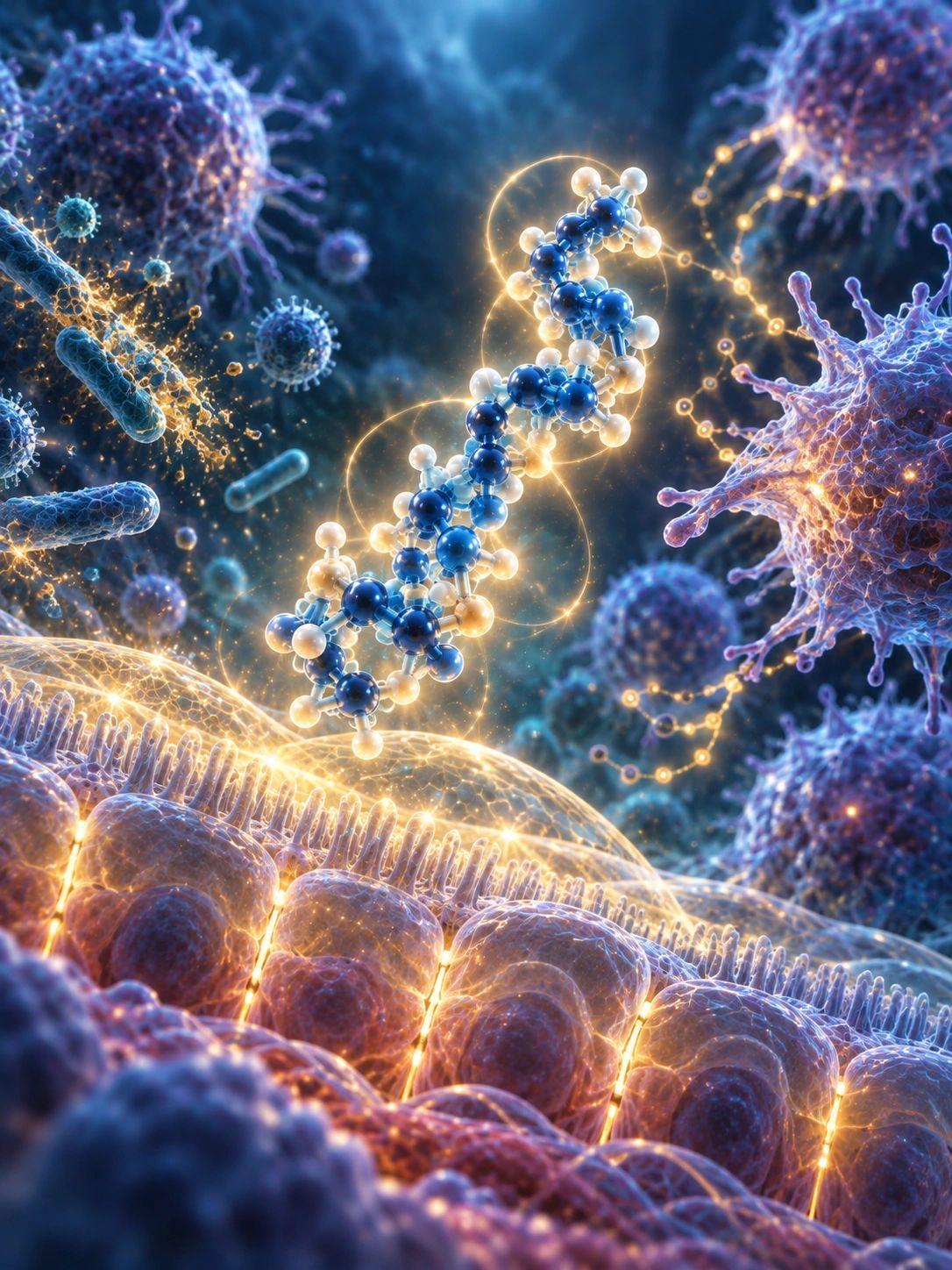
WHAT IS LL-37?

LL-37

IS LL-37 AN ANTIBIOTIC?

THE IDENTITY MODEL

LL-37 comes from the human cathelicidin precursor:

hCAP18

also known as:

CAMP — CATHELICIDIN ANTIMICROBIAL PEPTIDE.


The precursor is processed to release:

LL-37

which begins with two leucines:

L-L

and contains:

37 AMINO ACIDS.


Hence:

LL-37.


It is produced by multiple cell types, including:

neutrophils 

epithelial cells 

keratinocytes 

macrophages 

airway cells 

gastrointestinal epithelial cells 


That wide distribution tells us something important.


LL-37 is not confined to:

ONE ORGAN.


It is part of:

SYSTEM-WIDE BARRIER DEFENSE.

THE IDENTITY MODEL

IS LL-37 AN ANTIBIOTIC?

THE IDENTITY MODEL

CAMP / hCAP18

↓

Proteolytic processing

↓

LL-37

↓

Potential effects on:

MICROBIAL MEMBRANES

IMMUNE-CELL SIGNALING

CHEMOTAXIS

EPITHELIAL DEFENSE

BIOFILMS

ANGIOGENESIS

WOUND REPAIR

↓

Potential:

HOST DEFENSE + BARRIER RECOVERY


The key idea is:

LL-37 CAN ATTACK THE THREAT AND SHAPE THE RESPONSE TO THE THREAT.

IS LL-37 AN ANTIBIOTIC?

IS LL-37 AN ANTIBIOTIC?

IS LL-37 AN ANTIBIOTIC?

Not in the conventional pharmacologic sense.


A traditional antibiotic may inhibit:

bacterial cell-wall synthesis 

ribosomal function 

DNA replication 

folate metabolism 


LL-37 works differently.

It can interact with:

MICROBIAL MEMBRANES.


Because LL-37 is:

CATIONIC

and many microbial membranes are relatively:

NEGATIVELY CHARGED,

electrostatic attraction can occur.


The peptide can then disrupt:

MEMBRANE INTEGRITY.


So:

LL-37

is better understood as:

AN INNATE HOST-DEFENSE PEPTIDE WITH DIRECT ANTIMICROBIAL ACTIVITY.

HOW LL-37 MAY WORK

MEMBRANE DISRUPTION

IS LL-37 AN ANTIBIOTIC?

The major mechanistic themes include:

membrane disruption 

bacterial killing 

fungal activity 

antiviral interactions 

biofilm disruption/modulation 

chemotaxis 

immune-cell activation 

epithelial signaling 

inflammatory modulation 

angiogenesis 

wound healing 


Its pharmacology is therefore:

BROAD.

MEMBRANE DISRUPTION

MEMBRANE DISRUPTION

MEMBRANE DISRUPTION

This is the classic antimicrobial mechanism.

Microbial membranes often differ from mammalian membranes in:

lipid composition 

charge 

structure 


LL-37 can bind preferentially to microbial surfaces.


Once associated with the membrane, it can:

PERTURB OR DISRUPT THE MEMBRANE.


That can lead to:

LOSS OF CELLULAR INTEGRITY

and:

MICROBIAL DEATH.

THE MEMBRANE MODEL

MEMBRANE DISRUPTION

MEMBRANE DISRUPTION

LL-37

↓

Electrostatic attraction to:

MICROBIAL MEMBRANE

↓

Membrane insertion / disruption

↓

PERMEABILITY ↑

↓

Cellular contents leak

↓

Potential:

MICROBIAL DEATH


This mechanism is fundamentally different from:

TARGETING ONE MICROBIAL ENZYME.

WHY THIS MATTERS FOR RESISTANCE

WHY THIS MATTERS FOR RESISTANCE

WHY THIS MATTERS FOR RESISTANCE

Traditional antibiotics often act on:

SPECIFIC MOLECULAR TARGETS.


Microorganisms can develop resistance through:

enzyme modification 

target mutation 

drug efflux 

altered permeability 


Membrane-active host-defense peptides may impose:

A DIFFERENT TYPE OF SELECTIVE PRESSURE.


That does not mean:

RESISTANCE CANNOT OCCUR.


Microorganisms can still adapt through changes in:

membrane charge 

surface structures 

proteases 

biofilm formation 


But the resistance problem is:

BIOLOGICALLY DIFFERENT.


That is one reason antimicrobial peptides remain such an important research field.

ANTIBACTERIAL ACTIVITY

WHY THIS MATTERS FOR RESISTANCE

WHY THIS MATTERS FOR RESISTANCE

LL-37 has demonstrated activity against a broad range of bacteria in experimental systems.


This includes both:

GRAM-POSITIVE

and:

GRAM-NEGATIVE

organisms.


Examples studied include:

Staphylococcus aureus 

Escherichia coli 

Pseudomonas aeruginosa 

other opportunistic pathogens 


But susceptibility depends heavily on:

salt concentration 

pH 

peptide concentration 

serum proteins 

tissue environment 

microbial surface biology 


Again:

IN VITRO ANTIMICROBIAL ACTIVITY

is not identical to:

CLINICAL INFECTION CONTROL.


The tissue environment matters enormously.

ANTIFUNGAL ACTIVITY

WHY THIS MATTERS FOR RESISTANCE

ANTIFUNGAL ACTIVITY

LL-37 has also shown experimental activity against fungi, including:

Candida species.


This is particularly interesting at:

MUCOSAL AND EPITHELIAL SURFACES

where host-defense peptides participate in:

LOCAL IMMUNITY.


Again:

this does not mean LL-37 replaces:

ANTIFUNGAL THERAPY.


It means it participates in:

THE HOST'S OWN ANTIFUNGAL ENVIRONMENT.

ANTIVIRAL BIOLOGY

IMMUNE-CELL RECRUITMENT

ANTIFUNGAL ACTIVITY

 LL-37 has been studied for effects involving:

VIRAL PARTICLES

and:

HOST-CELL ENTRY / IMMUNE SIGNALING.


Depending on the virus and model, mechanisms may include:

disruption of viral envelopes 

interference with attachment 

modulation of innate

immune signaling 


Again:

different viruses behave differently.


A peptide active against one:

ENVELOPED VIRUS

does not automatically become:

A UNIVERSAL ANTIVIRAL.

BIOFILMS

IMMUNE-CELL RECRUITMENT

IMMUNE-CELL RECRUITMENT

Biofilms are one of the most important concepts in chronic infection biology.


A biofilm is not simply:

A PILE OF BACTERIA.


It is an organized microbial community embedded within:

EXTRACELLULAR MATRIX.


Biofilms can:

reduce antibiotic penetration 

alter microbial metabolism 

protect organisms from immunity 

create persistent infection 


LL-37 has shown effects on:

BIOFILM FORMATION AND STRUCTURE

in experimental settings.


That has created substantial interest in:

chronic wounds 

respiratory infection 

implant-associated infection 

persistent bacterial colonization 


But biofilm biology is highly:

ORGANISM SPECIFIC.


Some contexts are even more complicated because sublethal concentrations of host-defense peptides can influence microbial behavior in unexpected ways.


Again:

DOSE + ORGANISM + ENVIRONMENT MATTER.

IMMUNE-CELL RECRUITMENT

IMMUNE-CELL RECRUITMENT

IMMUNE-CELL RECRUITMENT

LL-37 does not only attack microbes.

It also communicates with:

IMMUNE CELLS.


LL-37 can influence:

neutrophils 

monocytes 

macrophages 

dendritic cells 

T cells 


One important function is:

CHEMOTAXIS.


Chemotaxis means:

DIRECTED CELL MOVEMENT TOWARD A CHEMICAL SIGNAL.


This means LL-37 can help:

RECRUIT IMMUNE CELLS TO THE SITE OF INJURY OR INFECTION.

THE HOST-DEFENSE MODEL

LPS / ENDOTOXIN INTERACTIONS

THE HOST-DEFENSE MODEL

MICROBIAL THREAT

↓

LL-37 release

↓

Direct:

MICROBIAL DAMAGE

Indirect:

IMMUNE-CELL RECRUITMENT

↓

Potential:

MORE EFFECTIVE LOCAL HOST DEFENSE


Again

the peptide operates on:

BOTH SIDES OF THE ENCOUNTER.

INFLAMMATORY SIGNALING

LPS / ENDOTOXIN INTERACTIONS

THE HOST-DEFENSE MODEL

This is where LL-37 becomes more complicated.


LL-37 can:

PROMOTE

or:

LIMIT

inflammatory responses depending on:

concentration 

tissue 

cell type 

pathogen 

inflammatory state 


That means LL-37 should not simply be labeled:

PRO-INFLAMMATORY

or:

ANTI-INFLAMMATORY.


It is:

CONTEXT-DEPENDENTLY IMMUNOMODULATORY.


That distinction is critical.

LPS / ENDOTOXIN INTERACTIONS

LPS / ENDOTOXIN INTERACTIONS

LPS / ENDOTOXIN INTERACTIONS

Gram-negative bacteria contain:

LIPOPOLYSACCHARIDE — LPS

also called:

ENDOTOXIN.


LPS strongly activates:

INNATE IMMUNE SIGNALING.


LL-37 can bind:

LPS

and under some conditions reduce its ability to trigger:

EXCESSIVE INFLAMMATORY ACTIVATION.


This creates an interesting dual role:

ATTACK BACTERIA

while potentially:

BUFFERING SOME OF THE INFLAMMATORY SIGNAL RELEASED FROM THEM.


Again:

that is host-defense coordination.

EPITHELIAL BARRIER BIOLOGY

EPITHELIAL BARRIER BIOLOGY

LPS / ENDOTOXIN INTERACTIONS

LL-37 is produced at:

BARRIER SURFACES.

This includes:

skin 

respiratory tract 

gastrointestinal tract 

urinary tract 


Those surfaces are constantly exposed to:

MICROORGANISMS.


The barrier must decide:

TOLERATE

or:

DEFEND.


LL-37 contributes to:

THAT FRONT-LINE DECISION SYSTEM.

VITAMIN D AND LL-37

EPITHELIAL BARRIER BIOLOGY

VITAMIN D AND LL-37

One of the most interesting regulatory connections is:

VITAMIN D.


The human CAMP gene contains a:

VITAMIN-D-RESPONSIVE ELEMENT.


Activation of the vitamin D receptor can increase:

CATHELICIDIN / LL-37 EXPRESSION

in selected cells.


That creates a direct mechanistic connection between:

VITAMIN D STATUS

and:

INNATE HOST-DEFENSE SIGNALING.


But again:

vitamin D does not simply:

“BOOST LL-37”

in every tissue to the same degree.


The biology depends on:

local vitamin D metabolism 

VDR expression 

immune activation 

tissue context 


Still, this is an elegant example of:

NUTRIENT SIGNALING → GENE EXPRESSION → HOST DEFENSE.

SKIN BIOLOGY

EPITHELIAL BARRIER BIOLOGY

VITAMIN D AND LL-37

The skin is one of the most important LL-37 tissues.


Keratinocytes can produce LL-37 during:

injury 

infection 

inflammation 

LL-37 can influence:

antimicrobial defense 

keratinocyte migration 

wound closure 

inflammatory signaling 


This makes LL-37 relevant to:

DERMATOLOGY + WOUND BIOLOGY.

PSORIASIS — AN IMPORTANT COUNTERPOINT

PSORIASIS — AN IMPORTANT COUNTERPOINT

PSORIASIS — AN IMPORTANT COUNTERPOINT

LL-37 provides a perfect example of why:

MORE HOST DEFENSE IS NOT ALWAYS BETTER.


In psoriasis, LL-37 can form complexes with:

SELF-DNA

or:

SELF-RNA.


These complexes can activate immune pathways that normally detect:

MICROBIAL NUCLEIC ACIDS.


That can contribute to:

AUTOIMMUNE / AUTOINFLAMMATORY SIGNALING.


So:

HIGH LL-37 ACTIVITY

may be useful during:

MICROBIAL DEFENSE

but problematic in:

SELECTED AUTOIMMUNE CONTEXTS.


That is exactly why the Praxis lens matters.

THE PSORIASIS MODEL

PSORIASIS — AN IMPORTANT COUNTERPOINT

PSORIASIS — AN IMPORTANT COUNTERPOINT

Cell damage

↓

Self-DNA released

↓

LL-37 binds self-DNA

↓

Complex recognized by immune sensors

↓

PLASMACYTOID DENDRITIC-CELL ACTIVATION

↓

Interferon signaling

↓

Potential:

PSORIATIC INFLAMMATION


Again:

same peptide.

Different context.

Different:

BIOLOGICAL OUTCOME.

ROSACEA

PSORIASIS — AN IMPORTANT COUNTERPOINT

WOUND HEALING

LL-37 is also relevant to:

ROSACEA BIOLOGY.


In rosacea, abnormal processing of cathelicidin can generate peptide patterns that contribute to:

inflammation 

vascular changes 

skin symptoms 


Again:

this teaches us:

LL-37 IS NOT SIMPLY “GOOD FOR SKIN.”


The same host-defense pathway can become:

DYSREGULATED.

WOUND HEALING

WOUND HEALING

WOUND HEALING

LL-37 has been associated with:

keratinocyte migration 

epithelial closure 

angiogenesis 

wound repair 


This makes sense because an open wound requires:

HOST DEFENSE

and:

REPAIR

simultaneously.


A wound that closes without controlling microbes is:

NOT SUCCESSFUL.


A wound that kills microbes but cannot regenerate barrier tissue is also:

NOT SUCCESSFUL.


LL-37 sits at the intersection of:

BOTH TASKS.

ANGIOGENESIS

WOUND HEALING

ANGIOGENESIS

LL-37 has demonstrated pro-angiogenic effects in experimental models.


That may support:

WOUND REPAIR

by increasing:

MICROVASCULAR SUPPORT.


Again:

angiogenesis is context dependent.


Useful in:

HEALING.


Potentially undesirable in:

SELECTED PATHOLOGICAL CONDITIONS.

THE CORE MECHANISM MAP

hCAP18 / CAMP

↓

LL-37

↓

Direct:

  • MICROBIAL MEMBRANE DISRUPTION
  • BIOFILM MODULATION

Indirect:

  • CHEMOTAXIS
  • IMMUNE SIGNALING
  • EPITHELIAL RESPONSE
  • ANGIOGENESIS

↓

Potential:

  • HOST DEFENSE + BARRIER REPAIR

But:

context can shift the same molecule toward:

  • EXCESSIVE INFLAMMATION / AUTOIMMUNE SIGNALING.

That is the central lesson.


WHAT THIS MECHANISM MAY SUGGEST

Mechanistically, LL-37 deserves research interest in:

  • chronic infection 
  • impaired innate host defense 
  • chronic wounds 
  • biofilm-associated disease 
  • epithelial barrier dysfunction 
  • selected respiratory infections 
  • dermatologic infection 
  • wound repair 
  • immune-deficient states 

Its strongest conceptual niche may be:

  • DEFENSE AT BARRIER SURFACES.

WHAT THIS MECHANISM DOES NOT PROVE

LL-37 biology does not prove that it:

  • replaces antibiotics 
  • treats every chronic infection 
  • eradicates every biofilm 
  • should be increased in every autoimmune disease 
  • improves every skin condition 
  • is appropriate whenever immune function seems low 
  • should be used whenever someone has recurrent infections 
  • is universally beneficial because it is naturally occurring 

Again:

  • HOST-DEFENSE SIGNALING CAN BECOME PATHOLOGICAL WHEN MISDIRECTED.

THE EVIDENCE, POTENTIAL APPLICATIONS, AND LIMITATIONS

ENDOGENOUS / PHYSIOLOGICAL BIOLOGY

STRONG

LL-37 is:

A REAL HUMAN INNATE-IMMUNE PEPTIDE

with extensive research across:

  • microbiology 
  • immunology 
  • dermatology 
  • wound healing 
  • respiratory biology 
  • barrier function 

Its physiological relevance is well established.

PRECLINICAL EVIDENCE

SUBSTANTIAL

Research includes:

  • bacterial killing 
  • fungal activity 
  • viral interactions 
  • biofilms 
  • wound healing 
  • angiogenesis 
  • inflammatory signaling 

Again:

  • the biological signal is broad.

HUMAN DISEASE BIOLOGY

MEANINGFUL

Altered LL-37 biology has been documented in human conditions including:

  • psoriasis 
  • rosacea 
  • chronic wounds 
  • respiratory disease 
  • infectious states 
  • inflammatory disorders 

This gives LL-37 strong:

  • HUMAN PATHOPHYSIOLOGICAL RELEVANCE.

DIRECT THERAPEUTIC HUMAN EVIDENCE

MORE LIMITED THAN THE ENDOGENOUS BIOLOGY

This distinction matters.

There is extensive evidence that:

  • LL-37 MATTERS IN HUMANS.

That does not automatically mean:

  • EXOGENOUS LL-37 THERAPY IS FULLY CHARACTERIZED ACROSS CLINICAL CONDITIONS.

Again:

endogenous physiology and therapeutic pharmacology are:

  • DIFFERENT QUESTIONS.

Research

CHRONIC WOUNDS

BIOFILM-ASSOCIATED INFECTION

BIOFILM-ASSOCIATED INFECTION

Chronic wounds are one of the most logical LL-37 applications because they combine:

MICROBIAL BURDEN

INFLAMMATION

FAILED EPITHELIAL REPAIR

POOR PERFUSION


LL-37 intersects with several of those systems.


This creates a biologically coherent rationale for:

WOUND-HEALING RESEARCH.


But if the wound is driven by:

SEVERE ARTERIAL DISEASE

or:

VENOUS HYPERTENSION,

the primary vascular driver still matters.

BIOFILM-ASSOCIATED INFECTION

BIOFILM-ASSOCIATED INFECTION

BIOFILM-ASSOCIATED INFECTION

Biofilms contribute to:

chronic wounds 

indwelling-device infections 

chronic airway infection 

persistent colonization 


LL-37's ability to interact with:

BIOFILM BIOLOGY

makes it particularly interesting here.


But again:

different organisms respond differently.


The correct question is not:

“DOES LL-37 BREAK BIOFILMS?”


It is:

“WHICH ORGANISM, WHICH BIOFILM, WHICH CONCENTRATION, AND IN WHAT TISSUE ENVIRONMENT?”

RESPIRATORY BIOLOGY

BIOFILM-ASSOCIATED INFECTION

RESPIRATORY BIOLOGY

The airway relies heavily on:

INNATE BARRIER DEFENSE.


LL-37 is produced by:

airway epithelium 

neutrophils 

immune cells 


It contributes to defense against inhaled microorganisms.

Potential relevance includes:

bacterial respiratory infection 

chronic airway colonization 

inflammatory lung disease 


But:

MORE LL-37

is not automatically:

BETTER AIRWAY IMMUNITY.


Excessive inflammatory signaling can itself damage:

THE LUNG.


SKIN INFECTION

SKIN INFECTION

RESPIRATORY BIOLOGY

Skin produces LL-37 in response to:

INJURY AND MICROBIAL EXPOSURE.


This makes it relevant to:

bacterial skin infection 

wound colonization 

barrier disruption 


Again:

the peptide does not replace:

SOURCE CONTROL

when abscess or necrotic tissue is present.


Host-defense peptides function within:

THE WHOLE INFECTION ENVIRONMENT.

PSORIASIS

SKIN INFECTION

PSORIASIS

Psoriasis is one of the clearest demonstrations of:

CONTEXT-DEPENDENT LL-37 BIOLOGY.


Here, LL-37 may contribute to:

ABNORMAL SELF-NUCLEIC-ACID RECOGNITION.


So if someone simply says:

“LL-37 IMPROVES IMMUNITY,”

they are missing half the story.


In some inflammatory environments:

LL-37 can become part of:

THE PATHOLOGY.

ROSACEA

SKIN INFECTION

PSORIASIS

Abnormal cathelicidin processing in rosacea demonstrates another important principle:

THE PRECURSOR, THE PROCESSING ENZYME, AND THE FINAL PEPTIDE ALL MATTER.


The issue may not be simply:

TOO MUCH CAMP.


It may be:

HOW THE PEPTIDE IS BEING PROCESSED.


That is a more sophisticated peptide-medicine concept.

AUTOIMMUNITY

VITAMIN D / INNATE IMMUNITY

VITAMIN D / INNATE IMMUNITY

LL-37 may become immunologically important when it binds:

SELF-DNA OR SELF-RNA.


This is an example of:

HOST-DEFENSE SIGNALING BECOMING MISDIRECTED TOWARD SELF.


That does not mean LL-37 causes:

ALL AUTOIMMUNITY.


It means:

THE SAME MOLECULE CAN PARTICIPATE IN DEFENSE OR DYSREGULATION DEPENDING ON CONTEXT.

VITAMIN D / INNATE IMMUNITY

VITAMIN D / INNATE IMMUNITY

VITAMIN D / INNATE IMMUNITY

The vitamin D–LL-37 relationship remains one of the most clinically interesting examples of nutritional immunology.


A nutrient-derived hormonal signal can influence:

HOST-DEFENSE PEPTIDE EXPRESSION.


That helps explain why vitamin D status has long attracted interest in:

INFECTION + IMMUNE REGULATION.


But again:

vitamin D's clinical effects cannot be reduced entirely to:

LL-37.


It is one pathway among many.

WHAT WE KNOW

VITAMIN D / INNATE IMMUNITY

WHAT WE THINK MAY BE HAPPENING

LL-37 is a 37-amino-acid human antimicrobial peptide.


It is produced from the cathelicidin precursor hCAP18 / CAMP.


It is part of innate host defense.

LL-37 can directly disrupt microbial membranes.


It has antibacterial activity in experimental systems.


It has antifungal activity.


It has antiviral effects in selected models.

It can influence biofilms.


LL-37 recruits and signals to immune cells.

It participates in epithelial and barrier immunity.


It contributes to wound-healing biology.

It can promote angiogenic signaling.


The CAMP gene is responsive to vitamin D signaling in humans.


LL-37 biology is altered in human inflammatory diseases including psoriasis and rosacea.


Its immune effects are strongly context dependent.


LL-37 can be protective in one biological environment and contribute to pathology in another.

WHAT WE THINK MAY BE HAPPENING

WHAT WE THINK MAY BE HAPPENING

WHAT WE THINK MAY BE HAPPENING

LL-37 may function as:

A FRONT-LINE ALARM + WEAPON + COORDINATOR.


The barrier detects:

MICROBIAL THREAT.

↓

LL-37 is released.

↓

Directly:

MICROBIAL MEMBRANES ARE DISRUPTED.


Meanwhile:

immune cells are recruited.

↓

Inflammatory signaling changes.

↓

Barrier cells migrate.

↓

Repair begins.

↓

The system should eventually:

RESOLVE.

But if LL-37 interacts with:

SELF-DNA

or is processed abnormally:

the same pathway can produce

CHRONIC INFLAMMATORY SIGNALING.


That makes LL-37 an excellent example of:

WHY MORE SIGNAL IS NOT ALWAYS BETTER.

WHAT REMAINS CONTEXT-DEPENDENT

WHAT WE THINK MAY BE HAPPENING

WHAT REMAINS CONTEXT-DEPENDENT

Important questions include:

Which infections are most susceptible to LL-37? 

How does physiological salt concentration alter activity? 

How much does serum binding reduce antimicrobial effect? 

Which biofilms respond best? 

Can therapeutic LL-37 reach effective local concentrations safely? 

Is local delivery more rational than systemic exposure? 

Which chronic wounds have low endogenous LL-37 activity? 

How does microbiome composition alter response? 

When does LL-37 become pro-inflammatory rather than protective? 

Which autoimmune phenotypes are most sensitive to LL-37–nucleic-acid complexes? 

How should vitamin D status be integrated into LL-37 biology? 

How does proteolytic degradation affect therapeutic exposure? 

What are the consequences of prolonged exogenous LL-37 signaling? 


These are not minor details.

They determine:

WHETHER HOST-DEFENSE BIOLOGY CAN BE TRANSLATED INTO THERAPY.

THE PRAXIS LENS

DO NOT BEGIN WITH LL-37

Begin with: WHAT HOST-DEFENSE PROBLEM IS ACTUALLY PRESENT?    

Then:

PHYSIOLOGY

↓

PATTERN

↓

MECHANISM

↓

EVIDENCE

↓

RISK

↓

MONITORING

↓

DECISION

PHYSIOLOGY

Healthy barrier immunity requires:

  • physical barrier integrity 
  • commensal microbiota 
  • antimicrobial peptides 
  • innate immune recognition 
  • neutrophils 
  • macrophages 
  • adaptive immunity 
  • inflammatory resolution 

LL-37 is:

  • ONE PART OF THIS NETWORK.

EVIDENCE

Ask:

  • WHAT TYPE OF EVIDENCE SUPPORTS THIS PARTICULAR APPLICATION?
  • Endogenous human biology?
  • Microbial susceptibility?
  • Animal model?
  • Human wound study?
  • Autoimmune disease mechanism?

Again:

  • DO NOT MIX EVIDENCE CLASSES.

PATTERN

What is actually happening?

  • active infection? 
  • chronic colonization? 
  • biofilm? 
  • impaired wound healing? 
  • immune deficiency? 
  • autoimmune inflammation? 
  • barrier dysfunction? 
  • recurrent infection? 

Again:

  • “I GET SICK OFTEN”

does not establish:

  • LOW LL-37.

RISK

Potential considerations include:

  • excessive inflammatory signaling 
  • autoimmune activation in susceptible contexts 
  • tissue irritation 
  • unwanted angiogenic effects 
  • product-quality problems 
  • inappropriate use during conditions where LL-37 is already elevated 
  • delaying conventional treatment of serious infection 

Again:

  • HOST DEFENSE CAN BE TOO LOW, TOO HIGH, OR MISDIRECTED.

MECHANISM

Does LL-37 biology match:

  • THE DOMINANT BOTTLENECK?

If recurrent infection is caused by:

  • A STRUCTURAL SINUS OBSTRUCTION,

host-defense signaling does not remove:

  • THE OBSTRUCTION.

If a wound is infected because:

  • NECROTIC TISSUE REMAINS,

source control matters.

If psoriasis is active:

  • MORE LL-37 SIGNALING MAY NOT BE THE GOAL.

Again:

  • same peptide.
  • Different context.

MONITORING

Monitoring should follow:

THE ACTUAL PROBLEM.

INFECTION

  • symptoms 
  • fever 
  • cultures where appropriate 
  • inflammatory markers 
  • source control 
  • recurrence 

WOUND

  • wound size 
  • drainage 
  • tissue quality 
  • infection 
  • closure rate 

AUTOIMMUNE / INFLAMMATORY CONTEXT

  • disease activity 
  • skin findings 
  • inflammatory symptoms 
  • tissue-specific outcomes 

BARRIER FUNCTION

  • recurrent infection 
  • healing 
  • symptom burden 
  • microbiological data where useful 

Again:

monitor:

  • THE HOST-DEFENSE OUTCOME.

THE PRAXIS 5
MECHANISM

LL-37 combines:

  • DIRECT ANTIMICROBIAL ACTION

with:

  • IMMUNE SIGNALING + BARRIER REPAIR.

That makes it unusually multifunctional.

EVIDENCE

Endogenous human biology:

  • STRONG.

Microbial / mechanistic evidence:

  • SUBSTANTIAL.

Human pathophysiological relevance:

  • STRONG.

Direct exogenous therapeutic evidence:

  • MORE APPLICATION-DEPENDENT.

Again:

  • this is a real human immune peptide with a deep biological foundation.

RISK

The biggest mistake is assuming:

  • MORE LL-37 = BETTER IMMUNITY.

Psoriasis and rosacea demonstrate that:

  • HOST-DEFENSE PEPTIDES CAN BECOME PART OF PATHOLOGY.

MONITORING

Monitor:

  • INFECTION CONTROL + TISSUE FUNCTION + INFLAMMATORY RESPONSE.

If the peptide is being considered for infection:

  • did the infection improve?
  • If for wound healing:
  • did the wound close?

If inflammation worsens:

  • why?

PATIENT CONTEXT

A patient with:

  • CHRONIC INFECTED WOUND

is not equivalent to:

a patient with:

  • PSORIASIS.

A patient with:

  • IMMUNE SUPPRESSION

is not identical to:

someone with:

  • AUTOIMMUNE ACTIVATION.

A patient with:

  • BIOFILM-ASSOCIATED INFECTION

is not the same as:

someone with:

  • STERILE INFLAMMATION.

Same peptide.

Completely different:

  • HOST-DEFENSE ENVIRONMENT.

SEVEN QUESTIONS TO ASK BEFORE LL-37

1. WHAT HOST-DEFENSE PROBLEM ARE WE TRYING TO CHANGE?

  • infection? 
  • biofilm? 
  • wound? 
  • barrier dysfunction? 
  • something else? 

2. IS THERE AN ACTIVE PATHOGEN?

If yes:

  • which organism? 
  • where? 
  • susceptible to what? 
  • is source control needed? 

3. DOES LL-37 BIOLOGY MATCH THE BOTTLENECK?

  • direct antimicrobial action? 
  • barrier defense? 
  • immune recruitment? 
  • wound repair? 

4. COULD LL-37 ALREADY BE CONTRIBUTING TO THE DISEASE?

Especially:

  • psoriasis? 
  • rosacea? 
  • selected autoimmune contexts? 

5. WHAT TYPE OF EVIDENCE SUPPORTS THIS SPECIFIC USE?

  • in vitro? 
  • animal? 
  • endogenous human? 
  • direct human therapeutic? 

6. WHAT WILL WE MONITOR?

  • microbial burden? 
  • symptoms? 
  • wound closure? 
  • inflammatory activity? 
  • autoimmune flare? 

7. WHAT WOULD DEFINE SUCCESS?

Not:

  • “IMMUNITY FELT STRONGER.”

But:

  • THE HOST CONTROLLED THE THREAT, THE BARRIER FUNCTIONED BETTER, AND COLLATERAL INFLAMMATION DID NOT WORSEN.


LL-37

KEY TAKEAWAYS

  • LL-37 is a 37-amino-acid human cathelicidin peptide.
  • It is generated from the hCAP18 / CAMP precursor.
  • LL-37 is an important component of innate host defense.
  • It is produced by neutrophils, epithelial cells, keratinocytes, macrophages, and other cells.
  • Its biological role extends far beyond direct microbial killing.
  • LL-37 can disrupt microbial membranes.
  • It has experimental antibacterial, antifungal, and antiviral activity.
  • It can influence biofilm biology.
  • Its antimicrobial activity depends strongly on concentration and the local biochemical environment.
  • LL-37 can recruit immune cells through chemotactic signaling.
  • It influences inflammatory responses.
  • It can bind bacterial LPS and alter endotoxin-driven signaling.
  • LL-37 participates in epithelial and barrier immunity.
  • It contributes to wound-healing biology.
  • It can support angiogenic signaling during repair.
  • The CAMP gene is regulated in part by vitamin D receptor signaling.
  • This creates an important link between nutrient signaling and innate immunity.
  • LL-37 is highly relevant to skin biology.
  • Its activity can be protective during infection and wound healing.
  • But LL-37 can also contribute to pathology.
  • In psoriasis, LL-37 can complex with self-DNA or RNA and promote inappropriate innate immune activation.
  • In rosacea, abnormal cathelicidin processing contributes to inflammatory and vascular pathology.
  • These conditions demonstrate that more LL-37 is not automatically better.
  • LL-37 is therefore best understood as immunomodulatory and context dependent.
  • Chronic infection should not automatically be interpreted as LL-37 deficiency.
  • Structural disease, source control, immune deficiency, vascular disease, microbiome disruption, and ongoing exposure may all matter.
  • LL-37 should not replace appropriate antimicrobial treatment for serious infection.
  • It should not be reduced to a generic “immune peptide.”
  • Its strongest conceptual identity is a barrier-associated human host-defense peptide.
  • The best question is not “does LL-37 kill pathogens?”
  • The better question is “what threat is the barrier trying to control, is the host-defense response inadequate or misdirected, does LL-37 biology match that failure, and can we improve microbial control without amplifying pathological inflammation?”

THE BOTTOM LINE

LL-37 is one of the best peptides for understanding:

  • WHAT INNATE IMMUNITY ACTUALLY IS.

The immune system does not always wait for:

  • ANTIBODIES.

It does not always wait for:

  • T-CELL EXPANSION.

At the barrier:

the body needs:

  • IMMEDIATE DEFENSE.

That is where peptides like LL-37 operate.

The sequence can be thought of as:

BARRIER DETECTS THREAT

↓

LL-37 RELEASE

↓

Direct:

MICROBIAL DAMAGE

Indirect:

IMMUNE RECRUITMENT

↓

THREAT CONTROL

↓

BARRIER REPAIR

That makes LL-37:

  • A WEAPON
  • A SIGNAL

and:

  • A REPAIR COORDINATOR.

But the same power explains its complexity.

If LL-37 begins interacting with:

  • SELF-DNA

or is processed abnormally:

the same immune system designed to detect microbes may begin treating:

  • SELF

like:

  • THREAT.

That is why psoriasis and rosacea are so instructive.

They show that:

  • THE PROBLEM IS NOT ALWAYS TOO LITTLE HOST DEFENSE.

Sometimes:

  • THE DEFENSE SYSTEM IS AIMED AT THE WRONG TARGET.

So the Praxis question should never simply be:

  • “HOW DO WE RAISE LL-37?”

It should be:

  • “WHAT IS THE BARRIER TRYING TO DEFEND AGAINST, IS THE antimicrobial response actually inadequate, is the problem an active pathogen, a biofilm, failed epithelial defense, or a misdirected inflammatory response, and does changing LL-37 signaling move the system toward better host defense or toward greater immune dysregulation?”

That is the difference between:

  • BOOSTING IMMUNITY

and:

  • UNDERSTANDING HOST DEFENSE.


STOP MEMORIZING PEPTIDES. START UNDERSTANDING THE SYSTEM.

  Praxis Peptide Institute provides educational information and is not a substitute for individualized medical diagnosis or treatment. LL-37 is a naturally occurring human host-defense peptide involved in antimicrobial activity, immune-cell signaling, barrier biology, angiogenesis, and tissue repair. Its effects are strongly context dependent, and the same pathway may be protective in infection while contributing to inflammatory or autoimmune pathology in other settings. Clinical interpretation should consider the underlying pathogen or inflammatory process, barrier integrity, immune status, tissue environment, concurrent treatment, route and product quality, and whether the desired outcome is improved microbial control, barrier recovery, or inflammatory regulation. 

Copyright © 2026 Praxis Peptide Institute - All Rights Reserved.

Powered by

This website uses cookies.

We use cookies to analyze website traffic and optimize your website experience. By accepting our use of cookies, your data will be aggregated with all other user data.

Accept