Clinical Peptide Medicine — Structured. Applied. Evolving.

Praxis Peptide Institute
  • HOME
  • START HERE
  • LEARN
  • PEPTIDE GUIDES
  • PEP EXPERIENCE REGISTRY
  • EXPLORE REGISTRY
  • ADVANCED LEARNER TRAINING
  • CLINICIAN TRAINING
  • ABOUT
  • More
    • HOME
    • START HERE
    • LEARN
    • PEPTIDE GUIDES
    • PEP EXPERIENCE REGISTRY
    • EXPLORE REGISTRY
    • ADVANCED LEARNER TRAINING
    • CLINICIAN TRAINING
    • ABOUT
  • Sign In
  • Create Account

  • My Account
  • Signed in as:

  • filler@godaddy.com


  • My Account
  • Sign out

Signed in as:

filler@godaddy.com

  • HOME
  • START HERE
  • LEARN
  • PEPTIDE GUIDES
  • PEP EXPERIENCE REGISTRY
  • EXPLORE REGISTRY
  • ADVANCED LEARNER TRAINING
  • CLINICIAN TRAINING
  • ABOUT

Account

  • My Account
  • Sign out

  • Sign In
  • My Account

Humanin Peptide Guide: Mitochondrial Signaling, Cytoprotection, Apoptosis, Neuroprotection, and More

 A comprehensive Humanin guide covering mitochondrial-derived peptide biology, BAX and apoptosis regulation, JAK/STAT signaling, neuroprotection, insulin sensitivity, cardiovascular biology, aging, evidence, monitoring, and the Praxis clinical reasoning framework. 

UNDERSTAND THE PEPTIDE

Humanin is a 24-amino-acid mitochondrial-derived peptide — MDP — encoded within the mitochondrial genome and released as part of the cellular response to stress.

That immediately makes Humanin conceptually important.

Mitochondria are usually taught as:

  • ENERGY ORGANELLES.

They generate ATP.

They regulate redox state.

They participate in apoptosis.

But Humanin helped reveal something much larger:

  • MITOCHONDRIA ALSO COMMUNICATE.

They can generate small signaling peptides that influence:

  • cell survival 
  • stress resistance 
  • apoptosis 
  • metabolism 
  • insulin action 
  • neuroprotection 
  • vascular function 
  • aging biology 

Humanin was the first widely characterized member of what is now called:

  • MITOCHONDRIAL-DERIVED PEPTIDES.

That family also includes:

  • MOTS-c 
  • SHLP1–6 

Humanin's central biological identity is therefore not:

  • “A BRAIN PEPTIDE.”

It is not:

  • “AN ANTI-AGING PEPTIDE.”

And it is not simply:

  • “A MITOCHONDRIAL ANTIOXIDANT.”

A better description is:

  • A MITOCHONDRIAL STRESS-SIGNALING PEPTIDE THAT HELPS DETERMINE WHETHER A CELL SURVIVES, ADAPTS, OR ENTERS PROGRAMMED CELL DEATH DURING METABOLIC OR CYTOTOXIC STRESS.

That is the deeper story. 
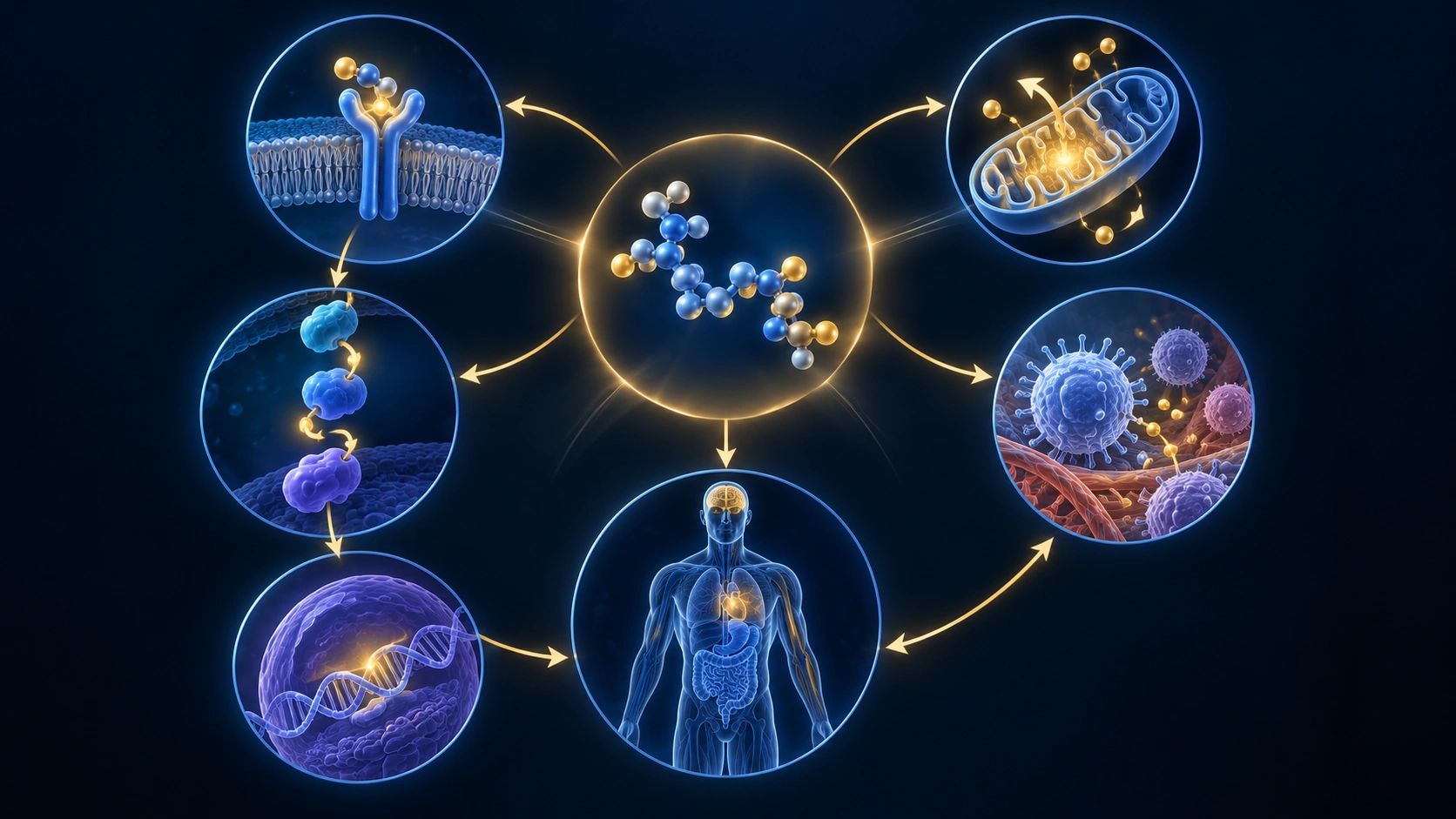
WHAT IS HUMANIN?

HUMANIN

MITOCHONDRIAL RETROGRADE SIGNALING

THE IDENTITY MODEL

Humanin is a:

24-AMINO-ACID PEPTIDE.


It is encoded within a short open reading frame associated with the mitochondrial:

16S rRNA / MT-RNR2 REGION.


That is remarkable.


Traditionally, mitochondrial rRNA genes were thought of primarily as:

STRUCTURAL RNA FOR MITOCHONDRIAL RIBOSOMES.


Humanin showed that a region embedded within mitochondrial RNA-related sequence can also encode:

A BIOLOGICALLY ACTIVE PEPTIDE.


This expanded our understanding of:

WHAT THE MITOCHONDRIAL GENOME CAN DO.


Humanin belongs to a broader family of mitochondrial-derived peptides involved in cellular adaptation and metabolism.

THE IDENTITY MODEL

MITOCHONDRIAL RETROGRADE SIGNALING

THE IDENTITY MODEL

MITOCHONDRIAL GENOME

↓

Short open reading frame

↓

HUMANIN

↓

Acts:

INTRACELLULARLY

and:

EXTRACELLULARLY

↓

Influences:

APOPTOSIS

CELL SURVIVAL

STRESS SIGNALING

METABOLISM

NEUROPROTECTION

↓

Potential:

CELLULAR RESILIENCE


The key idea is:

THE MITOCHONDRION IS NOT ONLY RESPONDING TO STRESS.


It is:

SIGNALING THE REST OF THE CELL ABOUT THE STRESS.

MITOCHONDRIAL RETROGRADE SIGNALING

MITOCHONDRIAL RETROGRADE SIGNALING

MITOCHONDRIAL RETROGRADE SIGNALING

Most people think of cellular signaling as:

NUCLEUS → MITOCHONDRIA.


The nucleus produces proteins.

The mitochondria use them.

But biology also works in the opposite direction.


Mitochondria communicate:

BACK TO THE NUCLEUS

and:

BACK TO THE CELL.


This is called:

MITOCHONDRIAL RETROGRADE SIGNALING.


Humanin is part of that concept.

THE RETROGRADE SIGNALING MODEL

APOPTOSIS — THE CENTRAL HUMANIN STORY

MITOCHONDRIAL RETROGRADE SIGNALING

 MITOCHONDRIAL STRESS

↓

Mitochondrial-derived signal

↓

HUMANIN

↓

Cellular signaling pathways

↓

Potential changes in:

GENE EXPRESSION

METABOLISM

APOPTOSIS

STRESS RESILIENCE

↓

Potential:

CELLULAR ADAPTATION


That makes Humanin a messenger between:

MITOCHONDRIAL STATUS

and:

WHOLE-CELL BEHAVIOR.

APOPTOSIS — THE CENTRAL HUMANIN STORY

APOPTOSIS — THE CENTRAL HUMANIN STORY

APOPTOSIS — THE CENTRAL HUMANIN STORY

One of Humanin's strongest biological identities is:

ANTI-APOPTOTIC CYTOPROTECTION.


Apoptosis is:

PROGRAMMED CELL DEATH.


It is essential.


Cells with:

severe DNA damage 

malignant transformation 

irreparable injury 

may need to:

DIE.


But excessive apoptosis contributes to:

neurodegeneration 

ischemic injury 

metabolic tissue loss 

cardiovascular injury 


Humanin appears to influence:

THE DECISION POINT BETWEEN SURVIVAL AND DEATH.

BAX — A KEY INTRACELLULAR TARGET

APOPTOSIS — THE CENTRAL HUMANIN STORY

APOPTOSIS — THE CENTRAL HUMANIN STORY

One of Humanin's best-characterized intracellular interactions involves:

BAX.


BAX is a member of the:

BCL-2 FAMILY

of apoptosis-regulating proteins.

When sufficiently activated:

BAX

↓

moves toward the mitochondrial membrane

↓

promotes mitochondrial outer-membrane permeabilization

↓

cytochrome c release

↓

caspase activation

↓

APOPTOSIS


Humanin can bind BAX and interfere with this death pathway. It has also been reported to interact with other pro-apoptotic proteins including Bim and tBid. 

THE BAX MODEL

CYTOPROTECTION DOES NOT MEAN “KEEP EVERY CELL ALIVE”

CYTOPROTECTION DOES NOT MEAN “KEEP EVERY CELL ALIVE”

CELLULAR STRESS

↓

BAX activation

↓

Mitochondrial membrane permeabilization

↓

Cytochrome c

↓

Caspases

↓

CELL DEATH

Humanin

↓

Interaction with:

BAX / RELATED PRO-APOPTOTIC SIGNALS

↓

Potential:

APOPTOTIC CASCADE ↓

↓

Potential:

CELL SURVIVAL ↑


This is why Humanin is best understood initially as:

A CYTOPROTECTIVE PEPTIDE.

CYTOPROTECTION DOES NOT MEAN “KEEP EVERY CELL ALIVE”

CYTOPROTECTION DOES NOT MEAN “KEEP EVERY CELL ALIVE”

CYTOPROTECTION DOES NOT MEAN “KEEP EVERY CELL ALIVE”

This distinction is crucial.


If a neuron is under:

REVERSIBLE OXIDATIVE STRESS,

preserving the cell may be desirable.


If a cell is:

IRREVERSIBLY DAMAGED

or:

MALIGNANT,

preventing apoptosis could theoretically have very different consequences.


Again:

CELL SURVIVAL IS NOT AUTOMATICALLY BENEFICIAL.


The correct question is:

WHICH CELL ARE WE PROTECTING — AND WHY IS IT TRYING TO DIE?


This is one of Humanin's most important Praxis lessons.

EXTRACELLULAR HUMANIN SIGNALING

CYTOPROTECTION DOES NOT MEAN “KEEP EVERY CELL ALIVE”

EXTRACELLULAR HUMANIN SIGNALING

Humanin is not limited to:

INTRACELLULAR BAX INTERACTION.


It can also act as a:

SECRETED SIGNAL.


Several extracellular signaling systems have been described.


These include:

FPRL1 / FPR2-related signaling 

a receptor complex involving: 

CNTFR-α 

WSX-1 

gp130 


The latter can activate:

JAK2 / STAT3 SIGNALING. 


This is important because Humanin can therefore influence cells through:

MULTIPLE MECHANISTIC ROUTES.

THE JAK / STAT MODEL

FPRL1 / FPR2 SIGNALING

EXTRACELLULAR HUMANIN SIGNALING

HUMANIN

↓

Receptor complex:

CNTFR-α + WSX-1 + gp130

↓

JAK2

↓

STAT3

↓

Changes in:

CELL SURVIVAL

METABOLIC SIGNALING

STRESS RESPONSE

↓

Potential:

CYTOPROTECTION


Again

Humanin is not just:

A MITOCHONDRIAL BAX BLOCKER.


It also acts as:

AN EXTRACELLULAR SIGNALING PEPTIDE.

FPRL1 / FPR2 SIGNALING

FPRL1 / FPR2 SIGNALING

FPRL1 / FPR2 SIGNALING

Humanin has also been reported to interact with:

FORMYL PEPTIDE RECEPTOR-LIKE SYSTEMS

including:

FPRL1 / FPR2.


These GPCR-related pathways are involved in:

immune signaling 

stress response 

cell migration 

inflammatory biology 


Humanin's use of several signaling systems helps explain why its effects appear across:

MULTIPLE ORGAN SYSTEMS. 


Again:

ONE PEPTIDE DOES NOT NECESSARILY MEAN ONE RECEPTOR.

IGFBP-3

FPRL1 / FPR2 SIGNALING

FPRL1 / FPR2 SIGNALING

Another particularly interesting Humanin interaction involves:

IGFBP-3 — INSULIN-LIKE GROWTH FACTOR BINDING PROTEIN-3.


Humanin binds IGFBP-3 with high affinity.

That interaction links Humanin biology to:

IGF SYSTEMS + CELL SURVIVAL.


An early study demonstrated a specific physical interaction between Humanin and IGFBP-3 and connected that interaction to regulation of:

CELL SURVIVAL AND APOPTOSIS. 


This creates another important network connection:

MITOCHONDRIAL SIGNALING

↔

IGF BIOLOGY

↔

CELL SURVIVAL.

HUMANIN AND IGF-I BIOLOGY

NEUROPROTECTION — WHERE HUMANIN WAS DISCOVERED

NEUROPROTECTION — WHERE HUMANIN WAS DISCOVERED

Humanin and IGF signaling appear to interact in complex ways.

The IGF system influences:

growth 

metabolism 

tissue repair 

aging 


Humanin may modify parts of that system through:

IGFBP-3

and other mechanisms.


This is one reason Humanin has become especially relevant to:

GEROSCIENCE.


Because:

CELL SURVIVAL + METABOLISM + IGF SIGNALING

are all central to aging biology.

NEUROPROTECTION — WHERE HUMANIN WAS DISCOVERED

NEUROPROTECTION — WHERE HUMANIN WAS DISCOVERED

NEUROPROTECTION — WHERE HUMANIN WAS DISCOVERED

Humanin was originally discovered in the context of:

ALZHEIMER'S DISEASE RESEARCH.


The peptide showed protection against neuronal death associated with:

familial Alzheimer-related mutant proteins 

amyloid-beta-related toxicity 


That discovery was important because it suggested:

A MITOCHONDRIALLY DERIVED SIGNAL COULD PROTECT NEURONS FROM DEGENERATIVE STRESS.


This was the beginning of the Humanin field. 

ALZHEIMER'S DISEASE

NEUROPROTECTION — WHERE HUMANIN WAS DISCOVERED

THE ALZHEIMER'S MODEL

Alzheimer's disease involves:

amyloid-beta 

tau 

synaptic dysfunction 

mitochondrial dysfunction 

oxidative stress 

inflammation 

apoptosis 


Humanin intersects especially with:

MITOCHONDRIAL STRESS + APOPTOSIS.


So the conceptual model is not:

“HUMANIN REMOVES ALZHEIMER'S.”


It is:

“CAN A MITOCHONDRIAL SURVIVAL SIGNAL HELP NEURONS RESIST SOME OF THE CELLULAR STRESS CREATED BY ALZHEIMER-TYPE PATHOLOGY?”


That is much more precise.

THE ALZHEIMER'S MODEL

THE ALZHEIMER'S MODEL

THE ALZHEIMER'S MODEL

AMYLOID / TAU / METABOLIC STRESS

↓

Mitochondrial dysfunction

↓

Oxidative stress

↓

BAX / apoptosis signaling

↓

Neuron loss

Humanin

↓

Potential:

CYTOPROTECTION

↓

Potential:

NEURONAL SURVIVAL ↑


Again:

protecting neurons does not automatically:

REMOVE THE PRIMARY PATHOLOGY.


This is:

NEUROPROTECTION

not necessarily:

DISEASE REVERSAL.

HUMANIN VS DIHEXA

THE ALZHEIMER'S MODEL

HUMANIN VS DIHEXA

These two peptides provide a useful contrast.


HUMANIN

Primary concept:

KEEP THE STRESSED NEURON ALIVE.


Mechanisms:

apoptosis regulation 

mitochondrial stress 

JAK/STAT 

BAX 


DIHEXA

Primary concept:

HELP NEURONS BUILD CONNECTIONS.

Mechanisms:

HGF 

c-Met 

synaptogenesis 

dendritic spines 


So:

HUMANIN = CELL SURVIVAL

while:

DIHEXA = NETWORK RECONSTRUCTION


Again:

there is overlap.

But the dominant biology differs.

HUMANIN VS MOTS-c

THE ALZHEIMER'S MODEL

HUMANIN VS DIHEXA

This is another very important comparison.

Both are:

MITOCHONDRIAL-DERIVED PEPTIDES.


But their dominant research identities differ.


MOTS-c

More strongly associated with:

AMPK 

metabolic flexibility 

glucose utilization 

exercise adaptation 

mitochondrial–nuclear signaling 


HUMANIN

More strongly associated with:

cytoprotection 

apoptosis 

neuronal survival 

cardiovascular stress 

insulin action 


So:

MOTS-c = METABOLIC ADAPTATION

while:

HUMANIN = CELLULAR SURVIVAL / STRESS PROTECTION


Again:

same mitochondrial family.


Different:

SIGNALING JOB.

METABOLIC BIOLOGY

THE BRAIN–LIVER METABOLIC AXIS

THE BRAIN–LIVER METABOLIC AXIS

Humanin also has important effects on:

INSULIN SENSITIVITY.


This makes it much more than a neuroprotective peptide.


Experimental studies have shown Humanin-related signaling can improve:

INSULIN ACTION

and influence:

hepatic glucose production 

systemic insulin sensitivity 

glucose homeostasis 


One particularly important study demonstrated that central Humanin signaling increased insulin sensitivity through hypothalamic:

STAT3

and that a potent Humanin analog improved glucose handling in diabetic rodents. 

THE BRAIN–LIVER METABOLIC AXIS

THE BRAIN–LIVER METABOLIC AXIS

THE BRAIN–LIVER METABOLIC AXIS

One of the most interesting findings was that Humanin's effects on hepatic insulin action appeared to depend on:

HYPOTHALAMIC SIGNALING.


That gives us the model:

HUMANIN

↓

Hypothalamic:

STAT3

↓

Neural / endocrine output

↓

LIVER

↓

Hepatic glucose production changes

↓

Potential:

INSULIN SENSITIVITY ↑


This is remarkable because:

A MITOCHONDRIAL PEPTIDE CAN ALTER PERIPHERAL METABOLISM THROUGH THE BRAIN.


Again

physiology is:

NETWORKED.

HUMANIN AND DIABETES

THE BRAIN–LIVER METABOLIC AXIS

HUMANIN AND DIABETES

Humanin has therefore been studied in:

insulin resistance 

type 2 diabetes 

beta-cell stress 

metabolic dysfunction 


A 2022 review summarized Humanin's experimental effects in diabetes-related biology, emphasizing cytoprotection and metabolic regulation while noting that most therapeutic evidence remains preclinical.


This makes Humanin particularly interesting at the intersection of:

METABOLISM + AGING + MITOCHONDRIAL STRESS.

BETA-CELL SURVIVAL

CARDIOVASCULAR BIOLOGY

HUMANIN AND DIABETES

Pancreatic beta cells are vulnerable to:

glucotoxicity 

lipotoxicity 

oxidative stress 

inflammatory damage 


Humanin-related cytoprotection has therefore generated interest in:

PRESERVING BETA-CELL FUNCTION.


That is conceptually important.

Because type 2 diabetes progression is not only:

INSULIN RESISTANCE.


Over time, it can also involve:

BETA-CELL FAILURE.


Again:

METABOLIC SIGNALING + CELL SURVIVAL

are linked.

CARDIOVASCULAR BIOLOGY

CARDIOVASCULAR BIOLOGY

CARDIOVASCULAR BIOLOGY

Humanin has also been extensively studied in:

CARDIOVASCULAR STRESS.


Potential areas include:

endothelial dysfunction 

atherosclerosis 

ischemic injury 

oxidative stress 

vascular aging 


A cardiovascular review describes Humanin as a mitochondrial-derived cytoprotective peptide with potential roles in endothelial function, oxidative stress reduction, metabolism, and cardiovascular disease. 


This makes biological sense.

The vascular system is constantly exposed to:

mechanical stress 

oxidative stress 

metabolic stress 

inflammation 


Humanin appears relevant to:

CELL SURVIVAL UNDER THOSE CONDITIONS.

ENDOTHELIAL FUNCTION

CARDIOVASCULAR BIOLOGY

CARDIOVASCULAR BIOLOGY

The endothelium regulates:

vascular tone 

nitric oxide 

inflammation 

coagulation 

leukocyte trafficking 


Endothelial dysfunction is central to:

hypertension 

atherosclerosis 

insulin resistance 

aging 


Humanin-related research suggests potential:

ENDOTHELIAL CYTOPROTECTION.


Again:

this does not make Humanin simply:

A VASODILATOR.


Its role is more closely related to:

PRESERVING CELLULAR FUNCTION UNDER STRESS.

ISCHEMIA

MITOCHONDRIAL COMPLEX I

OXIDATIVE STRESS

During ischemia:

BLOOD FLOW ↓

↓

OXYGEN ↓

↓

ATP falls

↓

Mitochondrial stress rises

↓

Apoptosis / necrosis pathways activate


A peptide that reduces inappropriate apoptosis could potentially help preserve:

BORDERLINE-VIABLE CELLS.


That makes Humanin mechanistically interesting in:

brain ischemia 

cardiac ischemia 

vascular stress 


Again

it does not replace:

RESTORING BLOOD FLOW.

OXIDATIVE STRESS

MITOCHONDRIAL COMPLEX I

OXIDATIVE STRESS

Humanin is frequently described as:

ANTIOXIDANT.


But that description can be misleading.

It may not simply behave like:

A FREE-RADICAL SCAVENGER.


Instead, Humanin appears to influence:

mitochondrial function 

stress signaling 

apoptosis 

endogenous protective pathways 


So a better description is:

REDOX-RESPONSIVE CYTOPROTECTION.


That is different from:

“TAKE HUMANIN TO NEUTRALIZE ROS.”

MITOCHONDRIAL COMPLEX I

MITOCHONDRIAL COMPLEX I

MITOCHONDRIAL COMPLEX I

Some Humanin cardiovascular literature has described modulation of:

MITOCHONDRIAL COMPLEX I

with downstream effects on oxidative stress. 


That is interesting because Complex I is a major site of:

MITOCHONDRIAL ELECTRON FLOW

and potential:

ROS GENERATION.


Again

Humanin may influence the mitochondrion both as:

A SIGNAL FROM MITOCHONDRIA

and through effects that feed back into:

MITOCHONDRIAL FUNCTION.

AGING

HIGH SIGNAL ≠ BETTER HEALTH

MITOCHONDRIAL COMPLEX I

Humanin has become especially important in:

AGING BIOLOGY.


Why?

Because aging is associated with:

mitochondrial dysfunction 

reduced stress resilience 

insulin resistance 

vascular dysfunction 

neurodegeneration 

altered apoptosis 

cellular senescence 


Humanin sits at the center of several of these.


A systematic review describes Humanin as a mitochondrial-derived cytoprotective peptide with relevance to age-related processes and diseases including neurodegeneration, cardiovascular disease, and cancer biology.

HUMANIN LEVELS AND AGE

HIGH SIGNAL ≠ BETTER HEALTH

HIGH SIGNAL ≠ BETTER HEALTH

A particularly interesting observation is that circulating Humanin levels have been reported to:

DECLINE WITH AGE

in human and animal studies.


The same experimental work found age-associated decreases in Humanin within selected rodent tissues and circulation.


That creates an appealing hypothesis:

AGING

↓

Humanin signaling ↓

↓

Stress resilience ↓

↓

Greater susceptibility to:

insulin resistance 

neurodegeneration 

vascular dysfunction 


But we must distinguish:

ASSOCIATION

from:

CAUSATION.


Lower Humanin may contribute to aging.


Or it may simply reflect:

AGING BIOLOGY.


That question remains open.

HIGH SIGNAL ≠ BETTER HEALTH

HIGH SIGNAL ≠ BETTER HEALTH

HIGH SIGNAL ≠ BETTER HEALTH


As with MOTS-c:

Humanin concentration should not be interpreted simplistically.

A higher peptide level could mean:

BETTER PROTECTIVE CAPACITY.

Or:

MORE CELLULAR STRESS IS DRIVING COMPENSATORY RELEASE.

So:

HUMANIN LEVEL

does not automatically equal:

HUMANIN FUNCTION.

This is especially important if Humanin is ever used as:

A BIOMARKER.

LONGEVITY BIOLOGY

HUMANIN ANALOGS — HNG

HUMANIN ANALOGS — HNG

Humanin is often discussed as:

A LONGEVITY PEPTIDE.


There is a mechanistic basis for interest.

If a peptide supports:

metabolic health 

neuronal survival 

vascular resilience 

mitochondrial stress resistance 

then it could plausibly influence:

HEALTHSPAN.


But that does not establish:

HUMAN LIFESPAN EXTENSION.


The more defensible framing is:

HUMANIN PARTICIPATES IN BIOLOGICAL PROCESSES THAT DETERIORATE WITH AGE.


That is already very interesting.

HUMANIN ANALOGS — HNG

HUMANIN ANALOGS — HNG

HUMANIN ANALOGS — HNG

Much Humanin research has used:

MORE POTENT ANALOGS.


One of the best known is:

S14G-HUMANIN

often abbreviated:

HNG.


This single amino-acid substitution produces substantially greater activity in many experimental systems.


That distinction matters.

A finding from:

HNG

should not automatically be attributed quantitatively to:

NATIVE HUMANIN.


Again:

ANALOG EVIDENCE ≠ PARENT-PEPTIDE EVIDENCE.


This is a core PPI principle.

WHY ANALOGS MATTER

HUMANIN ANALOGS — HNG

CANCER — A BIOLOGICALLY COMPLEX AREA

Native peptides may have limitations involving:

stability 

half-life 

potency 

tissue exposure 


Analog design can improve:

PHARMACOLOGY.


But changing the sequence may also alter:

TARGET SELECTIVITY + DISTRIBUTION + RISK.


So when reading Humanin studies, always ask:

WAS THIS HUMANIN OR A HUMANIN ANALOG?


That one question can dramatically change interpretation.

CANCER — A BIOLOGICALLY COMPLEX AREA

CANCER — A BIOLOGICALLY COMPLEX AREA

CANCER — A BIOLOGICALLY COMPLEX AREA

Humanin's cancer biology is especially nuanced.


Because Humanin is:

ANTI-APOPTOTIC,

a reasonable concern is:

COULD IT HELP ABNORMAL CELLS SURVIVE?


That is not a trivial question.


Reviews specifically note controversy over Humanin's role in:

cancer progression 

apoptosis 

chemoresistance 

and emphasize that this issue needs resolution before broad therapeutic translation. 


Again

this does not mean:

HUMANIN CAUSES CANCER.


It means:

CYTOPROTECTION HAS DIFFERENT MEANINGS IN HEALTHY AND MALIGNANT CELLS.

THE CANCER CONTEXT MODEL

CANCER — A BIOLOGICALLY COMPLEX AREA

CYTOPROTECTION VS CANCER SUPPRESSION

Healthy neuron under stress:

APOPTOSIS SIGNAL ↑

↓

Humanin

↓

Potential:

CELL SURVIVES

Potentially desirable.


Now:

Malignant cell under chemotherapy:

APOPTOSIS SIGNAL ↑

↓

If Humanin prevents that cell from dying:

potentially:

UNDESIRABLE.


Same anti-apoptotic mechanism.

Different cell.

Different clinical meaning.


This is:

MECHANISM-BASED RISK ANALYSIS.

CYTOPROTECTION VS CANCER SUPPRESSION

CANCER — A BIOLOGICALLY COMPLEX AREA

CYTOPROTECTION VS CANCER SUPPRESSION

This is the deeper biological tradeoff.

The body needs:

CELL SURVIVAL

but also:

DAMAGED-CELL ELIMINATION.


Too much apoptosis:

↓

degeneration.

Too little apoptosis:

↓

abnormal cells may persist.


So Humanin sits near one of biology's fundamental balances:

PRESERVE

versus:

REMOVE.


That makes context:

ESSENTIAL.

MALE REPRODUCTIVE BIOLOGY

MALE REPRODUCTIVE BIOLOGY

MALE REPRODUCTIVE BIOLOGY

Humanin has also been studied in:

testicular function 

germ-cell survival 

male infertility 


This fits its broader:

CYTOPROTECTIVE IDENTITY.


Germ cells undergo tightly regulated apoptosis.


Humanin interactions with:

IGFBP-3

have also been demonstrated in reproductive tissue. 


Again:

same survival pathway.

Different organ.

BONE BIOLOGY

MALE REPRODUCTIVE BIOLOGY

MALE REPRODUCTIVE BIOLOGY

Humanin research also extends into:

BONE AND SKELETAL BIOLOGY.


This may involve:

osteoblast survival 

age-related bone loss 

oxidative stress 

cellular apoptosis 


A 2022 review summarized potential roles of Humanin in both neural and skeletal disease and tissue regeneration. 


This reinforces that Humanin's real identity is not:

ORGAN-SPECIFIC.


It is:

STRESS-SURVIVAL SPECIFIC.

THE CORE MECHANISM MAP

MITOCHONDRIAL STRESS

↓

HUMANIN

↓

INTRACELLULAR

BAX / BIM / tBID

↓

Apoptosis signaling ↓

and:

EXTRACELLULAR

CNTFR-α / WSX-1 / gp130

↓

JAK2 / STAT3

plus:

FPRL-RELATED SIGNALING

↓

Potential:

  • CELL SURVIVAL
  • METABOLIC REGULATION
  • STRESS RESILIENCE

↓

Potential effects across:

  • BRAIN
  • VASCULAR SYSTEM
  • METABOLISM
  • AGING TISSUES

The core concept is:

  • HUMANIN HELPS TRANSLATE MITOCHONDRIAL STRESS INTO A CELL-SURVIVAL RESPONSE.


WHAT THIS MECHANISM MAY SUGGEST

Mechanistically, Humanin deserves research interest in:

  • neurodegenerative disease 
  • Alzheimer's-related neuronal stress 
  • ischemic injury 
  • cardiovascular disease 
  • endothelial dysfunction 
  • insulin resistance 
  • type 2 diabetes 
  • beta-cell stress 
  • age-related cellular dysfunction 
  • mitochondrial stress disorders 
  • selected reproductive disorders 
  • tissue preservation 

Its strongest conceptual niche may be:

  • A CELL THAT IS UNDER SERIOUS STRESS BUT STILL WORTH SAVING.

That is the Humanin problem.

WHAT THIS MECHANISM DOES NOT PROVE

Humanin biology does not prove that it:

  • reverses Alzheimer's disease 
  • prevents all age-related disease 
  • extends human lifespan 
  • cures diabetes 
  • reverses cardiovascular disease 
  • repairs dead tissue 
  • should suppress apoptosis in every setting 
  • is automatically beneficial in cancer 
  • should be increased whenever mitochondrial stress is present 
  • behaves identically to HNG or other analogs 
  • can be interpreted from one circulating Humanin measurement 

Again:

  • CYTOPROTECTION ≠ UNIVERSAL BENEFIT.

The biological question is always:

  • WHICH CELL ARE WE PROTECTING?

THE EVIDENCE, POTENTIAL APPLICATIONS, AND LIMITATIONS

ENDOGENOUS PHYSIOLOGY

STRONG

Humanin is a recognized mitochondrial-derived peptide with:

intracellular actions 

circulating presence 

autocrine / paracrine / endocrine effects 

and a substantial mechanistic literature. 

MECHANISTIC EVIDENCE

SUBSTANTIAL

Humanin has characterized interactions involving:

  • BAX 
  • Bim 
  • tBid 
  • IGFBP-3 
  • FPR-related receptors 
  • CNTFR-α / gp130 / WSX-1 
  • JAK2 / STAT3 

This provides an unusually broad but coherent:

  • CYTOPROTECTIVE SIGNALING NETWORK.

PRECLINICAL EVIDENCE

SUBSTANTIAL

Experimental research spans:

  • Alzheimer's disease 
  • stroke 
  • cardiovascular disease 
  • diabetes 
  • infertility 
  • bone biology 
  • oxidative stress 
  • aging 

Much of the therapeutic development remains in:

  • CELLULAR + ANIMAL MODELS.

HUMAN EVIDENCE

BIOLOGICALLY RELEVANT BUT THERAPEUTICALLY EARLY

Humanin is measurable in humans and has been associated with:

  • age 
  • metabolic status 
  • disease states 

But direct large-scale therapeutic trials of exogenous Humanin or Humanin analogs remain much less developed than:

  • THE PRECLINICAL BIOLOGY.

That is the appropriate evidence calibration.

Research

ALZHEIMER’S DISEASE

NEURODEGENERATIVE DISEASE

NEURODEGENERATIVE DISEASE

This is historically the foundational Humanin domain.


Humanin was identified because of its capacity to protect neurons from:

ALZHEIMER-RELATED CYTOTOXIC STRESS. 


This includes experimental protection against:

amyloid-related toxicity 

familial Alzheimer-related cellular stress 

apoptosis 


The important question is:

CAN NEURONS REMAIN FUNCTIONAL LONGER IF THE CELL-DEATH SIGNAL IS REDUCED?


That is different from:

REMOVING AMYLOID OR TAU.

NEURODEGENERATIVE DISEASE

NEURODEGENERATIVE DISEASE

NEURODEGENERATIVE DISEASE

Humanin has also been explored more broadly in:

Parkinsonian models 

Huntington-related biology 

age-related neuronal stress 


A recent 2025 review of mitochondrial-derived peptides again highlighted Humanin among the MDPs with neuroprotective potential across neurodegenerative disease models. 


Again

the shared denominator is:

MITOCHONDRIAL STRESS + CELL SURVIVAL.

TYPE 2 DIABETES

NEURODEGENERATIVE DISEASE

TYPE 2 DIABETES

Humanin's insulin-related effects are particularly interesting.


A major experimental study demonstrated:

IMPROVED INSULIN ACTION

through central:

STAT3 SIGNALING. 


This raises the possibility that Humanin participates in:

THE NEUROENDOCRINE REGULATION OF METABOLISM.


Again

the brain is not simply:

A GLUCOSE CONSUMER.


It is:

A METABOLIC CONTROLLER.

METABOLIC AGING

CARDIOVASCULAR DISEASE

TYPE 2 DIABETES

Insulin sensitivity commonly declines with:

AGE.


Humanin levels also appear to change with:

AGE. 


That creates a fascinating research question:

IS DECLINING HUMANIN SIGNALING ONE REASON OLDER CELLS BECOME LESS RESILIENT TO METABOLIC STRESS?


This is plausible.


But not yet:

PROVEN AS A HUMAN CAUSAL PATHWAY.

CARDIOVASCULAR DISEASE

CARDIOVASCULAR DISEASE

CARDIOVASCULAR DISEASE

Humanin research in cardiovascular disease includes:

endothelial protection 

oxidative stress 

ischemic injury 

vascular dysfunction 


The central concept remains:

PRESERVE STRESSED CELLS BEFORE THEY CROSS THE POINT OF IRREVERSIBLE DAMAGE. 


Again

vascular protection is not necessarily:

DIRECT VASODILATION.


It may instead involve:

CELLULAR RESILIENCE.

ISCHEMIA / REPERFUSION

CARDIOVASCULAR DISEASE

CARDIOVASCULAR DISEASE

Reperfusion is essential after ischemia.


But restoring oxygen can also generate:

REACTIVE OXYGEN SPECIES.


That creates:

ISCHEMIA-REPERFUSION INJURY.


Humanin's mitochondrial and anti-apoptotic biology therefore makes it mechanistically interesting during:

THE SECONDARY INJURY PHASE.


Again:

this is adjunctive biology.


Not:

A SUBSTITUTE FOR REPERFUSION.

AGING

CANCER AND CHEMORESISTANCE

CANCER AND CHEMORESISTANCE

Humanin may eventually prove especially relevant to:

HEALTHSPAN.


Why?


Because many major age-related diseases share:

CELLULAR STRESS + MITOCHONDRIAL DYSFUNCTION + APOPTOSIS.


Humanin may act as:

A COMMON RESILIENCE SIGNAL

across those different diseases.


That is conceptually powerful.


But:

SHARED MECHANISM ≠ UNIVERSAL THERAPY.

CANCER AND CHEMORESISTANCE

CANCER AND CHEMORESISTANCE

CANCER AND CHEMORESISTANCE

This is an area where Humanin deserves especially careful research.


If malignant cells use Humanin-related pathways to resist:

APOPTOSIS,

that could theoretically affect:

TUMOR SURVIVAL OR TREATMENT RESPONSE.


Reviews specifically identify cancer progression and chemoresistance as unresolved translational issues. 


Again

do not convert this into:

“HUMANIN FEEDS CANCER.”


The scientific question is:

DOES HUMANIN SIGNALING PROTECT SOME MALIGNANT CELLS UNDER CERTAIN CONDITIONS?


That is testable.


And much more precise.

WHAT WE KNOW

CANCER AND CHEMORESISTANCE

WHAT WE THINK MAY BE HAPPENING

Humanin is a 24-amino-acid mitochondrial-derived peptide. 


It is encoded within mitochondrial-genome-associated sequence and represents one of the earliest characterized mitochondrial-derived peptides. 


Humanin is strongly cytoprotective in experimental systems.


One of its central intracellular mechanisms involves binding to BAX and interfering with apoptosis. 


Humanin also interacts with Bim and tBid. 

It can act extracellularly through receptor systems including CNTFR-α/gp130/WSX-1 and activate JAK2/STAT3 signaling. 


Humanin also interacts with FPR-related receptor systems. 


Humanin binds IGFBP-3 and thereby connects mitochondrial-derived signaling with IGF-related cell-survival biology. 


Humanin was originally characterized through Alzheimer-related neuroprotection.


Its research has expanded into cardiovascular disease, diabetes, infertility, skeletal biology, and aging. 


Experimental Humanin signaling can improve insulin sensitivity through hypothalamic STAT3 pathways. 


Circulating Humanin has been reported to decline with age in humans and animal models. 


Humanin analogs such as HNG are frequently used experimentally and should not be assumed to have identical potency or pharmacology to native Humanin.


Cancer biology remains context dependent because the same anti-apoptotic property that protects healthy stressed cells could have different consequences in malignant cells. 


Direct modern human therapeutic efficacy remains less established than the mechanistic and preclinical evidence base.

WHAT WE THINK MAY BE HAPPENING

WHAT WE THINK MAY BE HAPPENING

WHAT WE THINK MAY BE HAPPENING

Humanin may function as:

A MITOCHONDRIAL DISTRESS SIGNAL THAT TELLS THE CELL NOT TO GIVE UP TOO EARLY.


The cell encounters:

METABOLIC / OXIDATIVE / TOXIC / DEGENERATIVE STRESS

↓

Mitochondrial integrity worsens.

↓

BAX and related death pathways activate.

↓

Cell moves toward:

APOPTOSIS.


Humanin

↓

Potential:

BAX / PRO-APOPTOTIC SIGNALING ↓

plus:

JAK / STAT SURVIVAL SIGNALING ↑

↓

The cell receives:

MORE TIME TO RECOVER.

If the stress resolves:

↓

Potential:

FUNCTION RESTORED.


If the damage is irreversible:

the cell may still ultimately:

FAIL.


This may be Humanin's deeper role.


Not:

MAKE CELLS IMMORTAL.

But:

RAISE THE THRESHOLD FOR STRESS-INDUCED CELL DEATH.


That is a much more useful concept.

WHAT REMAINS CONTEXT-DEPENDENT

WHAT WE THINK MAY BE HAPPENING

WHAT REMAINS CONTEXT-DEPENDENT

Important questions include:

What tissues produce the most Humanin under physiological conditions? 

How much Humanin is mitochondrial versus nuclear in origin? 

What controls Humanin synthesis? 

How is Humanin released? 

What determines circulating Humanin concentration? 

Which receptor system dominates in different tissues? 

How much of its biology is intracellular versus extracellular? 

How important is BAX inhibition in humans? 

Which effects depend on JAK2/STAT3? 

Which disease phenotypes respond best to Humanin analogs? 

How much Humanin reaches the human CNS after exogenous administration? 

What is the optimal duration of cytoprotective signaling? 

Does chronic Humanin exposure alter normal apoptotic surveillance? 

Which cancers use Humanin signaling? 

Does Humanin meaningfully alter chemoresistance? 

How should malignancy history influence risk assessment? 

Which Humanin analog provides the best therapeutic index? 

How do native Humanin and HNG differ clinically? 

Can circulating Humanin become a useful mitochondrial-resilience biomarker? 

Is low Humanin a cause of age-related dysfunction or a consequence? 

Can restoring Humanin signaling improve healthspan? 

Which objective biomarkers best indicate meaningful cellular rescue? 


Again:

these questions define the transition from:

MITOCHONDRIAL PEPTIDE BIOLOGY

to:

CLINICAL MITOCHONDRIAL MEDICINE.

THE PRAXIS LENS

DO NOT BEGIN WITH HUMANIN

Begin with: WHY IS THIS CELL OR TISSUE UNDER ENOUGH STRESS TO ACTIVATE A DEATH PROGRAM?                 

Then:

PHYSIOLOGY

↓

PATTERN

↓

MECHANISM

↓

EVIDENCE

↓

RISK

↓

MONITORING

↓

DECISION

PHYSIOLOGY

Healthy cells constantly balance:

STRESS

↓

ADAPTATION

or:

REPAIR

or:

APOPTOSIS.

Humanin appears especially relevant to:

  • THE DECISION BETWEEN REPAIR AND CELL DEATH.

EVIDENCE

Ask:

WHICH HUMANIN ARE WE DISCUSSING?

Native Humanin?

HNG?

Another analog?

Then:

what evidence?

  • endogenous physiology? 
  • cell model? 
  • animal model? 
  • human association? 
  • human therapeutic trial? 

Again:

  • ANALOG EVIDENCE MUST NOT AUTOMATICALLY BECOME NATIVE-PEPTIDE EVIDENCE.

PATTERN

What is actually present?

  • neurodegenerative stress? 
  • metabolic dysfunction? 
  • ischemia? 
  • vascular injury? 
  • mitochondrial dysfunction? 
  • age-related cellular decline? 
  • active malignancy? 
  • healthy aging? 

Again:

  • “MITOCHONDRIAL DYSFUNCTION” IS NOT ONE PATTERN.

RISK

Potential considerations include:

  • inappropriate suppression of apoptosis 
  • proliferative or malignant context 
  • uncertain long-term human exposure 
  • differences between Humanin and potent analogs 
  • product identity and purity 
  • missing the primary driver of tissue injury 
  • assuming biochemical cytoprotection means disease modification 

Again

the mechanism itself tells us where to look:

  • CELL SURVIVAL.

MECHANISM

Does Humanin biology match:

  • THE DOMINANT BOTTLENECK?

If cells are dying because:

  • BLOOD FLOW IS ABSENT,

restore:

  • PERFUSION.

If beta cells are stressed because:

  • SEVERE GLUCOTOXICITY CONTINUES,

correct:

  • THE METABOLIC ENVIRONMENT.

If neurons are exposed to ongoing:

  • NEURODEGENERATIVE STRESS,

cytoprotection becomes:

  • MORE MECHANISTICALLY INTERESTING.

But always ask:

  • SHOULD THIS CELL BE SAVED?

That question is especially important with Humanin.

MONITORING

Monitoring should follow:

  • THE TISSUE BEING PROTECTED.

NEUROLOGICAL

  • cognition 
  • memory 
  • neurological function 
  • disease-specific testing 

METABOLIC

  • fasting glucose 
  • insulin 
  • HbA1c 
  • glucose tolerance 
  • metabolic function 

CARDIOVASCULAR

  • blood pressure 
  • endothelial / vascular function where appropriate 
  • exercise capacity 
  • disease-specific markers 

AGING / RESILIENCE

  • functional capacity 
  • metabolic health 
  • cognition 
  • cardiovascular fitness 
  • body composition 

PROLIFERATIVE CONTEXT

appropriate:

  • DISEASE-SPECIFIC SURVEILLANCE

rather than assuming:

  • ONE GENERAL “CANCER MARKER.”

Again

monitor:

  • THE BIOLOGICAL SYSTEM HUMANIN IS SUPPOSED TO PROTECT.
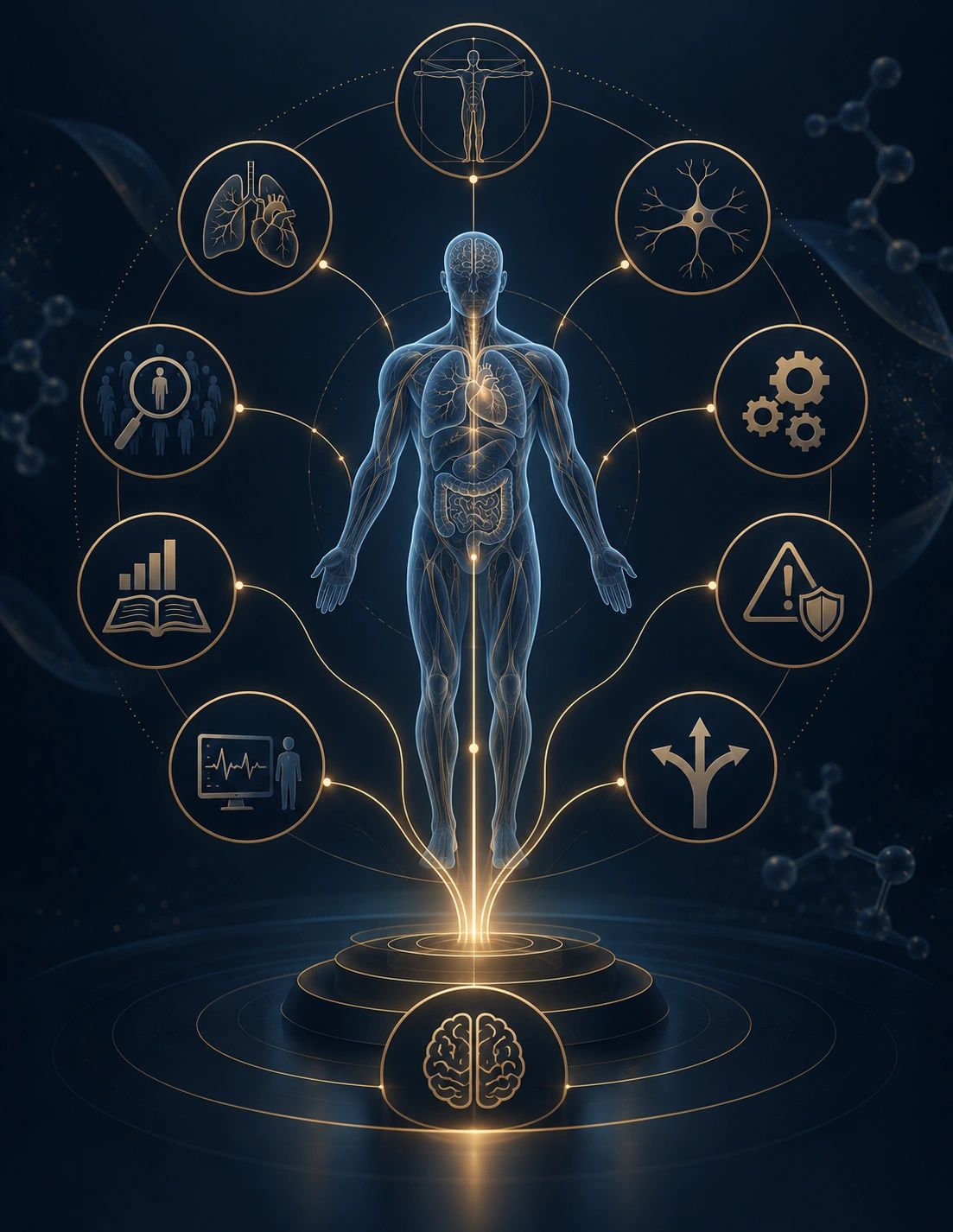
THE PRAXIS 5
MECHANISM

Humanin's strongest mechanistic identity is:

  • MITOCHONDRIAL STRESS SIGNALING + ANTI-APOPTOTIC CYTOPROTECTION.

Key pathways include:

  • BAX / BCL-2 FAMILY + JAK2 / STAT3 + RECEPTOR-MEDIATED SURVIVAL SIGNALING.

EVIDENCE

Endogenous physiology:

  • MEANINGFUL.

Mechanistic evidence:

  • SUBSTANTIAL.

Preclinical disease evidence:

  • SUBSTANTIAL.

Human biomarker / association evidence:

  • PRESENT.

Direct human therapeutic evidence:

  • LESS DEVELOPED.

That is the appropriate calibration.

RISK

The biggest conceptual mistake is:

  • ASSUMING CELL SURVIVAL IS ALWAYS DESIRABLE.

Sometimes the correct biological outcome is:

  • REPAIR.

Sometimes it is:

  • APOPTOSIS.

Humanin sits:

  • AT THAT DECISION POINT.

MONITORING

Monitor:

  • THE FUNCTION OF THE TISSUE BEING PRESERVED + THE DRIVER OF THE STRESS.

If the hypothesis is:

  • BETTER CELLULAR RESILIENCE,

then:

  • THE TISSUE SHOULD FUNCTION BETTER UNDER THE SAME OR REDUCED STRESS LOAD.

PATIENT CONTEXT

A neuron under:

  • REVERSIBLE OXIDATIVE STRESS

is not identical to

a cell with:

  • MALIGNANT TRANSFORMATION.

A patient with:

  • INSULIN RESISTANCE

is not identical to

someone with:

  • NORMAL METABOLISM SEEKING LONGEVITY.

A patient with:

  • EARLY NEURODEGENERATIVE STRESS

is not identical to

someone with:

  • IRREVERSIBLE NEURONAL LOSS.

Same peptide.

Different:

  • CELLULAR CONTEXT.

SEVEN QUESTIONS TO ASK BEFORE HUMANIN

1. WHAT CELL OR TISSUE ARE WE TRYING TO PROTECT?

  • neuron? 
  • endothelium? 
  • beta cell? 
  • myocardium? 
  • something else? 

2. WHY IS THAT CELL UNDER STRESS?

  • oxidative? 
  • metabolic? 
  • ischemic? 
  • toxic? 
  • neurodegenerative? 
  • inflammatory? 

3. IS APOPTOSIS PART OF THE ACTUAL BOTTLENECK?

If not:

Humanin may not be addressing:

  • THE PRIMARY FAILURE.

4. IS THE CELL WE ARE PROTECTING A CELL THAT SHOULD SURVIVE?

This question is critical when manipulating:

  • ANTI-APOPTOTIC BIOLOGY.

5. WHAT FORM OF HUMANIN EVIDENCE ARE WE USING?

  • native Humanin? 
  • HNG? 
  • another analog? 
  • cell culture? 
  • animal? 
  • human? 

6. WHAT WILL WE MONITOR?

  • cognition? 
  • glucose? 
  • vascular function? 
  • tissue-specific recovery? 
  • disease trajectory? 

7. WHAT WOULD DEFINE SUCCESS?

Not:

  • “HUMANIN WENT UP.”

But:

  • THE TARGET TISSUE BECAME MORE RESILIENT, FUNCTION IMPROVED, AND CELL SURVIVAL OCCURRED IN A BIOLOGICALLY APPROPRIATE CONTEXT.

HUMANIN

KEY TAKEAWAYS

  • Humanin is a 24-amino-acid mitochondrial-derived peptide.
  • It helped establish the concept that mitochondria produce signaling peptides rather than functioning only as energy-generating organelles. 
  • Humanin is best understood as a mitochondrial stress and cytoprotection signal.
  • Its strongest mechanistic theme is regulation of apoptosis.
  • Humanin can interact directly with BAX and other pro-apoptotic BCL-2-family proteins. 
  • This can reduce progression toward mitochondrial apoptosis in experimental systems.
  • Humanin also acts extracellularly.
  • A receptor complex involving CNTFR-α, WSX-1, and gp130 can activate JAK2/STAT3 signaling. 
  • Humanin also interacts with FPR-related signaling systems.
  • It binds IGFBP-3, connecting mitochondrial-derived signaling with IGF-related cell-survival biology. 
  • Humanin was discovered through Alzheimer-related neuroprotection.
  • Its research now extends far beyond the brain.
  • Experimental studies involve metabolic disease, cardiovascular stress, infertility, skeletal biology, and aging. 
  • Humanin can influence systemic insulin sensitivity through hypothalamic STAT3 signaling in experimental models. 
  • That means mitochondrial peptides can influence whole-body metabolism through brain signaling.
  • Humanin has also been associated with endothelial and cardiovascular protection. 
  • Circulating Humanin has been reported to decline with age. 
  • That makes it interesting in geroscience but does not prove that low Humanin causes aging.
  • Humanin and MOTS-c are both mitochondrial-derived peptides but should not be treated as interchangeable.
  • MOTS-c is more strongly centered on metabolic adaptation and AMPK-related physiology.
  • Humanin is more strongly centered on cytoprotection and apoptosis.
  • Humanin analogs such as HNG may be substantially more potent than native Humanin.
  • Evidence from an analog should not automatically be transferred quantitatively to the parent peptide.
  • Humanin's anti-apoptotic biology creates both therapeutic promise and an important biological question.
  • Saving a stressed neuron may be beneficial.
  • Saving a malignant cell from therapy-induced apoptosis could mean something entirely different.
  • Cancer-related concerns should therefore be framed as a cell-context question rather than the unsupported statement that Humanin causes cancer. 
  • The strongest evidence for Humanin remains mechanistic and preclinical.
  • Human physiological relevance is real.
  • Direct human therapeutic translation remains earlier.
  • The best question is not “is Humanin a longevity peptide?”
  • The better question is “which cells are under stress, why are they moving toward apoptosis, is that death response premature or biologically appropriate, does Humanin's mitochondrial survival signaling address the actual bottleneck, and can cellular rescue translate into preserved tissue function without protecting a cell that should instead be eliminated?”

THE BOTTOM LINE

Humanin may represent one of the deepest concepts in mitochondrial medicine:

  • THE MITOCHONDRION CAN ASK THE CELL FOR HELP.

We once thought mitochondria mostly:

  • MADE ATP.

But Humanin helped reveal a different system:

MITOCHONDRIAL STRESS

↓

MITOCHONDRIAL SIGNALING

↓

WHOLE-CELL ADAPTATION.

The cell encounters:

  • STRESS.

The mitochondria begin to fail.

BAX activates.

Apoptosis approaches.

Then Humanin-related biology may say:

NOT YET.

↓

Suppress part of the death program.

↓

Activate survival signaling.

↓

Give the cell:

  • TIME TO RECOVER.

That is an extraordinary biological idea.

And it explains why Humanin research appears in:

  • ALZHEIMER'S DISEASE
  • DIABETES
  • CARDIOVASCULAR DISEASE
  • AGING
  • INFERTILITY
  • ISCHEMIC INJURY.

Those diseases look very different clinically.

But at the cellular level they can share:

MITOCHONDRIAL STRESS

↓

APOPTOTIC PRESSURE

↓

LOSS OF FUNCTIONAL CELLS.

Humanin potentially acts at:

THAT SHARED NODE.

But there is also a crucial second half to the story.

The body evolved apoptosis:

  • FOR A REASON.

Sometimes a damaged cell should be:

  • SAVED.

Sometimes it should be:

  • REMOVED.

That is why the correct Humanin question cannot simply be:

  • “HOW DO WE STOP CELL DEATH?”

It must be:

  • “IS THIS CELL DYING TOO SOON — OR IS THIS CELL SUPPOSED TO DIE?”

That question separates:

  • CYTOPROTECTION

from:

  • BIOLOGICAL INTERFERENCE.

So the Praxis question becomes:

  • “WHAT is driving cellular stress, is mitochondrial dysfunction pushing a recoverable cell prematurely toward apoptosis, does Humanin's BAX/JAK-STAT cytoprotective biology meaningfully address that failed survival threshold, is the cell biologically appropriate to preserve, and what objective tissue-level function will prove that preventing cell death actually improved the system?”

That is the difference between:

  • CALLING HUMANIN AN ANTI-AGING PEPTIDE

and:

  • UNDERSTANDING MITOCHONDRIAL SURVIVAL SIGNALING.


STOP MEMORIZING PEPTIDES. START UNDERSTANDING THE SYSTEM.

           Praxis Peptide Institute provides educational information and is not a substitute for individualized medical diagnosis or treatment. Humanin is an endogenous mitochondrial-derived peptide studied for cytoprotective, anti-apoptotic, neuroprotective, metabolic, cardiovascular, and aging-related effects. Its relevance depends on the cell and tissue being targeted, the cause and reversibility of the cellular stress, metabolic and vascular context, proliferative and malignancy context, whether native Humanin or a more potent analog is being considered, route and product identity, concurrent therapies, and the objective functional outcome being targeted. Because Humanin acts near fundamental cell-survival and apoptosis pathways, mechanistic context is especially important when distinguishing desirable protection of recoverable tissue from inappropriate preservation of cells that should undergo programmed cell death. 

Copyright © 2026 Praxis Peptide Institute - All Rights Reserved.

Powered by

This website uses cookies.

We use cookies to analyze website traffic and optimize your website experience. By accepting our use of cookies, your data will be aggregated with all other user data.

Accept