Clinical Peptide Medicine — Structured. Applied. Evolving.

Praxis Peptide Institute
  • HOME
  • START HERE
  • LEARN
  • PEPTIDE GUIDES
  • PEP EXPERIENCE REGISTRY
  • EXPLORE REGISTRY
  • ADVANCED LEARNER TRAINING
  • CLINICIAN TRAINING
  • ABOUT
  • More
    • HOME
    • START HERE
    • LEARN
    • PEPTIDE GUIDES
    • PEP EXPERIENCE REGISTRY
    • EXPLORE REGISTRY
    • ADVANCED LEARNER TRAINING
    • CLINICIAN TRAINING
    • ABOUT
  • Sign In
  • Create Account

  • My Account
  • Signed in as:

  • filler@godaddy.com


  • My Account
  • Sign out

Signed in as:

filler@godaddy.com

  • HOME
  • START HERE
  • LEARN
  • PEPTIDE GUIDES
  • PEP EXPERIENCE REGISTRY
  • EXPLORE REGISTRY
  • ADVANCED LEARNER TRAINING
  • CLINICIAN TRAINING
  • ABOUT

Account

  • My Account
  • Sign out

  • Sign In
  • My Account

GHK-Cu Guide: Copper Peptide Biology, Skin Repair, Collagen, Tissue Remodeling, and the Praxis Lens

 A comprehensive GHK-Cu guide covering copper-peptide biology, collagen remodeling, wound repair, angiogenesis, antioxidant signaling, skin and hair research, tissue regeneration, evidence, monitoring, and the Praxis clinical reasoning framework. 

UNDERSTAND THE PEPTIDE

GHK-Cu is a naturally occurring copper-binding tripeptide composed of glycine, histidine, and lysine complexed with copper.

It is one of the more biologically interesting repair-associated peptides because it sits at the intersection of:

  • copper transport 
  • collagen remodeling 
  • extracellular-matrix biology 
  • wound repair 
  • angiogenesis 
  • antioxidant defense 
  • inflammatory regulation 
  • skin regeneration 
  • hair-follicle biology 
  • gene-expression signaling 

GHK itself is:

  • GLYCYL-L-HISTIDYL-L-LYSINE

and when bound to copper:

  • GHK-Cu

forms a biologically active complex.

The important point is that GHK-Cu is not simply:

  • “A COLLAGEN PEPTIDE.”

It appears to function more broadly as:

  • A REPAIR-COORDINATION SIGNAL THAT USES COPPER AS PART OF ITS BIOLOGICAL ACTIVITY.

That matters because copper is required for multiple enzymes involved in:

  • connective tissue 
  • antioxidant defense 
  • pigmentation 
  • mitochondrial metabolism 
  • iron handling 
  • vascular biology 

So when GHK binds copper, the molecule becomes part peptide signal and part:

  • TRACE-METAL DELIVERY SYSTEM.

This makes GHK-Cu biologically different from a peptide whose action is explained by one receptor alone. 
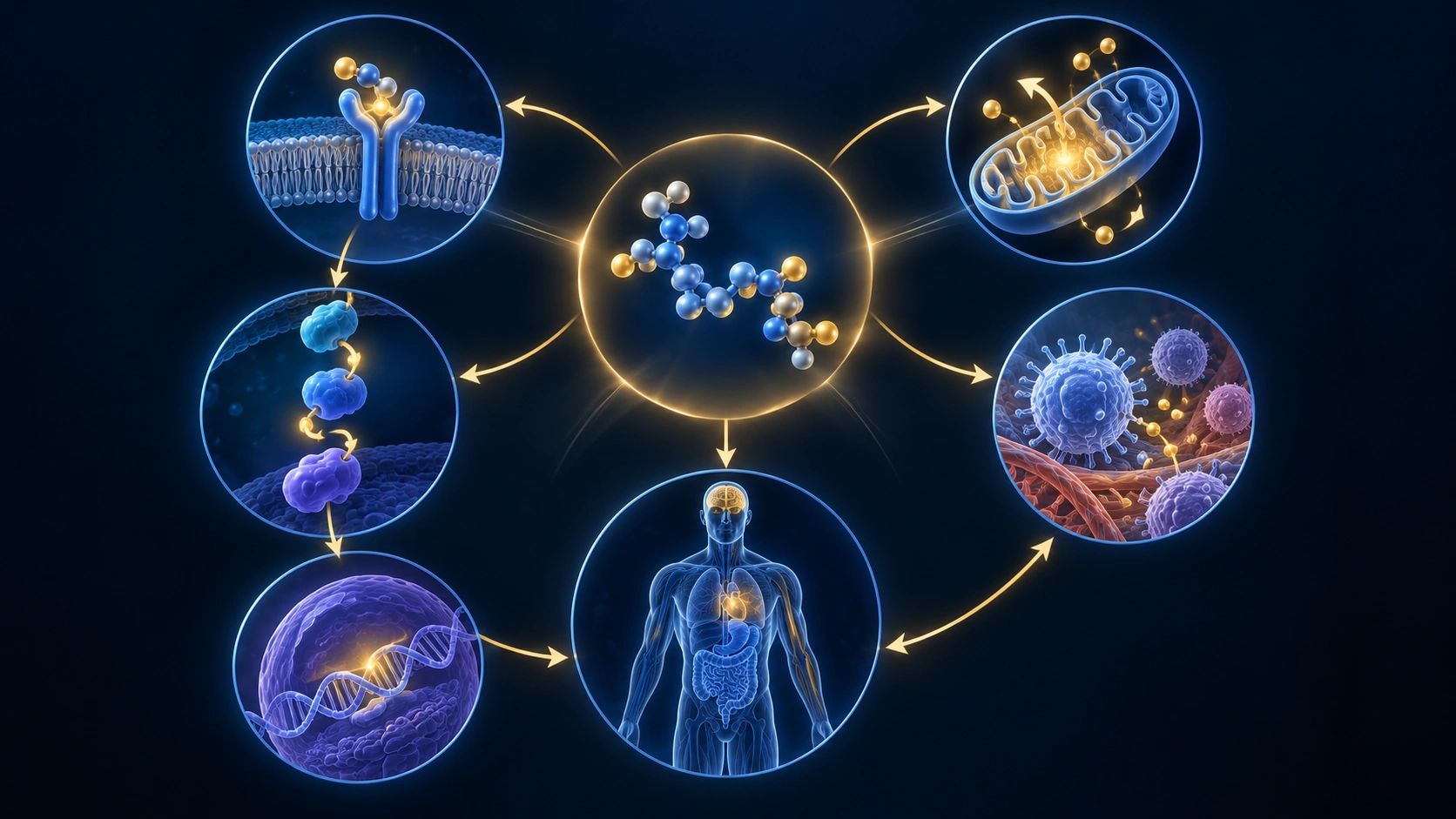
WHAT IS GHK-Cu?

GHK-Cu

IS GHK-Cu A HORMONE?

THE IDENTITY MODEL

3-AMINO-ACID PEPTIDE

composed of:

GLYCINE

↓

HISTIDINE

↓

LYSINE


Its histidine residue allows it to bind:

COPPER IONS.

The resulting complex:

GHK-Cu

has been detected naturally in human biological fluids and tissues.


Research has identified GHK in:

plasma 

saliva 

urine 

tissue environments 


Its concentration appears to decline with:

AGE.


That observation helped drive interest in GHK-Cu as:

A REPAIR AND REGENERATIVE SIGNAL.

But again:

age-related decline does not automatically mean:

AGE = GHK-Cu DEFICIENCY.


The biology is more complex.

THE IDENTITY MODEL

IS GHK-Cu A HORMONE?

THE IDENTITY MODEL

GLYCINE + HISTIDINE + LYSINE

↓

GHK

↓

Binds:

Cu²⁺

↓

GHK-Cu

↓

Potential effects on:

COPPER DELIVERY

COLLAGEN SYNTHESIS

EXTRACELLULAR-MATRIX REMODELING

ANGIOGENESIS

ANTIOXIDANT DEFENSE

GENE EXPRESSION

WOUND REPAIR

↓

Potential:

TISSUE REMODELING + REPAIR

IS GHK-Cu A HORMONE?

IS GHK-Cu A HORMONE?

DOES GHK-Cu HAVE ONE KNOWN RECEPTOR?

Not in the classic endocrine sense.

It is better understood as:

A BIOACTIVE PEPTIDE-METAL COMPLEX INVOLVED IN REPAIR AND CELLULAR SIGNALING.


It does not function like:

insulin 

glucagon 

GLP-1 

thyroid hormone 

with one dominant endocrine axis.


Instead, GHK-Cu appears to influence:

MULTIPLE REPAIR-RELATED BIOLOGICAL SYSTEMS.

DOES GHK-Cu HAVE ONE KNOWN RECEPTOR?

DOES GHK-Cu HAVE ONE KNOWN RECEPTOR?

DOES GHK-Cu HAVE ONE KNOWN RECEPTOR?

Not one clearly established receptor explaining all of its biological effects.


Instead, GHK-Cu appears to influence:

gene transcription 

metal-dependent enzymes 

extracellular-matrix remodeling 

cellular migration 

oxidative-stress pathways 

inflammatory signaling 

angiogenic pathways 


Again:

this makes GHK-Cu less like:

ONE RECEPTOR → ONE EFFECT

and more like:

A BIOLOGICAL REPAIR NETWORK MODULATOR.


HOW GHK-Cu MAY WORK

COPPER BINDING AND DELIVERY

Copper is not simply:

A MINERAL IN A MULTIVITAMIN.


It is an essential cofactor for enzymes involved in:

collagen maturation 

antioxidant defense 

mitochondrial respiration 

iron metabolism 

pigmentation 

connective-tissue integrity 


GHK binds copper strongly and may help:

TRANSPORT OR PRESENT COPPER TO BIOLOGICAL SYSTEMS THAT NEED IT.

This is central to its function.

THE COPPER MODEL

DOES GHK-Cu HAVE ONE KNOWN RECEPTOR?

COLLAGEN SYNTHESIS

GHK

↓

Binds:

COPPER

↓

GHK-Cu

↓

Copper becomes biologically available within:

REPAIR-RELATED PATHWAYS

↓

Potential effects on:

MATRIX + VASCULAR + ANTIOXIDANT BIOLOGY


Again:

GHK-Cu is not simply:

PEPTIDE SIGNALING.


It is:

PEPTIDE SIGNALING + METAL BIOLOGY.

COLLAGEN SYNTHESIS

DOES GHK-Cu HAVE ONE KNOWN RECEPTOR?

COLLAGEN SYNTHESIS

GHK-Cu is strongly associated with:

COLLAGEN PRODUCTION AND REMODELING.


Collagen provides structural support to:

skin 

tendon 

ligament 

fascia 

bone matrix 

blood vessels 


GHK-Cu has been studied for effects on:

fibroblast activity 

collagen synthesis 

extracellular-matrix organization 

wound closure 


This is one reason GHK-Cu became widely used in:

DERMATOLOGY AND COSMETIC SKIN FORMULATIONS.

THE COLLAGEN MODEL

ELASTIN AND EXTRACELLULAR MATRIX

ELASTIN AND EXTRACELLULAR MATRIX

GHK-Cu

↓

FIBROBLAST SIGNALING

↓

Potential increase in:

COLLAGEN SYNTHESIS

MATRIX REMODELING

↓

Potential:

IMPROVED TISSUE STRUCTURE


But:

MORE COLLAGEN IS NOT ALWAYS BETTER.


The desired endpoint is:

APPROPRIATE MATRIX REMODELING.

Not:

UNCONTROLLED FIBROSIS.

ELASTIN AND EXTRACELLULAR MATRIX

ELASTIN AND EXTRACELLULAR MATRIX

ELASTIN AND EXTRACELLULAR MATRIX

 Skin and connective tissue depend on more than collagen.


The extracellular matrix includes:

collagen 

elastin 

glycosaminoglycans 

proteoglycans 

structural proteins 


GHK-Cu has been associated with changes in:

MATRIX PRODUCTION AND ORGANIZATION.


That makes its biology relevant to:

TISSUE QUALITY, not simply collagen quantity.

LYSYL OXIDASE AND COPPER

ELASTIN AND EXTRACELLULAR MATRIX

LYSYL OXIDASE AND COPPER

 Copper is required for:

LYSYL OXIDASE.


Lysyl oxidase contributes to:

CROSSLINKING COLLAGEN AND ELASTIN.

This matters because collagen production alone is not enough.


Fibers must be:

ORGANIZED + CROSSLINKED + INTEGRATED INTO TISSUE.


Again:

GHK-Cu biology potentially intersects with:

STRUCTURAL MATURATION.

WOUND REPAIR

FIBROBLAST FUNCTION

LYSYL OXIDASE AND COPPER

GHK-Cu has long been associated with:

WOUND-HEALING BIOLOGY.


Repair requires several coordinated processes:

INFLAMMATION

↓

CELL MIGRATION

↓

ANGIOGENESIS

↓

MATRIX FORMATION

↓

REMODELING


GHK-Cu appears to intersect with several of these stages.


That is why it should be thought of as:

A REPAIR-ENVIRONMENT MODULATOR

rather than simply:

A SKIN PEPTIDE.

FIBROBLAST FUNCTION

FIBROBLAST FUNCTION

FIBROBLAST FUNCTION

Fibroblasts participate in:

collagen production 

extracellular matrix 

wound contraction 

tissue remodeling 


GHK-Cu has repeatedly been associated with:

FIBROBLAST PROLIFERATION AND FUNCTION.


Again

this helps explain why its effects appear in:

skin 

wound 

connective-tissue research

ANGIOGENESIS

FIBROBLAST FUNCTION

FIBROBLAST FUNCTION

Repairing tissue needs:

BLOOD SUPPLY.


Without adequate perfusion:

oxygen is limited 

nutrient delivery is impaired 

waste removal slows 

healing stalls 


GHK-Cu has been associated with:

ANGIOGENIC SIGNALING

including effects on:

VEGF-RELATED BIOLOGY.

THE VASCULAR REPAIR MODEL

THE OXIDATIVE-STRESS MODEL

THE VASCULAR REPAIR MODEL

TISSUE INJURY

↓

GHK-Cu-RELATED SIGNALING

↓

Potential:

ANGIOGENIC RESPONSE

↓

MICROVASCULAR SUPPORT

↓

Potential:

IMPROVED REPAIR ENVIRONMENT

Again:

angiogenesis is:

CONTEXT DEPENDENT.


Useful in:

HEALING.

Potentially undesirable in:

SELECTED PATHOLOGICAL ENVIRONMENTS.


That does not make GHK-Cu inherently dangerous.

It means:

THE BIOLOGICAL CONTEXT MATTERS.

ANTIOXIDANT BIOLOGY

THE OXIDATIVE-STRESS MODEL

THE VASCULAR REPAIR MODEL

Copper also participates in:

SUPEROXIDE DISMUTASE — SOD.


SOD helps regulate:

REACTIVE OXYGEN SPECIES.


Oxidative signaling is part of:

repair 

immune response 

metabolism 


But excessive oxidative stress contributes to:

protein damage 

lipid damage 

DNA injury 

cellular dysfunction 


GHK-Cu has shown antioxidant-related effects in experimental systems.


This may be partly related to:

COPPER HANDLING + GENE SIGNALING.

THE OXIDATIVE-STRESS MODEL

THE OXIDATIVE-STRESS MODEL

THE OXIDATIVE-STRESS MODEL

CELLULAR STRESS

↓

ROS ↑

↓

Potential:

GHK-Cu SIGNALING

↓

ANTIOXIDANT / REPAIR PROGRAMS

↓

Potential reduction in:

EXCESSIVE OXIDATIVE DAMAGE


Again:

the goal is not:

ZERO ROS.

Reactive oxygen species are also:

SIGNALING MOLECULES.


The goal is:

REDOX BALANCE.

INFLAMMATORY SIGNALING

THE TRANSCRIPTION MODEL

THE OXIDATIVE-STRESS MODEL

GHK-Cu has also been associated with:

INFLAMMATION-MODULATING EFFECTS.


Research suggests interactions with pathways related to:

cytokine signaling 

oxidative stress 

repair 

inflammatory gene expression 


Again:

GHK-Cu should not simply be described as:

ANTI-INFLAMMATORY.


Inflammation is necessary for:

NORMAL HEALING.


The better question is:

DOES GHK-Cu HELP SHIFT THE TISSUE FROM DAMAGE TOWARD ORGANIZED REPAIR?

GENE EXPRESSION

THE TRANSCRIPTION MODEL

THE TRANSCRIPTION MODEL

This is one of the most interesting aspects of GHK biology.


Research has suggested that GHK can influence expression of:

LARGE NUMBERS OF GENES.


These genes may relate to:

tissue repair 

oxidative stress 

inflammatory signaling 

extracellular matrix 

cell survival 

neuronal biology 


This is sometimes described as:

GENE-RESETTING

or:

GENE-REPROGRAMMING.


I would use those terms carefully.

A better description is:

GHK-Cu APPEARS CAPABLE OF MODIFYING TRANSCRIPTIONAL PROGRAMS ASSOCIATED WITH REPAIR AND CELLULAR HOMEOSTASIS.


That is still a very significant biological claim.

THE TRANSCRIPTION MODEL

THE TRANSCRIPTION MODEL

THE TRANSCRIPTION MODEL

GHK-Cu

↓

Changes:

CELLULAR SIGNALING

↓

Potential changes in:

GENE EXPRESSION

↓

Effects across:

REPAIR

MATRIX

INFLAMMATION

ANTIOXIDANT DEFENSE

↓

Potential:

CELLULAR REMODELING

SKIN BIOLOGY

SKIN BIOLOGY

SKIN BIOLOGY

GHK-Cu may be most recognizable from:

SKIN-CARE PRODUCTS.


But the dermatological interest comes from real biological mechanisms.


GHK-Cu has been investigated for effects involving:

collagen 

elastin 

glycosaminoglycans 

wound healing 

skin thickness 

pigmentation 

fine lines 

photodamage 

skin barrier quality 


Again:

cosmetic use is one expression of

A LARGER REPAIR BIOLOGY.

PHOTOAGING

SKIN BIOLOGY

SKIN BIOLOGY

Ultraviolet exposure contributes to:

oxidative stress 

collagen degradation 

matrix metalloproteinase activity 

altered pigmentation 

inflammation 


GHK-Cu may potentially influence:

REPAIR AFTER PHOTODAMAGE

through:

matrix remodeling 

antioxidant response 

collagen biology


Again:

this makes it mechanistically relevant to:

SKIN AGING.


But skin aging remains influenced by:

ultraviolet exposure 

smoking 

hormones 

nutrition 

glycation 

sleep 

inflammation 

genetics 


No peptide replaces:

THE ENVIRONMENT THE SKIN LIVES IN.

HAIR BIOLOGY

SKIN BIOLOGY

NERVE AND NEUROLOGICAL BIOLOGY

GHK-Cu is also commonly discussed in:

HAIR-LOSS / HAIR-GROWTH SETTINGS.


Why?

Hair follicles depend on:

vascular supply 

growth signaling 

inflammatory environment 

extracellular matrix 

androgen signaling 

follicular cycling 


Copper peptides have shown experimental and cosmetic interest related to:

HAIR-FOLLICLE SUPPORT.


But:

HAIR LOSS IS NOT ONE DISEASE.

Androgenetic alopecia.

Alopecia areata.

Telogen effluvium.

Nutrient deficiency.

Thyroid disease.

Scarring alopecia.


Again:

same symptom.

Different:

MECHANISM.

NERVE AND NEUROLOGICAL BIOLOGY

NERVE AND NEUROLOGICAL BIOLOGY

NERVE AND NEUROLOGICAL BIOLOGY

GHK-Cu has also shown research interest in:

nerve regeneration 

neurite growth 

neural repair 

cellular protection 


This remains much less established clinically than:

SKIN AND WOUND BIOLOGY.


But it reinforces the broader concept:

GHK-Cu may influence

REPAIR PROGRAMS ACROSS MULTIPLE TISSUES.

THE CORE MECHANISM MAP

GHK

↓

Binds:

COPPER

↓

GHK-Cu

↓

Modulation of:

FIBROBLAST ACTIVITY

COLLAGEN / ELASTIN REMODELING

ANGIOGENESIS

ANTIOXIDANT DEFENSE

INFLAMMATORY SIGNALING

GENE EXPRESSION

↓

Potential:

WOUND REPAIR

SKIN REMODELING

CONNECTIVE-TISSUE SUPPORT

VASCULAR SUPPORT

CELLULAR REPAIR


The best way to understand GHK-Cu is:

  • REPAIR COORDINATION THROUGH PEPTIDE + COPPER BIOLOGY.


WHAT THIS MECHANISM MAY SUGGEST

Mechanistically, GHK-Cu may deserve investigation or clinical interest in:

  • skin aging 
  • photodamage 
  • wound repair 
  • scar remodeling 
  • hair-follicle support 
  • connective-tissue repair 
  • tissue remodeling 
  • selected neurological repair contexts 
  • inflammatory tissue injury 
  • vascular-support biology

WHAT THIS MECHANISM DOES NOT PROVE

GHK-Cu biology does not prove that it:

  • reverses all skin aging 
  • regrows hair in every form of alopecia 
  • heals every wound 
  • regenerates tendons 
  • reverses fibrosis 
  • restores nerves after every type of injury 
  • eliminates scars 
  • reverses systemic aging 
  • should be used simply because someone wants “more collagen” 

Again:

  • THE MECHANISM HAS TO MATCH THE TISSUE PROBLEM.

THE EVIDENCE, POTENTIAL APPLICATIONS, AND LIMITATIONS

 ENDOGENOUS / PHYSIOLOGICAL BIOLOGY

MEANINGFUL

GHK is naturally present in humans.

Its ability to bind copper is well established.

The peptide has decades of research involving:

skin 

wounds 

collagen 

connective tissue 

gene expression 


Its physiology is therefore substantially more established than that of many synthetic repai

PRECLINICAL EVIDENCE

SUBSTANTIAL

Experimental studies have examined:

  • wound healing 
  • collagen synthesis 
  • fibroblast activity 
  • angiogenesis 
  • oxidative stress 
  • inflammatory signaling 
  • nerve repair 
  • gene regulation 

This is where the broadest mechanistic evidence exists.

HUMAN TOPICAL / DERMATOLOGICAL EVIDENCE

MEANINGFUL BUT VARIABLE

GHK-Cu has perhaps its most mature practical use in:

TOPICAL SKIN APPLICATIONS.

Human cosmetic and dermatological work has examined:

  • fine lines 
  • skin texture 
  • firmness 
  • skin density 
  • photodamage 

This is an important distinction.

GHK-Cu is not simply a peptide that exists only in:

  • ANIMAL RESEARCH.

There is meaningful human use and clinical experience, particularly:

  • TOPICALLY.

SYSTEMIC / INJECTABLE HUMAN EVIDENCE

LESS DEVELOPED

The existence of topical human use does not automatically establish:

  • SYSTEMIC PHARMACOLOGY.

Topical application creates:

  • LOCAL EXPOSURE.

Injection creates:

  • SYSTEMIC OR DEEPER-TISSUE EXPOSURE.

Those are different pharmacological contexts.

Again:

  • not a reason to dismiss systemic interest.

It simply means:

  • THE ROUTE MATTERS.

Research

SKIN AGING AND PHOTOAGING

SKIN AGING AND PHOTOAGING

SKIN AGING AND PHOTOAGING

This is probably the strongest practical application area.


GHK-Cu has been investigated for:

improved skin quality 

collagen support 

reduced appearance of fine lines 

improved elasticity 

improved density or thickness 

repair after environmental stress 


Its biological rationale is strong because skin aging includes:

COLLAGEN LOSS

ELASTIN CHANGE

OXIDATIVE STRESS

MATRIX DEGRADATION

REDUCED REPAIR CAPACITY


GHK-Cu intersects with several of those pathways.

WOUND HEALING

SKIN AGING AND PHOTOAGING

SKIN AGING AND PHOTOAGING

Wound repair is another major research area.


GHK-Cu can potentially influence:

fibroblast migration 

collagen deposition 

angiogenesis 

tissue remodeling 

inflammatory balance 


This makes it biologically compelling for:

TISSUE REPAIR.


But again:

wounds may be impaired by:

infection 

ischemia 

diabetes 

pressure 

malnutrition 

venous disease 

arterial disease 


A peptide cannot correct:

AN UNRESOLVED PRIMARY DRIVER.

SCAR REMODELING

SKIN AGING AND PHOTOAGING

SCAR REMODELING

GHK-Cu is interesting in scar biology because scars depend on:

COLLAGEN REMODELING.


But scar formation is not simply:

TOO LITTLE COLLAGEN.


Hypertrophic scars and keloids can involve:

EXCESSIVE OR DISORGANIZED MATRIX PRODUCTION.


Again:

the goal is

NORMALIZED REMODELING.


Not:

MORE COLLAGEN.


HAIR

NEUROLOGICAL REPAIR

SCAR REMODELING

Copper peptides are widely used in hair and scalp products.


Potential mechanisms include:

vascular support 

follicular environment 

matrix signaling 

anti-inflammatory effects 


This may provide support in selected hair-loss patterns.


But androgenetic alopecia remains strongly driven by:

ANDROGEN / DHT BIOLOGY + GENETICS.


A copper peptide may support the:

FOLLICULAR ENVIRONMENT

without necessarily removing:

THE PRIMARY ANDROGENIC DRIVER.

CONNECTIVE TISSUE

NEUROLOGICAL REPAIR

NEUROLOGICAL REPAIR

GHK-Cu is biologically relevant to connective tissue because:

COPPER + COLLAGEN + ELASTIN + FIBROBLASTS

are deeply linked.


Potential interest extends to:

tendon 

ligament 

fascia 

dermis 


But human clinical evidence for systemic connective-tissue rehabilitation remains less developed than:

SKIN / WOUND APPLICATIONS.

NEUROLOGICAL REPAIR

NEUROLOGICAL REPAIR

NEUROLOGICAL REPAIR

Experimental GHK-Cu literature suggests potential effects involving:

neuronal growth 

nerve repair 

neuroprotection 


This may be particularly interesting where:

CELLULAR REPAIR PROGRAMS

are impaired.


But neurological disease should never be reduced to:

“MORE REPAIR SIGNALING.”


Neurodegeneration.

Trauma.

neuropathy.

autoimmune disease.

ischemia.


Again:

completely different:

BIOLOGICAL PATTERNS.

NEUROLOGICAL REPAIR

GENE-EXPRESSION RESEARCH

GENE-EXPRESSION RESEARCH

GHK has also attracted interest because gene-expression analyses have suggested potential effects on:

FIBROTIC AND INFLAMMATORY GENE PROGRAMS.


This is particularly interesting because one might assume:

COLLAGEN-STIMULATING PEPTIDE = MORE FIBROSIS.


But biology is rarely that simple.

GHK may influence:

REMODELING QUALITY

rather than simply:

COLLAGEN QUANTITY.

This is an important distinction.

GENE-EXPRESSION RESEARCH

GENE-EXPRESSION RESEARCH

GENE-EXPRESSION RESEARCH

One of the more provocative areas of GHK research involves large-scale:

GENE-EXPRESSION PATTERNS.


Investigators have proposed that GHK may shift gene expression toward:

tissue repair 

antioxidant activity 

reduced inflammatory signaling 

healthier extracellular-matrix behavior 


This has driven much of the:

ANTI-AGING

interest around GHK.


But:

GENE-EXPRESSION CHANGE ≠ CLINICAL REJUVENATION.


The biology is interesting.

The outcome still has to be demonstrated.

WHAT WE KNOW

GENE-EXPRESSION RESEARCH

WHAT WE THINK MAY BE HAPPENING

GHK is a naturally occurring human tripeptide.


It binds copper strongly.


GHK-Cu participates in repair-associated biology.


Copper is required for important connective-tissue and antioxidant enzymes.


GHK-Cu influences fibroblast activity.


It influences collagen and extracellular-matrix biology.

It is associated with angiogenic signaling.

It is associated with antioxidant and inflammatory pathways.

It has been extensively studied in skin and wound-healing contexts.


Topical copper peptides have meaningful human use.


GHK-related research suggests broad effects on gene-expression programs.


Its biological relevance appears to extend beyond cosmetic skin care.

WHAT WE THINK MAY BE HAPPENING

WHAT WE THINK MAY BE HAPPENING

WHAT WE THINK MAY BE HAPPENING

GHK-Cu may act as:

A DAMAGE-RESPONSE SIGNAL THAT HELPS COORDINATE COPPER DELIVERY WITH TISSUE REPAIR.


Injury occurs.

↓

The tissue needs:

COLLAGEN

BLOOD SUPPLY

ANTIOXIDANT DEFENSE

CELL MIGRATION

MATRIX REMODELING

↓

GHK-Cu may help coordinate:

MULTIPLE PARTS OF THAT RESPONSE.

In this model:

GHK-Cu is less:

“BUILD MORE COLLAGEN.”

and more:

“ORGANIZE THE REPAIR ENVIRONMENT.”


That is a much more useful way to think about the molecule.

WHAT REMAINS CONTEXT-DEPENDENT

WHAT WE THINK MAY BE HAPPENING

WHAT REMAINS CONTEXT-DEPENDENT

Important questions include:

Which tissues respond most strongly? 

How much of topical evidence translates to injectable use? 

What systemic exposure is biologically optimal? 

Does GHK-Cu improve structural tendon or ligament outcomes in humans? 

Which forms of hair loss respond best? 

What role does baseline copper status play? 

Does excessive copper alter the therapeutic window? 

How should systemic copper status be monitored during prolonged use? 

How does GHK-Cu behave in malignancy-associated environments? 

Does angiogenic signaling differ by tissue or dose? 

How much of its gene-expression signature translates into clinically meaningful regeneration? 

What is the ideal duration of exposure?


Again:

these questions make GHK-Cu:

A HIGH-VALUE RESEARCH PEPTIDE.


Not:

A PEPTIDE TO DISMISS.

THE PRAXIS LENS

DO NOT BEGIN WITH GHK-Cu

Begin with: WHAT TISSUE IS FAILING TO REPAIR — AND WHY?  

Then:

PHYSIOLOGY

↓

PATTERN

↓

MECHANISM

↓

EVIDENCE

↓

RISK

↓

MONITORING

↓

DECISION

PHYSIOLOGY

Healthy tissue repair requires:

  • adequate circulation 
  • oxygen 
  • protein 
  • micronutrients 
  • copper balance 
  • fibroblast function 
  • collagen synthesis 
  • matrix remodeling 
  • controlled inflammation 
  • mechanical loading where appropriate 

Again:

GHK-Cu participates in

  • THE REPAIR ENVIRONMENT.

It does not replace:

  • THE ENVIRONMENT.

EVIDENCE

Ask:

  • WHAT KIND OF EVIDENCE EXISTS FOR THIS SPECIFIC USE AND ROUTE?
  • Topical skin use?
  • Wound application?
  • Injectable systemic therapy?
  • Hair?
  • Neurological repair?

Again:

different applications have

  • DIFFERENT EVIDENCE.

Do not flatten them into:

  • “GHK-Cu WORKS.”

or:

  • “GHK-Cu HAS NO HUMAN EVIDENCE.”

Both lose the nuance.

PATTERN

What is actually present?

  • skin aging? 
  • photodamage? 
  • nonhealing wound? 
  • scar? 
  • tendon injury? 
  • hair loss? 
  • neuropathy? 
  • connective-tissue dysfunction? 

Again:

  • “I WANT MORE COLLAGEN”

is not:

  • A DIAGNOSIS.

RISK

Potential considerations include:

  • local irritation 
  • injection complications 
  • product contamination 
  • inappropriate copper exposure 
  • copper imbalance 
  • angiogenic context 
  • masking the underlying cause of poor healing 
  • assuming repair signaling can substitute for correction of structural disease 

Again:

the peptide may be only one variable in

  • A MUCH LARGER SYSTEM.

MECHANISM

Does GHK-Cu biology match:

  • THE DOMINANT BOTTLENECK?

If a wound is not healing because of:

  • SEVERE ARTERIAL INSUFFICIENCY,

the primary problem is:

  • BLOOD FLOW.

If hair loss is caused primarily by:

  • DHT-DRIVEN MINIATURIZATION,

GHK-Cu may support:

  • THE FOLLICULAR ENVIRONMENT

without correcting:

  • THE ENTIRE ANDROGENIC SIGNAL.

If skin aging is driven predominantly by:

  • CHRONIC UV EXPOSURE,

repair signaling cannot replace:

  • SUN PROTECTION.

Again:

the bottleneck determines:

  • THE VALUE OF THE SIGNAL.THE FOUNDATIONAL DRIVER.

MONITORING

Monitoring depends on:

  • THE GOAL.

SKIN

  • texture 
  • irritation 
  • pigmentation 
  • wound response 
  • clinical photography 

HAIR

  • shedding 
  • hair density 
  • scalp condition 
  • standardized photography 

WOUND / TISSUE REPAIR

  • wound dimensions 
  • function 
  • pain 
  • tissue quality 
  • healing rate 

SYSTEMIC / PROLONGED USE

When clinically relevant:

  • copper status 
  • ceruloplasmin 
  • liver context 
  • symptoms of imbalance 

Again:

monitor

  • THE TARGETED TISSUE AND THE RELEVANT BIOLOGY.

THE PRAXIS 5
MECHANISM

GHK-Cu appears to influence:

  • COPPER HANDLING + MATRIX REMODELING + VASCULAR REPAIR + GENE SIGNALING.

Its strongest mechanistic themes involve:

  • fibroblasts 
  • collagen 
  • angiogenesis 
  • antioxidant defense 
  • inflammatory regulation

EVIDENCE

Topical skin / cosmetic biology:

  • MEANINGFUL HUMAN EXPERIENCE.

Wound and repair biology:

  • STRONG MECHANISTIC / PRECLINICAL SUPPORT.

Systemic regenerative applications:

  • LESS DEVELOPED.

Again:

  • route and indication matter.

RISK

GHK-Cu should not be treated as though:

  • NATURAL = RISK FREE.

Copper is biologically essential.

But:

  • TRACE METALS REQUIRE BALANCE.

Likewise:

angiogenesis can support:

  • HEALING

while requiring more caution in:

  • SELECTED DISEASE CONTEXTS.

MONITORING

Monitor:

  • THE TISSUE OUTCOME

plus:

  • COPPER BIOLOGY WHEN SYSTEMIC EXPOSURE OR PROLONGED USE MAKES THAT RELEVANT.

PATIENT CONTEXT

A patient with:

  • PHOTOAGED SKIN

is not the same as:

a patient with:

  • A DIABETIC NONHEALING WOUND.

A patient with:

  • ANDROGENETIC ALOPECIA

is not the same as:

someone with:

  • ALOPECIA AREATA.

And a patient with:

  • NORMAL COPPER STATUS

is not identical to one with:

  • COPPER DEFICIENCY OR COPPER-OVERLOAD DISORDER.

Same molecule.

Different:

  • BIOLOGICAL ENVIRONMENT.

SEVEN QUESTIONS TO ASK BEFORE GHK-Cu

1. WHAT TISSUE OR REPAIR PROBLEM ARE WE ACTUALLY TRYING TO CHANGE?

  • skin? 
  • wound? 
  • hair? 
  • tendon? 
  • nerve? 
  • something else? 

2. DOES GHK-Cu'S MECHANISM MATCH THAT PROBLEM?

  • copper delivery? 
  • collagen remodeling? 
  • fibroblast signaling? 
  • angiogenesis? 
  • antioxidant defense? 

3. WHAT TYPE OF EVIDENCE SUPPORTS THIS SPECIFIC USE?

  • topical human? 
  • wound? 
  • preclinical repair? 
  • systemic? 
  • cosmetic? 
  • structural? 

4. IS THERE A MORE IMPORTANT DRIVER THAT HAS NOT BEEN CORRECTED?

  • ischemia? 
  • infection? 
  • diabetes? 
  • mechanical overload? 
  • androgen signaling? 
  • UV exposure? 
  • nutrient deficiency? 

5. WHAT COULD GO WRONG IF WE ALTER THIS REPAIR ENVIRONMENT?

  • irritation? 
  • abnormal copper exposure? 
  • injection complication? 
  • unwanted angiogenic signaling? 
  • delayed diagnosis? 

6. WHAT WILL WE MONITOR?

  • skin quality? 
  • wound closure? 
  • hair density? 
  • function? 
  • copper status? 

7. WHAT WOULD DEFINE SUCCESS?

Not:

  • “I USED GHK-Cu.”

But:

  • THE TARGET TISSUE ACTUALLY REMODELED IN A MEANINGFUL DIRECTION.

GHK-Cu

KEY TAKEAWAYS

  • GHK-Cu is a naturally occurring copper-binding tripeptide.
  • GHK consists of glycine, histidine, and lysine.
  • Its histidine residue allows strong copper binding.
  • GHK-Cu combines peptide signaling with trace-metal biology.
  • Copper is required for multiple enzymes involved in connective tissue, antioxidant defense, and cellular metabolism.
  • GHK-Cu is strongly associated with fibroblast function.
  • It has been associated with collagen synthesis and extracellular-matrix remodeling.
  • Copper-dependent lysyl oxidase contributes to collagen and elastin crosslinking.
  • This means tissue quality depends on more than simply producing collagen.
  • GHK-Cu is associated with wound-healing biology.
  • It may influence angiogenic signaling and microvascular support.
  • Angiogenesis can be beneficial during repair but remains biologically context dependent.
  • GHK-Cu has antioxidant-related effects.
  • It can influence inflammatory signaling.
  • Its biology appears to include broad effects on gene-expression programs.
  • Gene-expression effects should not automatically be translated into clinical rejuvenation claims.
  • GHK-Cu has meaningful topical and dermatological human use.
  • Skin is one of the best-developed practical application areas.
  • GHK-Cu has been studied for photodamage, skin quality, collagen remodeling, and wound repair.
  • Hair and scalp applications are biologically plausible but depend heavily on the cause of hair loss.
  • Androgenetic alopecia remains strongly influenced by androgen signaling.
  • GHK-Cu may support the follicular environment without necessarily eliminating the primary driver.
  • Systemic and injectable applications should be considered separately from topical use.
  • Local exposure and systemic exposure are different pharmacological states.
  • GHK-Cu should not be reduced to a cosmetic peptide.
  • Its biology includes connective tissue, vascular signaling, oxidative stress, inflammation, and gene regulation.
  • GHK-Cu should also not be reduced to a simple collagen booster.
  • The more useful model is repair coordination.
  • A nonhealing tissue usually has a reason it is not healing.
  • Repair peptides work best conceptually when they match the dominant bottleneck.
  • Copper balance matters when systemic exposure becomes relevant.
  • The best question is not “does GHK-Cu increase collagen?”
  • The better question is “what tissue is failing to remodel, what is limiting repair, does GHK-Cu biology address that bottleneck, and what measurable structural or functional change would demonstrate that the tissue actually improved?”

THE BOTTOM LINE

GHK-Cu is much more interesting than its reputation as:

  • A SKIN-CARE PEPTIDE.

Its biology sits at the intersection of:

  • PEPTIDE SIGNALING

and:

  • COPPER BIOLOGY.

That creates a molecule capable of influencing:

  • COLLAGEN
  • ELASTIN
  • FIBROBLASTS
  • ANGIOGENESIS
  • OXIDATIVE STRESS
  • INFLAMMATION
  • GENE EXPRESSION

and:

  • TISSUE REMODELING.

The deeper concept is not:

  • MAKE MORE COLLAGEN.

It is:

  • RESTORE A MORE FUNCTIONAL REPAIR ENVIRONMENT.

That distinction is important.

Because tissue repair does not happen when one molecule is increased.

Healing requires:

  • BLOOD FLOW.
  • OXYGEN.
  • NUTRIENTS.
  • INFLAMMATORY COORDINATION.
  • CELL MIGRATION.
  • MATRIX PRODUCTION.
  • MATRIX REMODELING.
  • MECHANICAL SIGNALING.

And:

  • TIME.

GHK-Cu appears capable of interacting with several of these layers.

That is why the same peptide appears in research involving:

  • SKIN
  • HAIR
  • WOUNDS
  • CONNECTIVE TISSUE

and even:

  • NEURAL REPAIR.

The common denominator may not be:

  • THE ORGAN.

It may be:

  • THE REPAIR PROGRAM.

That is also why the Praxis framework matters.

Instead of asking:

  • “WHAT CAN GHK-Cu HEAL?”

ask:

“WHAT IS PREVENTING THIS TISSUE FROM HEALING, WHICH PART OF THE REPAIR NETWORK IS UNDERPERFORMING, DOES GHK-Cu BIOLOGY ACTUALLY INTERSECT WITH THAT BOTTLENECK, WHAT OTHER pathways could move when copper and repair signaling are altered, and what objective structural or functional outcome would demonstrate that the tissue truly remodeled?”

That is the difference between:

  • COLLAGEN MARKETING

and:

  • REGENERATIVE BIOLOGY.


STOP MEMORIZING PEPTIDES. START UNDERSTANDING THE SYSTEM.

  Praxis Peptide Institute provides educational information and is not a substitute for individualized medical diagnosis or treatment. GHK-Cu participates in copper handling, extracellular-matrix remodeling, wound repair, vascular signaling, antioxidant defense, and other repair-associated pathways. Its relevance may differ substantially according to the tissue being targeted, route of administration, baseline copper status, wound environment, vascular supply, nutritional status, underlying disease, malignancy context, and concurrent therapies. Human experience is strongest in topical and dermatological applications, while broader systemic regenerative uses remain less fully characterized. Decisions involving GHK-Cu should focus on the actual biological bottleneck, product quality, route, measurable tissue outcomes, copper physiology when relevant, and the larger clinical context. 

Copyright © 2026 Praxis Peptide Institute - All Rights Reserved.

Powered by

This website uses cookies.

We use cookies to analyze website traffic and optimize your website experience. By accepting our use of cookies, your data will be aggregated with all other user data.

Accept