Clinical Peptide Medicine — Structured. Applied. Evolving.
UNDERSTAND THE PEPTIDE
Epitalon — also commonly written Epithalon or Epithalone — is a four-amino-acid peptide with the sequence alanine-glutamic acid-aspartic acid-glycine: Ala-Glu-Asp-Gly, or AEDG.
It emerged from research into:
- PINEAL-GLAND PEPTIDE BIOREGULATION
and was developed from work involving the pineal polypeptide preparation:
- EPITHALAMIN.
A recent review describes Epitalon as an AEDG tetrapeptide synthesized based on the amino-acid composition of Epithalamin and subsequently studied for neuroendocrine, antioxidant, gene-regulatory, and geroprotective effects.
Epitalon is most famous for one mechanism:
- TELOMERASE.
And one outcome:
- TELOMERE LENGTH.
But that has led to a major oversimplification.
Epitalon is frequently reduced to:
- “THE TELOMERE PEPTIDE.”
Or even:
- “THE ANTI-AGING PEPTIDE.”
Neither description captures the full biology.
Research involving Epitalon has explored:
- telomerase activity
- telomere maintenance
- cellular replicative capacity
- melatonin production
- pineal signaling
- circadian regulation
- antioxidant biology
- gene expression
- neuroendocrine aging
- cellular stress responses
The more useful way to understand Epitalon is:
- A SHORT PINEAL-RELATED BIOREGULATORY PEPTIDE STUDIED FOR ITS EFFECTS ON CELLULAR AGING PROGRAMS, TELOMERE BIOLOGY, AND NEUROENDOCRINE/CIRCADIAN REGULATION.
That framing is important.
Because:
- LONGER TELOMERES ≠ LONGER HUMAN LIFE.
And:
- TELOMERASE ACTIVATION ≠ REVERSAL OF AGING.
Those mechanisms are biologically interesting.
But aging is a:
- SYSTEM.
THE CORE MECHANISM MAP
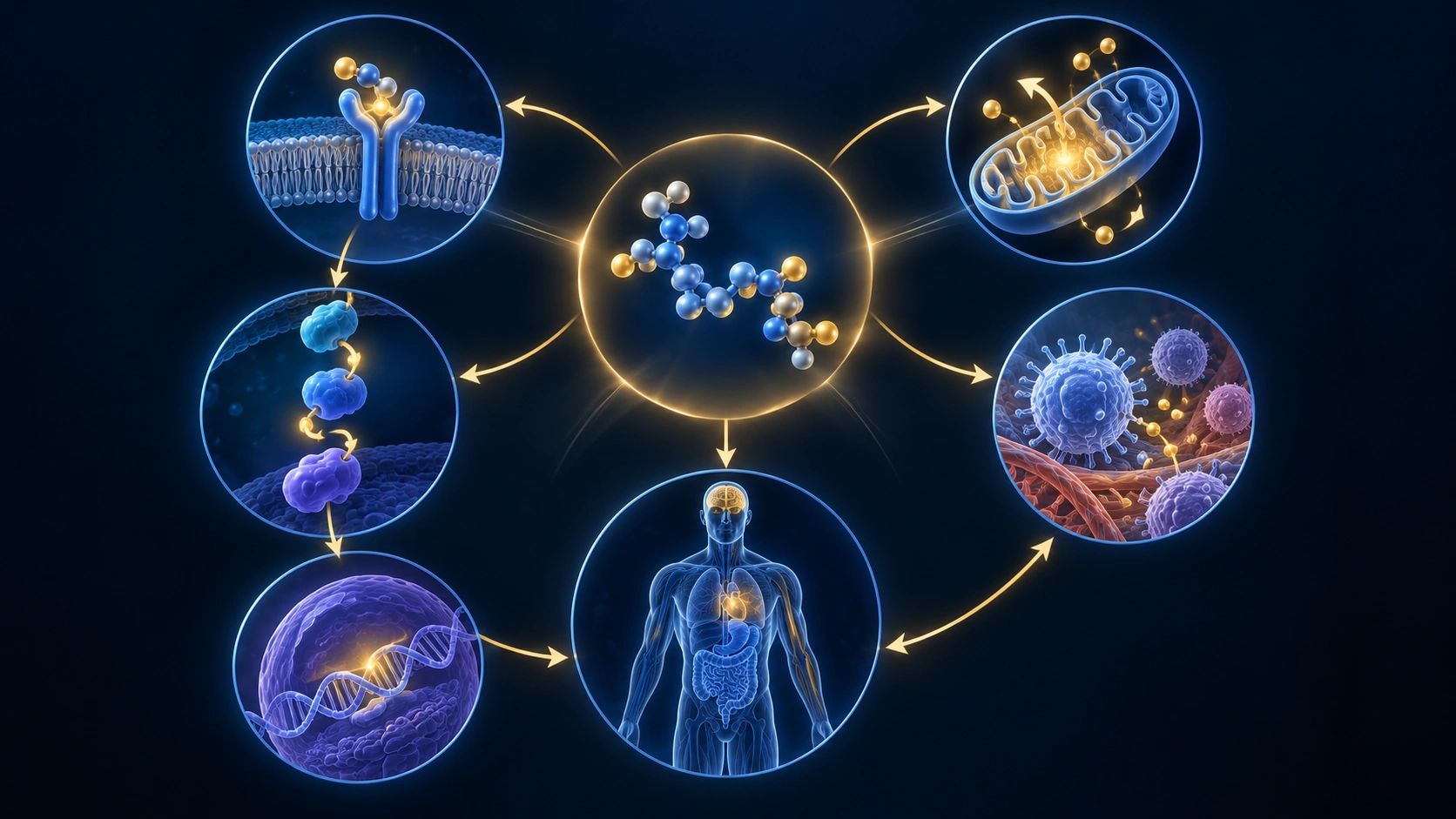
EPITALON — AEDG
↓
Potential intracellular / regulatory effects
↓
hTERT / TELOMERASE
TELOMERE MAINTENANCE
MELATONIN / PINEAL SIGNALING
GENE REGULATION
OXIDATIVE-STRESS MODULATION
↓
Potential:
- CELLULAR REPLICATIVE CAPACITY
- CIRCADIAN / NEUROENDOCRINE ORGANIZATION
- AGE-RELATED CELLULAR RESILIENCE
The core concept is:
- EPITALON MAY INFLUENCE BOTH THE REPLICATIVE CLOCK INSIDE CELLS AND THE CIRCADIAN CLOCK ORGANIZING THE BODY.
That is what makes the peptide unusually interesting.
WHAT THIS MECHANISM MAY SUGGEST
Mechanistically, Epitalon deserves research interest in:
- cellular aging
- telomere biology
- telomerase regulation
- age-related circadian disruption
- pineal aging
- melatonin regulation
- geroprotection
- neuroendocrine aging
- age-related cellular stress
- longevity biology
Its strongest conceptual niche may be:
- THE INTERSECTION OF CELLULAR AGING AND BIOLOGICAL TIME.
WHAT THIS MECHANISM DOES NOT PROVE
Epitalon biology does not prove that it:
- reverses human aging
- extends human lifespan
- makes every telomere longer
- prevents cancer
- causes cancer
- restores every age-related hormone change
- cures insomnia
- permanently resets the circadian clock
- prevents dementia
- eliminates cellular senescence
- should be used simply because someone is older
- makes a biological-age test younger in a clinically meaningful way
Again:
- TELOMERE LENGTH ≠ HEALTHSPAN.
And:
- CELLULAR REPLICATIVE CAPACITY ≠ WHOLE-HUMAN LONGEVITY.

RECENT INDEPENDENT CELLULAR EVIDENCE
IMPORTANT
The 2025 Biogerontology study again demonstrated Epitalon-associated telomere lengthening in human cell lines and characterized both:
- hTERT / TELOMERASE
and:
- ALT
mechanisms depending on cell type.
This materially strengthens the argument that:
- EPITALON REALLY DOES INTERACT WITH TELOMERE-MAINTENANCE BIOLOGY IN CELLULAR SYSTEMS.
But:
- WHAT THAT MEANS CLINICALLY
remains a different question.
PRECLINICAL GERONTOLOGY EVIDENCE
MEANINGFUL BUT HISTORICALLY CONCENTRATED
Epitalon has a long experimental literature involving:
- lifespan
- tumor development
- circadian biology
- melatonin
- neuroendocrine aging
- oxidative stress
Much of this originates from a relatively concentrated research group and scientific tradition.
That should not make the research disappear.
But it should influence:
- EVIDENCE WEIGHTING.
HUMAN CLINICAL EVIDENCE
LIMITED RELATIVE TO THE SIZE OF THE CLAIMS MADE ONLINE
Human peptide-regulator research exists in gerontology.
But the evidence for:
- PURE EPITALON → HUMAN LIFESPAN EXTENSION
is not comparable to:
- A LARGE, MODERN, LONG-TERM RANDOMIZED LONGEVITY TRIAL.
That distinction is essential.
The strongest direct evidence remains:
- CELLULAR + PRECLINICAL + LIMITED HUMAN GERONTOLOGY EXPERIENCE.
That is still interesting.
It simply tells us:
- WHERE THE TRANSLATION STANDS.
DO NOT BEGIN WITH EPITALON
Begin with: WHAT COMPONENT OF AGING OR CIRCADIAN PHYSIOLOGY ARE WE ACTUALLY TRYING TO CHANGE?
Then:
PHYSIOLOGY
↓
PATTERN
↓
MECHANISM
↓
EVIDENCE
↓
RISK
↓
MONITORING
↓
DECISION
PHYSIOLOGY
Healthy aging depends on:
- genomic integrity
- telomere maintenance
- mitochondrial function
- metabolic health
- immune regulation
- proteostasis
- stem-cell capacity
- circadian organization
- vascular health
- physical activity
- sleep
Epitalon appears especially relevant to:
- TELOMERE + PINEAL / CIRCADIAN BIOLOGY.
Again:
those are important nodes.
They are not:
- THE ENTIRE AGING SYSTEM.
EVIDENCE
Ask:
WHAT CLAIM ARE WE EVALUATING?
Telomerase activation?
There is:
DIRECT CELLULAR EVIDENCE.
Telomere elongation?
There is:
DIRECT CELLULAR EVIDENCE.
More fibroblast divisions?
There is:
CELL-CULTURE EVIDENCE.
Better circadian physiology?
There is:
PINEAL / MELATONIN RESEARCH.
Longer human lifespan?
That is:
A MUCH LARGER CLAIM
requiring:
A MUCH HIGHER EVIDENCE BAR.
This is exactly why evidence classes matter.
PATTERN
What are we actually observing?
- age-related circadian fragmentation?
- poor melatonin rhythm?
- cellular-aging research target?
- telomere attrition?
- cognitive aging?
- general longevity interest?
- metabolic aging?
- frailty?
Again:
- “AGING” IS NOT A SINGLE CLINICAL PATTERN.
RISK
Important considerations include:
- abnormal proliferative context
- known or suspected malignancy
- uncertainty surrounding long-term telomere manipulation
- unclear human dose-response
- product identity and purity
- using “anti-aging” treatment instead of correcting major drivers of morbidity
- overinterpreting telomere tests
The 2025 cancer-cell findings make:
- CELLULAR CONTEXT
particularly important when discussing telomere manipulation.
Again:
this is not fear-based reasoning.
It is:
- MECHANISM-BASED RISK ANALYSIS.
MECHANISM
Does Epitalon's biology match:
- THE DOMINANT BOTTLENECK?
If the patient has:
- SARCOPENIA,
then:
- RESISTANCE TRAINING + PROTEIN + ANABOLIC PHYSIOLOGY
may dominate.
If the patient has:
- INSULIN RESISTANCE,
address:
- METABOLIC PHYSIOLOGY.
If sleep timing is destroyed by:
- NIGHTLY LIGHT EXPOSURE + SHIFT WORK,
circadian inputs matter.
If the research question is specifically:
- TELOMERE MAINTENANCE + CELLULAR REPLICATIVE AGING,
Epitalon becomes:
- MUCH MORE MECHANISTICALLY RELEVANT.
MONITORING
Monitoring should follow:
THE HYPOTHESIS.
CIRCADIAN / SLEEP
- sleep timing
- sleep latency
- awakenings
- morning alertness
- light exposure
- circadian consistency
METABOLIC / AGING CONTEXT
- glucose regulation
- blood pressure
- body composition
- cardiorespiratory fitness
- strength
- functional status
CELLULAR AGING RESEARCH
Potential research endpoints may include:
- telomere length
- telomerase activity
- biological-age measures
- inflammatory markers
But:
- A BIOMARKER SHOULD NOT BECOME THE OUTCOME BY ITSELF.
If telomeres change but:
- FUNCTION DOES NOT,
the clinical meaning remains uncertain.

THE PRAXIS 5
MECHANISM
Epitalon's strongest mechanistic themes involve:
- TELOMERASE / TELOMERES + PINEAL / MELATONIN BIOLOGY + SHORT-PEPTIDE REGULATION.
EVIDENCE
Cellular telomerase evidence:
- MEANINGFUL.
Cellular telomere evidence:
- MEANINGFUL AND RECENTLY REPLICATED.
Preclinical gerontology evidence:
- SUBSTANTIAL BUT CONCENTRATED.
Human longevity evidence:
- MUCH LESS DEVELOPED.
This is the appropriate calibration.
RISK
The biggest conceptual mistake is assuming:
- LONGER TELOMERES = BETTER HUMAN HEALTH.
The biology is more complicated.
- Normal cells.
- Stem cells.
- Immune cells.
- Cancer cells.
All use telomere biology differently.
MONITORING
Monitor:
- THE SYSTEM BEING TARGETED.
If:
- CIRCADIAN FUNCTION
then monitor:
- CIRCADIAN FUNCTION.
If:
- HEALTHY AGING
then monitor:
- HEALTHSPAN-RELEVANT FUNCTION.
Do not reduce the outcome to:
- ONE LAB NUMBER.
PATIENT CONTEXT
A healthy 45-year-old interested in:
- LONGEVITY OPTIMIZATION
is not identical to:
an 80-year-old with:
- FRAILTY + CIRCADIAN DISRUPTION.
A patient with:
- NORMAL CANCER SCREENING AND LOW RISK
is not identical to:
someone with:
- ACTIVE MALIGNANCY.
A shift worker with:
- CHRONIC CIRCADIAN MISALIGNMENT
is not identical to:
someone with:
- PRIMARY INSOMNIA.
Same peptide.
Different:
- BIOLOGICAL CONTEXT.
SEVEN QUESTIONS TO ASK BEFORE EPITALON
1. WHAT ARE WE ACTUALLY TRYING TO CHANGE?
- telomere biology?
- circadian rhythm?
- sleep timing?
- healthy aging?
- cellular resilience?
2. WHAT IS DRIVING THE AGE-RELATED PROBLEM?
- metabolic disease?
- vascular disease?
- circadian disruption?
- inflammation?
- sarcopenia?
- cellular senescence?
3. DOES EPITALON'S BIOLOGY MATCH THAT BOTTLENECK?
- telomerase?
- telomeres?
- pineal signaling?
- melatonin?
- cellular regulation?
4. WHAT TYPE OF EVIDENCE SUPPORTS THE CLAIM?
- human cell?
- animal?
- human clinical?
- biomarker?
- lifespan?
5. IS THERE A CELLULAR CONTEXT WHERE INCREASING REPLICATIVE CAPACITY MAY BE UNDESIRABLE?
That deserves consideration whenever:
- TELOMERE-MAINTENANCE BIOLOGY
is being intentionally manipulated.
6. WHAT WILL WE MONITOR?
- sleep?
- circadian timing?
- functional aging?
- telomeres?
- healthspan metrics?
7. WHAT WOULD DEFINE SUCCESS?
Not:
- “MY TELOMERES GOT LONGER.”
But:
- THE TARGETED BIOLOGY CHANGED AND THAT CHANGE TRANSLATED INTO BETTER PHYSIOLOGICAL OR FUNCTIONAL AGING WITHOUT CREATING AN UNFAVORABLE SIGNAL ELSEWHERE.


EPITALON
KEY TAKEAWAYS
- Epitalon / Epithalon is a four-amino-acid peptide.
- Its sequence is Ala-Glu-Asp-Gly — AEDG.
- It emerged from pineal peptide-bioregulator research involving Epithalamin.
- Epitalon and Epithalamin should not be treated as identical preparations.
- Epitalon's most famous biological target is telomere regulation.
- Telomeres protect chromosome ends.
- Telomeres generally shorten during repeated somatic-cell division.
- Critically short telomeres can contribute to cellular senescence.
- Telomerase can rebuild telomeric DNA.
- Epitalon has been shown experimentally to induce hTERT expression and telomerase activity in human cells.
- It has also been shown to increase telomere length.
- Older experiments reported increased replicative capacity in Epitalon-treated human fibroblasts.
- A 2025 study provided modern evidence that Epitalon can influence telomere-maintenance systems in human cell lines.
- That study also found telomere elongation in breast-cancer cell lines, associated particularly with alternative lengthening of telomeres.
- This does not demonstrate that Epitalon causes cancer.
- It does demonstrate that telomere biology must be interpreted according to cell type and disease context.
- Telomerase itself is not inherently beneficial or harmful.
- Its effect depends on which cell is using the additional replicative capacity.
- Epitalon also has important pineal and melatonin-related biology.
- That creates interest in circadian and neuroendocrine aging.
- Sleep and circadian regulation are not identical.
- A substance can cause sleep without restoring circadian organization.
- Epitalon's pineal biology is therefore potentially more interesting as biological-time regulation than as simple sedation.
- Epitalon has also been studied for antioxidant, neuroprotective, antimutagenic, and gene-regulatory effects.
- Its biological identity therefore extends beyond telomerase.
- Telomere attrition is only one component of aging.
- Mitochondrial dysfunction, metabolic disease, vascular aging, senescence, proteostasis, immune aging, and epigenetic change also matter.
- Longer telomeres do not automatically mean longer human life.
- Improving one aging biomarker does not prove improved healthspan.
- The strongest Epitalon evidence currently lies in cellular mechanism and preclinical gerontology rather than definitive human lifespan extension.
- That should not be used to dismiss the peptide.
- It tells us exactly which questions have already been answered and which questions remain open.
- The best question is not “does Epitalon reverse aging?”
- The better question is “which component of biological aging are we trying to modify, does telomerase, telomere maintenance, pineal signaling, or cellular regulation actually represent the relevant bottleneck, and does changing that biology translate into better human function rather than merely a more attractive biomarker?”
THE BOTTOM LINE
Epitalon may be one of the most fascinating peptides in this entire library because it sits at the intersection of:
- TWO DIFFERENT CONCEPTS OF TIME.
Inside the cell:
there is:
- REPLICATIVE TIME.
With repeated division:
- TELOMERES SHORTEN.
At the level of the organism:
there is:
- CIRCADIAN TIME.
The brain and pineal system coordinate:
- DAY
and:
- NIGHT.
Epitalon has research touching:
- BOTH.
That gives us a conceptual model:
EPITALON
↓
CELLULAR CLOCK
hTERT
↓
TELOMERASE
↓
TELOMERE MAINTENANCE
↓
Potential:
REPLICATIVE RESILIENCE
and:
SYSTEMIC CLOCK
PINEAL / MELATONIN BIOLOGY
↓
Potential:
CIRCADIAN ORGANIZATION
↓
Potential:
NEUROENDOCRINE RESILIENCE
That is a remarkably interesting biological intersection.
But it also explains why this peptide is so easy to:
- OVERSELL.
Because once someone hears:
- TELOMERES GOT LONGER,
it is tempting to immediately conclude:
- AGING REVERSED.
That leap is not justified.
A cell is not:
- A HUMAN.
A telomere is not:
- HEALTHSPAN.
And aging is not:
- ONE MECHANISM.
At the same time, it would be equally simplistic to dismiss Epitalon because definitive lifespan trials do not yet exist.
There is real mechanistic biology here.
The 2003 work showed:
- TELOMERASE ACTIVATION.
The 2004 work showed:
- GREATER REPLICATIVE CAPACITY.
And the 2025 work again demonstrated:
- TELOMERE-MAINTENANCE EFFECTS IN HUMAN CELL LINES.
That is enough to justify serious scientific interest.
The next step is not hype.
It is:
- BETTER TRANSLATION.
So the Praxis question becomes:
- “WHAT aspect of aging is actually failing, is cellular replicative capacity or circadian organization genuinely part of that failure, does Epitalon's AEDG biology meaningfully modify the relevant node, what happens in normal versus abnormal proliferative tissue, and can a measurable molecular change ultimately be connected to improved sleep, resilience, cognition, physical function, disease risk, or healthspan?”
That is the difference between:
- CHASING LONGEVITY
and:
- UNDERSTANDING THE BIOLOGY OF AGING.
STOP MEMORIZING PEPTIDES. START UNDERSTANDING THE SYSTEM.