Clinical Peptide Medicine — Structured. Applied. Evolving.
UNDERSTAND THE PEPTIDE
Dihexa is a metabolically stabilized, blood-brain-barrier-permeable Angiotensin IV–derived peptidomimetic developed primarily for its procognitive and synaptogenic properties.
Its chemical identity is commonly written:
- N-HEXANOIC-TYR-ILE-(6)-AMINOHEXANOIC AMIDE
and it has also appeared in research literature as:
- PNB-0408.
This immediately makes Dihexa different from many peptides in this library.
It is not simply:
- A NATURALLY OCCURRING PEPTIDE BEING REPLACED.
It represents:
- PEPTIDE-INSPIRED MOLECULAR ENGINEERING.
Researchers began with:
ANGIOTENSIN IV–RELATED BIOLOGY
↓
modified the structure to improve:
- metabolic stability
- lipophilicity
- oral activity
- blood-brain-barrier penetration
↓
and ultimately developed:
- DIHEXA.
Early pharmacological work characterized Dihexa as orally active, metabolically stabilized, brain penetrant, procognitive, and strongly synaptogenic in experimental models.
But Dihexa becomes far more interesting when we move beyond:
- “MEMORY ENHANCEMENT.”
Its central biological story involves:
- HEPATOCYTE GROWTH FACTOR — HGF
and its receptor:
- c-MET.
That places Dihexa directly into:
- GROWTH-FACTOR SIGNALING + SYNAPSE FORMATION + NEURAL PLASTICITY.
The better way to describe Dihexa is:
- AN ANGIOTENSIN-IV–DERIVED HGF-MODULATING PEPTIDOMIMETIC THAT APPEARS TO FACILITATE c-MET SIGNALING AND PROMOTE THE FORMATION OF FUNCTIONAL SYNAPTIC CONNECTIONS.
That is much more precise than:
- “A SUPER-NOOTROPIC.”
THE CORE MECHANISM MAP
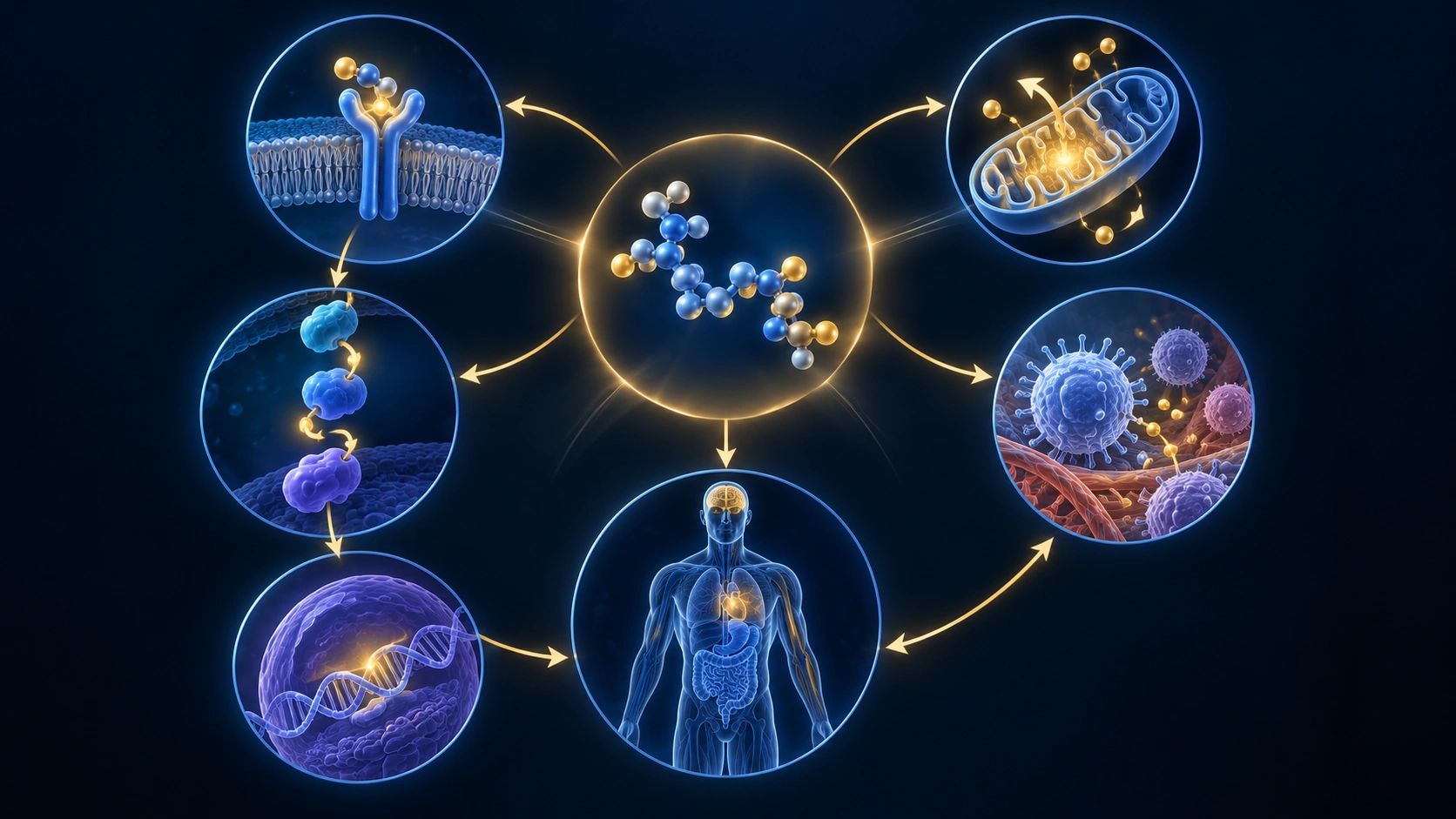
ANGIOTENSIN IV BIOLOGY
↓
Molecular engineering
↓
DIHEXA
↓
High-affinity interaction with:
HGF
↓
Facilitation of:
HGF → c-MET
↓
Downstream signaling:
- PI3K / AKT
- MAPK / OTHER GROWTH PATHWAYS
↓
DENDRITIC SPINOGENESIS
SYNAPTOGENESIS
Potential:
NEURONAL SURVIVAL
↓
Potential:
NETWORK CONNECTIVITY ↑
↓
Potential:
- LEARNING + MEMORY + COGNITIVE RECOVERY
The core concept is:
- DIHEXA MAY INCREASE THE BRAIN'S CAPACITY TO BUILD FUNCTIONAL CONNECTIONS BY AMPLIFYING HGF-DEPENDENT PLASTICITY SIGNALING.
WHAT THIS MECHANISM MAY SUGGEST
Mechanistically, Dihexa deserves research interest in:
- Alzheimer’s disease
- age-related cognitive decline
- synaptic-loss disorders
- memory impairment
- neurodegenerative disease
- impaired neural plasticity
- cognitive recovery
- post-injury network reconstruction
- Parkinsonian research
- Huntington-related neurodegeneration research
Its strongest conceptual niche may be:
- THE BRAIN HAS VIABLE NEURONS, BUT TOO MANY OF THE CONNECTIONS BETWEEN THEM HAVE BEEN LOST OR WEAKENED.
WHAT THIS MECHANISM DOES NOT PROVE
Dihexa biology does not prove that it:
- reverses Alzheimer’s disease
- permanently increases intelligence
- restores every lost memory
- regenerates dead brain tissue
- cures Parkinson’s disease
- treats Huntington’s disease
- works in every form of cognitive decline
- safely increases c-Met signaling indefinitely
- produces the same effect in humans as rodents
- should be used whenever someone wants better focus
- replaces cognitive rehabilitation
- removes amyloid or tau simply because cognition improves
Again:
- SYNAPTOGENESIS ≠ DISEASE REVERSAL.

PRECLINICAL COGNITIVE EVIDENCE
MEANINGFUL
Dihexa has demonstrated cognitive benefit in:
- scopolamine-impaired rats
- aged animals
- Alzheimer’s models
and has shown strong synaptogenic activity.
Again
mechanism and functional outcomes point:
- IN THE SAME DIRECTION.
NEURODEGENERATION EVIDENCE
EXPANDING PRECLINICALLY
Research has moved beyond Alzheimer’s-type models into other neurodegenerative settings, including recent Huntington-like disease work.
That suggests the underlying therapeutic idea may involve:
- NETWORK RECONSTRUCTION
rather than:
- ONE DISEASE-SPECIFIC PROTEIN.
HUMAN THERAPEUTIC EVIDENCE
NOT YET ESTABLISHED
This is the major translational gap.
Despite strong preclinical interest there is not yet a mature body of:
LARGE CONTROLLED HUMAN CLINICAL TRIALS
demonstrating Dihexa efficacy for:
- Alzheimer’s disease
- cognitive enhancement
- TBI
- Parkinson’s disease
- dementia
The correct conclusion is:
- THE PRECLINICAL SIGNAL IS UNUSUALLY INTERESTING.
But:
- HUMAN THERAPEUTIC EFFECTIVENESS REMAINS TO BE ESTABLISHED.
That is evidence calibration.
Not dismissal.
DO NOT BEGIN WITH DIHEXA
Begin with: IS THE COGNITIVE FAILURE ACTUALLY A CONNECTIVITY / PLASTICITY PROBLEM?
Then:
PHYSIOLOGY
↓
PATTERN
↓
MECHANISM
↓
EVIDENCE
↓
RISK
↓
MONITORING
↓
DECISION
PHYSIOLOGY
Normal cognition requires:
- viable neurons
- dendritic structure
- functional synapses
- neurotransmission
- cerebral perfusion
- mitochondrial energy
- sleep
- learning input
- neurotrophic signaling
Dihexa appears most relevant to:
- DENDRITIC + SYNAPTIC CONNECTIVITY.
EVIDENCE
Ask:
WHAT EVIDENCE ARE WE USING?
HGF binding?
DIRECT MECHANISTIC EVIDENCE.
c-Met activation?
DIRECT CELLULAR EVIDENCE.
Spinogenesis?
PRECLINICAL STRUCTURAL EVIDENCE.
Memory improvement?
PRECLINICAL FUNCTIONAL EVIDENCE.
Human dementia treatment?
NOT YET ESTABLISHED.
This is exactly why:
EVIDENCE CLASSES MATTER.
PATTERN
What is actually present?
- age-related cognitive decline?
- Alzheimer-type decline?
- post-injury dysfunction?
- impaired learning?
- synaptic-loss disorder?
- attention failure?
- sleep-related cognition?
- vascular cognitive impairment?
Again:
- “BRAIN FOG” IS NOT A SYNAPTOGENESIS DIAGNOSIS.
RISK
The relevant risk discussion begins with:
- THE MECHANISM.
Potential considerations include:
- unknown human dose-response
- unknown long-term CNS effects
- excessive or inappropriate plasticity
- peripheral HGF/c-Met exposure
- abnormal proliferative context
- active or prior malignancy requiring thoughtful evaluation
- product identity and purity
- interactions with other neuroactive therapies
- using cognitive enhancement to delay diagnosis of a progressive neurological disorder
Again
the HGF/c-Met oncology connection should not become:
- FEAR-BASED REASONING.
There is no basis to simply state:
- DIHEXA CAUSES CANCER.
The more appropriate position is:
- A GROWTH-FACTOR PATHWAY WITH KNOWN ONCOLOGIC RELEVANCE DESERVES CONTEXT-AWARE MONITORING AND BETTER HUMAN SAFETY DATA.
MECHANISM
Does HGF / c-Met biology match:
- THE DOMINANT BOTTLENECK?
If cognition is impaired because of:
- SEVERE SLEEP APNEA,
correct:
- OXYGENATION + SLEEP.
If:
- HYPOTHYROIDISM
is driving slowing:
correct:
- THYROID PHYSIOLOGY.
If the patient has:
- B12 DEFICIENCY,
correct:
- THE DEFICIENCY.
But if there is:
- SYNAPTIC LOSS + PRESERVED VIABLE NEURAL TISSUE,
then Dihexa becomes:
- MUCH MORE MECHANISTICALLY INTERESTING.
MONITORING
Monitoring should follow:
- THE NEURAL HYPOTHESIS.
COGNITION
- memory
- learning
- delayed recall
- attention
- executive function
- processing speed
FUNCTION
- occupational performance
- daily tasks
- medication management
- navigation
- independence
NEUROLOGICAL TRAJECTORY
where relevant:
- standardized cognitive testing
- neurological examination
- disease-specific measures
- imaging when clinically appropriate
FOUNDATIONAL DRIVERS
- sleep
- glucose
- blood pressure
- vascular risk
- thyroid
- nutritional status
- medication burden
Again:
if the hypothesis is:
- SYNAPTIC CONNECTIVITY IMPROVED,
then:
- LEARNING OR FUNCTION SHOULD IMPROVE.

THE PRAXIS 5
MECHANISM
Dihexa's strongest mechanistic identity is:
- HGF FACILITATION → c-MET → SYNAPTOGENESIS / SPINOGENESIS.
That is unusually specific for an experimental cognition-targeting molecule.
EVIDENCE
Target mechanism:
- STRONG PRECLINICALLY.
Synaptogenesis:
- STRONG PRECLINICALLY.
Animal cognition:
- MEANINGFUL.
Neurodegenerative models:
- PROMISING.
Direct human therapeutic evidence:
- NOT YET ESTABLISHED.
That is the appropriate calibration.
RISK
The most important conceptual mistake is:
- ASSUMING MORE SYNAPSES AUTOMATICALLY MEAN A HEALTHIER BRAIN.
Plasticity must be:
- APPROPRIATE
and:
- DIRECTED.
The second major issue is recognizing that:
- HGF / c-MET IS A POWERFUL GROWTH-FACTOR SYSTEM.
Context matters.
MONITORING
Monitor:
- LEARNING + MEMORY + FUNCTION + NEUROLOGICAL TRAJECTORY.
If the hypothesis is:
- NETWORK CONNECTIVITY IMPROVED,
then:
- THE NETWORK SHOULD PERFORM BETTER.
PATIENT CONTEXT
A healthy person looking for:
- MORE FOCUS
is not identical to someone with:
- EARLY SYNAPTIC LOSS.
A patient with:
- ALZHEIMER'S DISEASE
is not identical to someone whose cognition is impaired by:
- DEPRESSION OR SLEEP APNEA.
A patient with:
- NORMAL PROLIFERATIVE BIOLOGY
is not identical to someone with:
- ACTIVE c-MET-DRIVEN MALIGNANCY.
Same molecule.
Different:
- BIOLOGICAL ENVIRONMENT.
SEVEN QUESTIONS TO ASK BEFORE DIHEXA
1. WHAT COGNITIVE OR NEURAL FUNCTION ARE WE ACTUALLY TRYING TO CHANGE?
- memory?
- learning?
- neurodegeneration?
- post-injury connectivity?
- something else?
2. WHAT IS CAUSING THAT FAILURE?
- synaptic loss?
- neuronal death?
- vascular disease?
- sleep?
- metabolic dysfunction?
- attention failure?
3. DOES HGF / c-MET-DEPENDENT SYNAPTOGENESIS MATCH THE BOTTLENECK?
- This is the central mechanistic question.
4. WHAT TYPE OF EVIDENCE SUPPORTS THIS USE?
- molecular?
- cellular?
- animal cognition?
- neurodegeneration model?
- human trial?
5. WHAT BIOLOGICAL ENVIRONMENT WILL RECEIVE THE GROWTH SIGNAL?
This matters particularly when working with:
- HGF / c-MET BIOLOGY.
6. WHAT LEARNING OR REHABILITATION INPUT WILL DIRECT THE PLASTICITY?
- memory training?
- cognitive rehabilitation?
- physical activity?
- environmental enrichment?
7. WHAT WOULD DEFINE SUCCESS?
Not:
- “I FELT MORE MENTALLY ACTIVE.”
But:
- LEARNING, MEMORY, DAILY FUNCTION, OR NEUROLOGICAL PERFORMANCE IMPROVED IN A REPRODUCIBLE WAY WITHOUT AN UNFAVORABLE SIGNAL ELSEWHERE.


DIHEXA
KEY TAKEAWAYS
- Dihexa is a metabolically stabilized Angiotensin-IV–derived peptidomimetic.
- Its chemical identity is N-hexanoic-Tyr-Ile-(6)-aminohexanoic amide.
- It was engineered specifically to improve pharmacological properties that limited earlier AngIV-related peptides.
- Preclinical research describes Dihexa as orally active and blood-brain-barrier permeable.
- Its dominant mechanistic story involves hepatocyte growth factor — HGF — and the c-Met receptor system.
- Dihexa binds HGF with high affinity.
- Rather than simply acting as a conventional c-Met agonist, Dihexa appears to potentiate HGF-dependent c-Met signaling.
- That is a crucial mechanistic distinction.
- Dihexa has demonstrated hippocampal dendritic-spine formation and synaptogenesis experimentally.
- Its procognitive effects are strongly linked experimentally to the HGF/c-Met system.
- Blocking that system can block Dihexa's cognitive activity in animal models.
- Dihexa has improved spatial learning and memory in multiple preclinical paradigms.
- Its Alzheimer-related research is especially interesting because synaptic loss is a major component of cognitive failure.
- Dihexa therefore represents a different therapeutic strategy from simply removing amyloid or modifying a neurotransmitter.
- Its strategy is potentially to rebuild connectivity.
- An APP/PS1 mouse study also reported PI3K/AKT activation, improved cognitive performance, higher synaptic markers, and altered neuroinflammatory signaling.
- Research has expanded into other neurodegenerative models, including Huntington-like pathology.
- HGF/c-Met signaling is not unique to the brain.
- It is a powerful tissue-growth, survival, migration, and repair system.
- Abnormal c-Met activity also participates in some human cancers.
- That does not demonstrate that Dihexa causes cancer.
- It does mean that cellular context matters when evaluating long-term manipulation of the pathway.
- This is mechanism-based risk reasoning rather than a reason to dismiss the molecule.
- Dihexa should not be reduced to a generic nootropic.
- Its deeper biological identity is synaptogenic.
- Its most interesting question is not whether it makes someone feel more focused.
- It is whether an injured, aging, or degenerating brain can rebuild functional synaptic connectivity.
- Plasticity still requires direction.
- New synapses must become part of useful neural circuits.
- Learning, exercise, rehabilitation, sleep, and environmental input therefore remain biologically relevant.
- Direct human therapeutic efficacy remains much less established than the preclinical mechanistic evidence.
- That is the primary translational gap.
- The best question is not “is Dihexa the strongest cognitive peptide?”
- The better question is “has this brain lost functional connectivity, are sufficient viable neurons still present, is impaired HGF/c-Met-dependent synaptic plasticity a relevant bottleneck, can Dihexa meaningfully increase useful connections, and what cognitive input and objective functional outcome will show whether those connections actually improved the network?”
THE BOTTOM LINE
Dihexa may be one of the most important conceptual peptides in this section because it changes the question from:
- HOW DO WE MAKE THE NEURON FIRE MORE?
to:
- HOW DO WE HELP NEURONS RECONNECT?
That is a much deeper question.
A neuron can be alive.
It can have:
- oxygen
- glucose
- mitochondria
- neurotransmitters
and still contribute very little if:
- ITS NETWORK CONNECTIONS ARE GONE.
The brain is not simply:
- A COLLECTION OF CELLS.
It is:
- A NETWORK OF CONNECTIONS.
And cognition emerges from:
- THAT NETWORK.
So the Dihexa model becomes:
DISEASE / AGE / INJURY
↓
DENDRITIC SPINES LOST
↓
SYNAPSES LOST
↓
NEURAL NETWORK FRAGMENTS
↓
COGNITION DECLINES
Dihexa
↓
HGF FACILITATION
↓
c-MET SIGNALING
↓
SPINOGENESIS + SYNAPTOGENESIS
↓
Potential:
NETWORK RECONSTRUCTION
Then:
LEARNING / EXPERIENCE / REHABILITATION
↓
Connections stabilize according to:
WHAT THE BRAIN IS ACTUALLY ASKED TO DO.
That last step matters enormously.
Because:
- PLASTICITY IS NOT INTELLIGENCE.
Plasticity is:
- THE CAPACITY TO CHANGE.
And experience determines:
- WHAT CHANGE IS REINFORCED.
Dihexa also forces us to confront another fundamental biological principle:
- REPAIR AND GROWTH ARE CLOSE RELATIVES.
HGF/c-Met can support:
- NEURAL REPAIR.
The same system participates in:
- TISSUE GROWTH + CELL MIGRATION.
And when dysregulated it participates in:
- CANCER BIOLOGY.
That does not make the pathway:
- BAD.
Without growth signaling we could not:
- DEVELOP
- HEAL
- REGENERATE
or:
- REBUILD SYNAPSES.
The correct question is always:
- WHERE?
- WHEN?
- HOW MUCH?
- IN WHAT CELL?
That is the Praxis Lens.
So the final question becomes:
- “WHAT is actually causing the cognitive failure, are the neurons gone or merely disconnected, is synaptic connectivity really the limiting node, can HGF/c-Met facilitation create useful new connections, what learning environment will tell those connections where they belong, and how will we determine whether the brain became more functional rather than simply more biologically active?”
That is the difference between:
- CALLING DIHEXA A NOOTROPIC
and:
- UNDERSTANDING SYNAPTIC REGENERATION.
STOP MEMORIZING PEPTIDES. START UNDERSTANDING THE SYSTEM.