Clinical Peptide Medicine — Structured. Applied. Evolving.
UNDERSTAND THE PEPTIDE
Cerebrolysin is not a single peptide.
That is the first thing to understand.
It is a:
- PARENTERAL PEPTIDE / AMINO-ACID PREPARATION
containing low-molecular-weight peptides and amino acids derived through controlled enzymatic processing of porcine brain proteins.
That makes Cerebrolysin fundamentally different from:
- Semax
- Selank
- PE-22-28
- Pinealon
- Oxytocin
Those are:
- DEFINED MOLECULES.
Cerebrolysin is:
- A COMPLEX BIOACTIVE MIXTURE.
Its research has focused on:
- neuroprotection
- neuroplasticity
- neuronal survival
- synaptic recovery
- stroke
- traumatic brain injury
- cognitive decline
- neurodegenerative disease
- neurotrophic signaling
The best way to understand Cerebrolysin is not:
- “A BRAIN-HEALING PEPTIDE.”
A better description is:
- A MULTICOMPONENT NEUROTROPHIC PEPTIDE PREPARATION DESIGNED TO SUPPORT NEURONAL SURVIVAL, PLASTICITY, AND RECOVERY ACROSS MULTIPLE BRAIN-INJURY PATHWAYS.
That distinction matters.
Because brain injury is rarely:
- ONE PATHWAY.
It is usually:
- ENERGY FAILURE
- EXCITOTOXICITY
- INFLAMMATION
- OXIDATIVE STRESS
- CELL DEATH
- LOSS OF CONNECTIVITY
- IMPAIRED PLASTICITY
Cerebrolysin is interesting because the proposed biology aims at:
- THE WHOLE RECOVERY ENVIRONMENT.
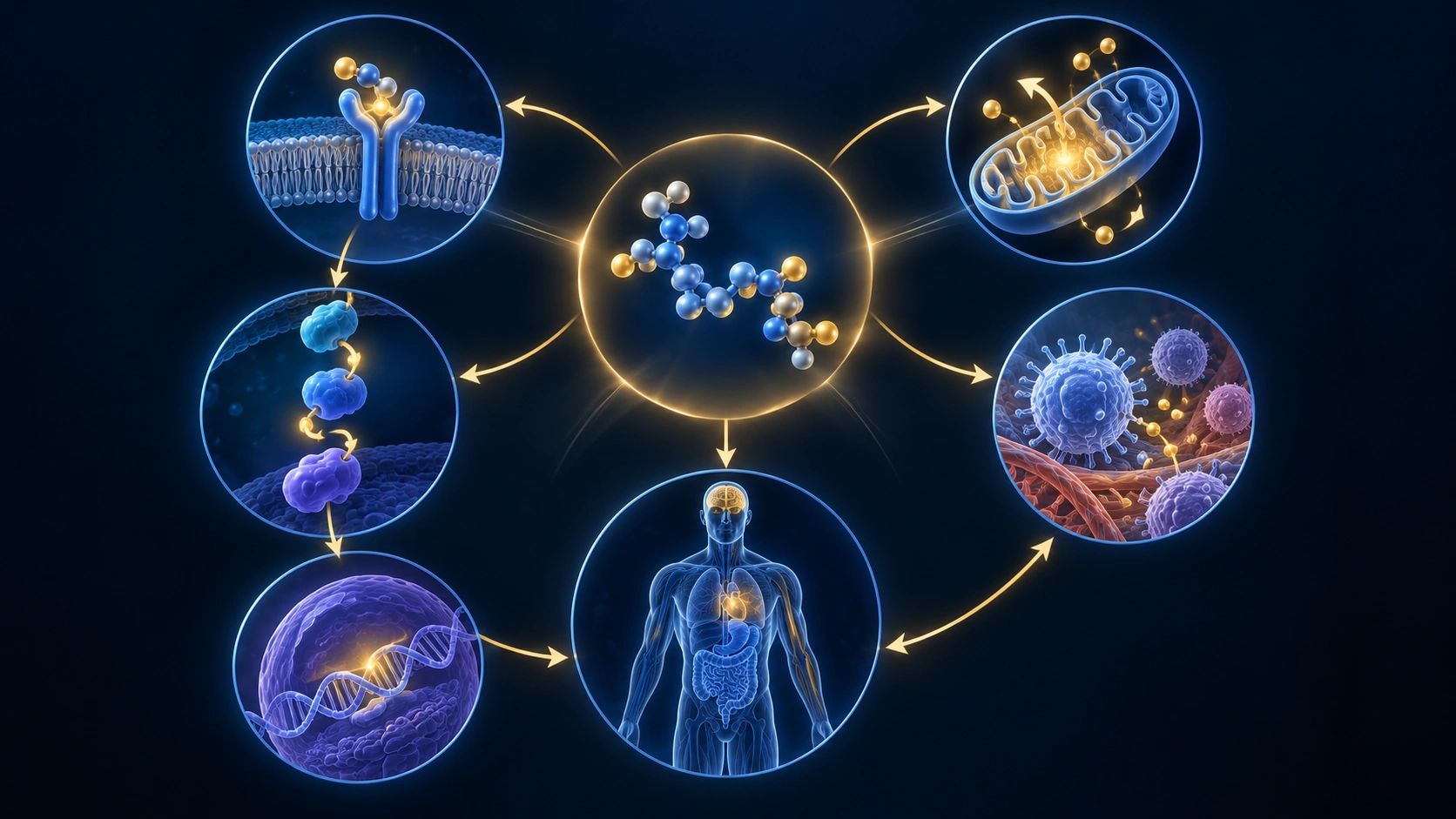
THE CORE MECHANISM MAP
CEREBROLYSIN
↓
Multicomponent low-molecular-weight peptide preparation
↓
Potential:
- NEUROTROPHIC SIGNALING
- CELL-SURVIVAL SUPPORT
- SYNAPTIC PLASTICITY
- INFLAMMATORY / OXIDATIVE-STRESS MODULATION
↓
Potential:
- NEURONAL PRESERVATION
- NETWORK REORGANIZATION
↓
Potential:
- NEUROLOGICAL + COGNITIVE RECOVERY
The core concept is:
- CEREBROLYSIN IS BEST UNDERSTOOD AS A NEURORECOVERY ENVIRONMENT MODIFIER RATHER THAN A SINGLE-PATHWAY DRUG.
WHAT THIS MECHANISM MAY SUGGEST
Mechanistically, Cerebrolysin deserves interest in:
- acute ischemic stroke
- stroke rehabilitation
- traumatic brain injury
- post-injury cognitive dysfunction
- neuroplasticity
- selected neurodegenerative conditions
- cognitive recovery
- neuronal injury
- neurorehabilitation
Its strongest conceptual niche may be:
- A DAMAGED BUT STILL ADAPTABLE NERVOUS SYSTEM.
WHAT THIS MECHANISM DOES NOT PROVE
Cerebrolysin biology does not prove that it:
- regenerates dead brain tissue
- reverses every stroke
- replaces thrombectomy or thrombolysis
- cures traumatic brain injury
- reverses Alzheimer's disease
- permanently restores all lost cognition
- replaces physical, occupational, or speech therapy
- improves every form of brain fog
- works equally well at every stage of neurological injury
Again:
- DEAD TISSUE
and:
- DYSFUNCTIONAL BUT VIABLE TISSUE
are not the same biological target.

HUMAN STROKE EVIDENCE
SUBSTANTIAL BUT CONFLICTING
There are multiple randomized clinical trials and meta-analyses.
Some analyses report:
- EARLY NEUROLOGICAL BENEFIT.
Others find:
- NO CLEAR LONG-TERM FUNCTIONAL SUPERIORITY.
This makes Cerebrolysin one of those therapies where:
- THE EVIDENCE CANNOT HONESTLY BE SUMMARIZED IN ONE WORD.
HUMAN TBI EVIDENCE
PROMISING
Randomized trials have reported signals in:
- cognition
- neurological recovery
- multidimensional outcome measures
but trial sizes remain relatively modest and confirmatory work remains important.
SAFETY EVIDENCE
A 2021 systematic review and meta-analysis pooled 2,202 patients from 12 randomized stroke trials and did not find statistically significant differences in major safety outcomes between Cerebrolysin and placebo.
That is meaningful.
But safety still depends on:
- patient context
- route
- comorbidities
- concurrent therapies
- product integrity
Again:
- TRIAL-LEVEL SAFETY ≠ ZERO INDIVIDUAL RISK.
DO NOT BEGIN WITH CEREBROLYSIN
Begin with: WHAT PART OF THE NERVOUS SYSTEM IS DAMAGED — AND WHAT PART IS STILL RECOVERABLE?
Then:
PHYSIOLOGY
↓
PATTERN
↓
MECHANISM
↓
EVIDENCE
↓
RISK
↓
MONITORING
↓
DECISION
PHYSIOLOGY
Neurological recovery requires:
- viable neurons
- adequate perfusion
- oxygen
- glucose
- mitochondrial function
- controlled inflammation
- synaptic plasticity
- rehabilitation
- sleep
- metabolic support
Cerebrolysin appears most relevant to:
SURVIVAL + PLASTICITY + RECOVERY.
EVIDENCE
Ask:
WHAT OUTCOME ARE WE TRYING TO CHANGE?
- Early NIHSS?
- 90-day mRS?
- Memory?
- Executive function?
- Activities of daily living?
Then:
- USE THE EVIDENCE FOR THAT OUTCOME.
Cerebrolysin is a perfect example of why:
- ONE META-ANALYSIS HEADLINE
does not tell the whole story.
PATTERN
What is actually present?
- acute ischemic stroke?
- post-stroke deficit?
- mild TBI?
- severe TBI?
- cognitive impairment?
- neurodegenerative disease?
- post-hypoxic injury?
Again:
- “BRAIN INJURY” IS NOT ONE PATTERN.
RISK
Potential considerations include:
- infusion-related adverse effects
- agitation or neurologic symptoms in susceptible individuals
- seizure-related clinical context where appropriate
- product integrity
- renal/medical context
- interactions with complex neurological treatment
- delaying proven acute neurological treatment
- assuming cognitive improvement means structural disease modification
Again:
the biggest risk can be:
- USING ADJUNCTIVE NEURORECOVERY IN PLACE OF PRIMARY CARE THAT SAVES TISSUE.
MECHANISM
Does Cerebrolysin biology match:
- THE DOMINANT BOTTLENECK?
If acute stroke tissue is dying because:
- AN ARTERY IS OCCLUDED,
the first priority is:
- REPERFUSION.
If the patient has:
- UNTREATED SLEEP APNEA
driving cognitive impairment:
correct:
- THE HYPOXIA.
If the patient is in:
- ACTIVE NEUROREHABILITATION
with viable but dysfunctional neural networks:
neurotrophic/plasticity support becomes:
- MUCH MORE MECHANISTICALLY INTERESTING.
MONITORING
Monitoring should follow:
- THE NEUROLOGICAL TARGET.
STROKE
- NIHSS
- modified Rankin Scale
- Barthel Index
- motor recovery
- speech
- activities of daily living
TBI
- cognition
- executive function
- memory
- balance
- mood
- daily function
- return to work
COGNITIVE DISORDERS
- standardized testing
- memory
- attention
- executive function
- functional independence
REHABILITATION
- task performance
- strength
- gait
- speech
- occupational function
Again
monitor:
- WHAT THE BRAIN CAN DO.

THE PRAXIS 5
MECHANISM
Cerebrolysin appears to work through:
- MULTIPATHWAY NEUROTROPHIC + NEUROPROTECTIVE + NEUROPLASTIC BIOLOGY.
EVIDENCE
Mechanistic / preclinical:
- SUBSTANTIAL.
Stroke clinical evidence:
- SUBSTANTIAL BUT MIXED.
TBI clinical evidence:
- PROMISING.
Neurodegenerative applications:
- APPLICATION-DEPENDENT.
Safety evidence:
- GENERALLY REASSURING IN RANDOMIZED STROKE DATA.
RISK
The largest conceptual error is:
- ASSUMING A NEUROTROPHIC THERAPY CAN RESTORE TISSUE THAT IS ALREADY IRREVERSIBLY DESTROYED.
The likely target is:
- VIABLE OR ADAPTABLE NEURAL TISSUE.
MONITORING
Monitor:
- NEUROLOGICAL FUNCTION + COGNITION + REHABILITATION TRAJECTORY.
If the hypothesis is:
- BETTER RECOVERY,
then:
- RECOVERY SHOULD ACCELERATE OR IMPROVE.
PATIENT CONTEXT
A patient:
- 6 HOURS AFTER ISCHEMIC STROKE
is not identical to:
someone:
- 6 MONTHS INTO STROKE REHABILITATION.
A patient with:
- MILD CONCUSSION
is not identical to:
someone with:
- DIFFUSE AXONAL INJURY.
A patient with:
- ALZHEIMER'S DISEASE
is not identical to:
someone recovering from:
- AN ACUTE TBI.
Same therapy.
Different:
- NEURAL RECOVERY ENVIRONMENT.
SEVEN QUESTIONS TO ASK BEFORE CEREBROLYSIN
1. WHAT NEUROLOGICAL PROBLEM ARE WE ACTUALLY TRYING TO CHANGE?
- stroke?
- TBI?
- cognition?
- neurodegeneration?
- rehabilitation?
2. WHAT TISSUE IS STILL VIABLE AND RECOVERABLE?
- This may be one of the most important questions.
3. WHAT STAGE OF INJURY IS PRESENT?
- acute neuroprotection?
- subacute recovery?
- chronic rehabilitation?
- progressive degeneration?
4. DOES CEREBROLYSIN'S NEUROTROPHIC / PLASTICITY BIOLOGY MATCH THAT STAGE?
The mechanism must fit:
- THE TIMELINE.
5. WHAT TYPE OF EVIDENCE SUPPORTS THIS PARTICULAR USE?
- stroke RCT?
- TBI RCT?
- cognitive trial?
- animal model?
- mechanistic research?
6. WHAT REHABILITATION INPUT WILL DIRECT THE PLASTICITY?
- PT?
- OT?
- speech?
- cognitive rehab?
7. WHAT WOULD DEFINE SUCCESS?
Not:
- “THE PATIENT FELT CLEARER.”
But:
- NEUROLOGICAL FUNCTION, COGNITION, INDEPENDENCE, OR REHABILITATION TRAJECTORY IMPROVED IN A REPRODUCIBLE WAY.


CEREBROLYSIN
KEY TAKEAWAYS
- Cerebrolysin is not a single defined peptide.
- It is a multicomponent preparation containing low-molecular-weight peptides and amino acids.
- Its central pharmacological identity is neurotrophic and neurorestorative.
- It has been used clinically in multiple countries and has a substantial neurological research history.
- Cerebrolysin is best understood through neuroprotection and neurorestoration.
- Neuroprotection aims to preserve injured but viable tissue.
- Neurorestoration aims to help surviving neural networks reorganize.
- These are different stages of recovery.
- Cerebrolysin has extensive stroke research.
- Some randomized-trial meta-analyses show significant early neurological improvement.
- Other meta-analyses do not demonstrate significant improvement in longer-term disability measures.
- This should be described as mixed evidence rather than simply positive or negative.
- Different outcomes and time points may partly explain apparently conflicting conclusions.
- Cerebrolysin has also been studied in traumatic brain injury.
- Randomized TBI trials have reported promising cognitive and multidimensional recovery signals.
- The TBI evidence remains smaller than the stroke literature.
- Cerebrolysin should not replace reperfusion in acute ischemic stroke.
- It should not replace rehabilitation after stroke or TBI.
- Its most coherent role is as an adjunct within a larger neurorecovery system.
- Plasticity requires direction.
- Physical therapy, occupational therapy, speech therapy, cognitive rehabilitation, sleep, nutrition, and repeated task-specific input remain part of the biological recovery process.
- A neurotrophic environment without meaningful rehabilitation may fail to translate into functional recovery.
- The safety profile across pooled randomized stroke trials has generally been comparable with placebo.
- Cerebrolysin's multicomponent nature is both a potential strength and a scientific limitation.
- A mixture may influence multiple injury pathways simultaneously.
- But it also makes precise receptor-level pharmacology more difficult to define.
- Cognitive improvement does not automatically mean neurodegenerative disease progression has been reversed.
- Functional improvement and disease modification are different outcomes.
- The best question is not “does Cerebrolysin heal the brain?”
- The better question is “what neural tissue remains viable, which stage of injury or recovery is present, is impaired survival or plasticity actually the bottleneck, can the therapy improve the biological environment for recovery, and what rehabilitation and objective functional measures will show whether the nervous system truly reorganized?”
THE BOTTOM LINE
Cerebrolysin may be one of the best examples in this library for understanding:
- WHY REGENERATIVE NEUROLOGY CANNOT BE REDUCED TO ONE MOLECULE.
A stroke does not damage:
- ONE PATHWAY.
A TBI does not damage:
- ONE PATHWAY.
They create:
ENERGY FAILURE
↓
ION DYSREGULATION
↓
EXCITOTOXICITY
↓
OXIDATIVE STRESS
↓
INFLAMMATION
↓
CELL DEATH
↓
LOSS OF NETWORK CONNECTIONS
And then:
if the patient survives:
the brain has to:
- REBUILD FUNCTION.
That requires:
- PLASTICITY.
Cerebrolysin is interesting because it is conceptually designed around:
- THAT MULTIPATHWAY PROBLEM.
The potential model is:
INJURY
↓
Protect what can still be protected.
↓
Support surviving neurons.
↓
Create a more favorable trophic environment.
↓
Introduce:
REHABILITATION.
↓
Repeat meaningful movement, language, memory, or cognitive tasks.
↓
Neural networks reorganize.
↓
Potential:
FUNCTION RETURNS.
That last step matters most.
Not:
- BDNF.
Not:
- ONE PEPTIDE FRACTION.
Not:
- ONE MRI IMAGE.
The outcome is:
- CAN THE PERSON WALK?
- CAN THE PERSON SPEAK?
- CAN THE PERSON REMEMBER?
- CAN THE PERSON FUNCTION INDEPENDENTLY?
And this also explains why the stroke evidence can look contradictory.
A therapy might improve:
- EARLY NEUROLOGICAL DEFICIT
while producing a smaller or harder-to-detect difference in:
- LONG-TERM DISABILITY.
Those are not the same outcome.
So the Praxis question becomes:
- “WHAT neural tissue is still salvageable or adaptable, what stage of injury is present, is the dominant problem ongoing cell loss or inadequate network reorganization, does Cerebrolysin's multicomponent neurotrophic biology match that stage, what rehabilitative input will direct the plasticity, and what objective neurological or cognitive measure will demonstrate that recovery actually improved?”
That is the difference between:
- CALLING SOMETHING A BRAIN-REPAIR DRUG
and:
- UNDERSTANDING NEURORECOVERY.
STOP MEMORIZING PEPTIDES. START UNDERSTANDING THE SYSTEM.