Clinical Peptide Medicine — Structured. Applied. Evolving.

Praxis Peptide Institute
  • HOME
  • START HERE
  • LEARN
  • PEPTIDE GUIDES
  • PEP EXPERIENCE REGISTRY
  • EXPLORE REGISTRY
  • ADVANCED LEARNER TRAINING
  • CLINICIAN TRAINING
  • ABOUT
  • More
    • HOME
    • START HERE
    • LEARN
    • PEPTIDE GUIDES
    • PEP EXPERIENCE REGISTRY
    • EXPLORE REGISTRY
    • ADVANCED LEARNER TRAINING
    • CLINICIAN TRAINING
    • ABOUT
  • Sign In
  • Create Account

  • My Account
  • Signed in as:

  • filler@godaddy.com


  • My Account
  • Sign out

Signed in as:

filler@godaddy.com

  • HOME
  • START HERE
  • LEARN
  • PEPTIDE GUIDES
  • PEP EXPERIENCE REGISTRY
  • EXPLORE REGISTRY
  • ADVANCED LEARNER TRAINING
  • CLINICIAN TRAINING
  • ABOUT

Account

  • My Account
  • Sign out

  • Sign In
  • My Account

BPC-157 Guide: Mechanism, Evidence, Safety, Tissue Repair, and the Praxis Lens

 A comprehensive BPC-157 guide covering biological identity, proposed repair mechanisms, gastrointestinal and musculoskeletal evidence, human data limitations, safety, monitoring, product quality, and the Praxis clinical reasoning framework. 

UNDERSTAND THE PEPTIDE

BPC-157 is a synthetic 15-amino-acid peptide that has become one of the most discussed compounds in regenerative and peptide-medicine communities.


Its reputation comes largely from a broad preclinical literature showing effects in models involving:

  • gastrointestinal injury 
  • tendon and ligament healing 
  • skeletal-muscle injury 
  • vascular repair 
  • nitric-oxide signaling 
  • angiogenesis 
  • inflammatory regulation 
  • neurological injury 


That biology is genuinely interesting.

But the clinical evidence has advanced far more slowly than:

  • THE CLAIMS SURROUNDING THE PEPTIDE.

BPC-157 HAS A SUBSTANTIAL PRECLINICAL SIGNAL, EXTREMELY LIMITED HUMAN CLINICAL VALIDATION, AND MAJOR UNANSWERED QUESTIONS ABOUT PHARMACOLOGY, SAFETY, PRODUCT QUALITY, AND WHICH HUMAN CONDITIONS—WILL ULTIMATELY JUSTIFY ITS USE. 
WHAT IS BPC-157?

BODY PROTECTION COMPOUND-157

BODY PROTECTION COMPOUND-157

BODY PROTECTION COMPOUND-157

 It is a:

15-AMINO-ACID PENTADECApeptide.


The sequence is generally described as having been derived from a peptide fragment associated with gastric protein biology.


That point deserves precision.

BPC-157 is often marketed as though it were simply:

“A NATURAL PEPTIDE ALREADY PRESENT THROUGHOUT THE HUMAN BODY.”


That characterization is too broad.


The therapeutic compound being discussed is:

A SYNTHETIC PEPTIDE USED EXPERIMENTALLY TO REPRODUCE OR EXTEND BIOLOGICAL EFFECTS OBSERVED IN PRECLINICAL MODELS.

THE IDENTITY MODEL

BODY PROTECTION COMPOUND-157

BODY PROTECTION COMPOUND-157

 GASTRIC-ASSOCIATED PEPTIDE SEQUENCE

↓

SYNTHETIC 15-AMINO-ACID BPC-157

↓

Potential effects on:

REPAIR SIGNALING

VASCULAR SIGNALING

INFLAMMATORY SIGNALING

CELL SURVIVAL

TISSUE RESPONSE

↓

Potential physiological outcome


POTENTIAL PHYSIOLOGICAL OUTCOME ≠ PROVEN HUMAN TREATMENT

IS BPC-157 A HORMONE?

BODY PROTECTION COMPOUND-157

DOES BPC-157 HAVE ONE KNOWN RECEPTOR?

 Not in the classic endocrine sense.

It is not best understood like:

insulin 

glucagon 

thyroid hormone 

GLP-1 

Where a clearly defined endocrine organ releases the molecule into circulation to regulate a well-characterized receptor system.


BPC-157 is better approached as an:

EXPERIMENTAL BIOACTIVE PEPTIDE WITH MULTIPLE PROPOSED CELLULAR AND TISSUE EFFECTS.


That distinction matters because the mechanism of BPC-157 is:

LESS RECEPTOR-DEFINED

than many established therapeutic peptides.

DOES BPC-157 HAVE ONE KNOWN RECEPTOR?

DOES BPC-157 HAVE ONE KNOWN RECEPTOR?

DOES BPC-157 HAVE ONE KNOWN RECEPTOR?

 This is one of the most important things to understand.


For GLP-1:

GLP-1 → GLP-1 RECEPTOR


For ghrelin:

GHRELIN → GHSR


For insulin:

INSULIN → INSULIN RECEPTOR


For BPC-157:

the biology is:

MUCH LESS CLEANLY DEFINED.


There is not currently one universally accepted, clinically validated receptor that explains all of the effects attributed to BPC-157.


Instead, preclinical literature suggests interactions involving multiple signaling systems.


That immediately increases uncertainty.


MULTIPLE DOWNSTREAM EFFECTS WITHOUT A SINGLE WELL-CHARACTERIZED PRIMARY TARGET MAKE PHARMACOLOGY HARDER TO PREDICT.

HOW BPC-157 MAY WORK

DOES BPC-157 HAVE ONE KNOWN RECEPTOR?

NITRIC-OXIDE SIGNALING

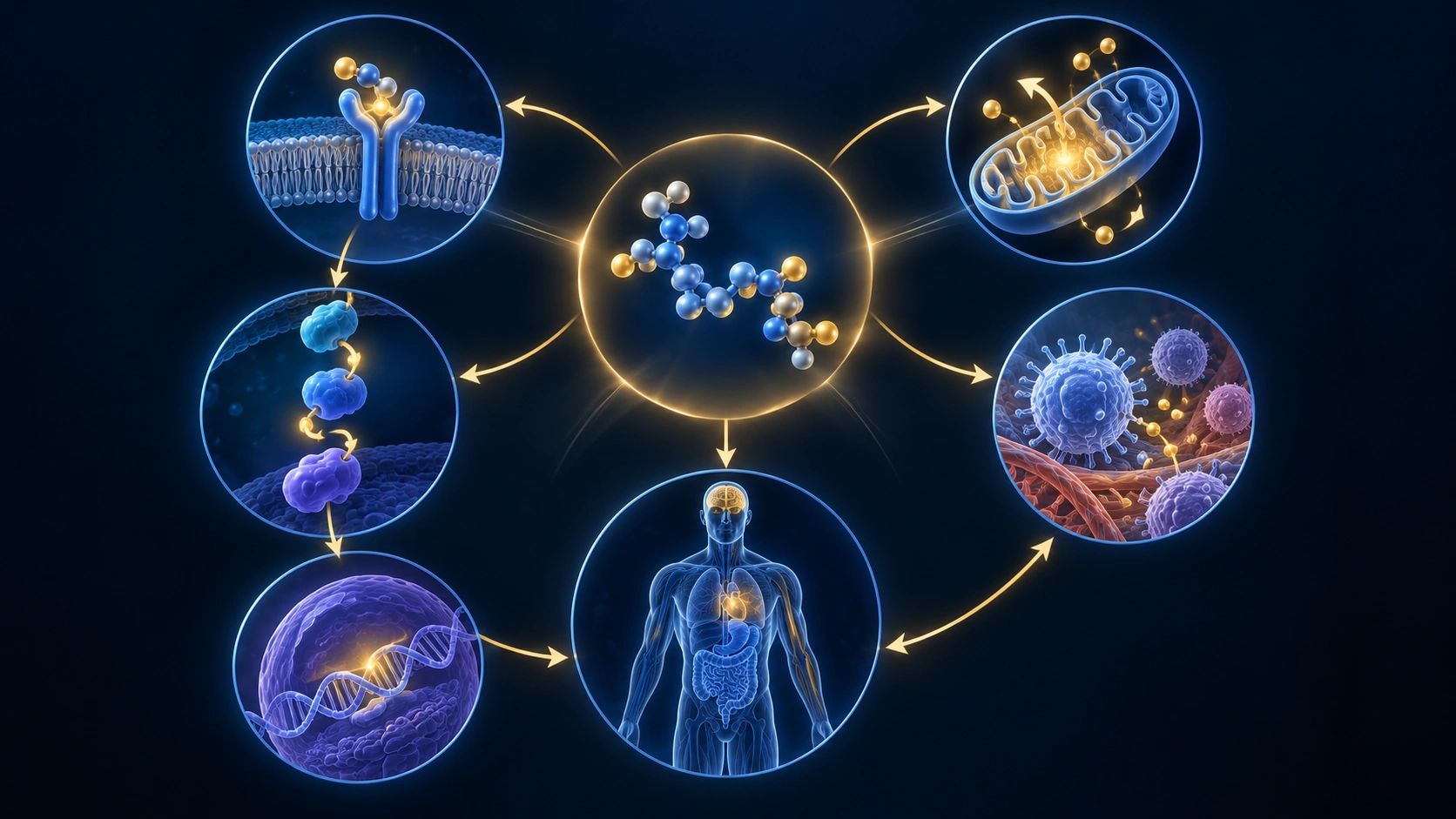
 Several proposed mechanisms repeatedly appear in the preclinical literature.

These include:

nitric-oxide signaling 

angiogenesis 

VEGF-related pathways 

endothelial repair 

inflammatory regulation 

ERK-related signaling 

fibroblast activity 

tissue remodeling 

cellular survival pathways 


Recent reviews describe proposed effects involving nitric-oxide synthase, vascular signaling, endothelial activity, ERK1/2, fibroblast behavior, and inflammatory modulation, while emphasizing that these mechanisms remain predominantly preclinical.

NITRIC-OXIDE SIGNALING

DOES BPC-157 HAVE ONE KNOWN RECEPTOR?

NITRIC-OXIDE SIGNALING

 One of the repeatedly proposed BPC-157 pathways involves:

NITRIC OXIDE — NO.


Nitric oxide participates in:

vascular tone 

blood flow 

endothelial function 

tissue perfusion 

inflammatory biology 

repair signaling 


BPC-157 has been reported in experimental models to interact with:

NOS / NO-RELATED PATHWAYS.

ANGIOGENESIS AND VEGF

AN IMPORTANT COUNTERPOINT

ANGIOGENESIS AND VEGF

 BPC-157 is frequently associated with:

ANGIOGENIC SIGNALING.


Angiogenesis means:

FORMATION OR EXPANSION OF BLOOD-VESSEL NETWORKS.


This can be beneficial during:

wound healing 

tissue repair 

tendon healing 

ischemic recovery 


Because damaged tissue needs:

OXYGEN + NUTRIENT DELIVERY.


Experimental studies have suggested effects involving:

VEGF-RELATED SIGNALING.

THE REPAIR MODEL

AN IMPORTANT COUNTERPOINT

ANGIOGENESIS AND VEGF

 TISSUE DAMAGE

↓

LOCAL REPAIR SIGNALING

↓

Potential BPC-157 influence on:

VEGF / ENDOTHELIAL SIGNALING

↓

VASCULAR SUPPORT

↓

Potential:

TISSUE RECOVERY

AN IMPORTANT COUNTERPOINT

AN IMPORTANT COUNTERPOINT

AN IMPORTANT COUNTERPOINT

  Angiogenesis is not universally:

GOOD.


It is a physiological process.

The body uses it for:

HEALING.


But pathological tissues can also use vascular signaling.

That is why:

“IT INCREASES ANGIOGENESIS”

should never automatically be translated into:

“THEREFORE IT IS SAFE AND REGENERATIVE.”


The correct question is:

WHERE?

HOW MUCH?

FOR HOW LONG?

IN WHAT PATIENT?

ENDOTHELIAL FUNCTION

ERK / MAPK-RELATED SIGNALING

AN IMPORTANT COUNTERPOINT

 The endothelium lines:

BLOOD VESSELS.


It controls:

vascular tone 

permeability 

coagulation biology 

inflammatory recruitment 

tissue perfusion 


BPC-157 has shown experimental effects involving:

ENDOTHELIAL PRESERVATION AND VASCULAR RESPONSE.


Again:

this may help explain why one peptide appears to affect:

MULTIPLE DIFFERENT TISSUES.


Many damaged tissues share one requirement:

ADEQUATE MICROVASCULAR SUPPORT.

FIBROBLAST ACTIVITY

ERK / MAPK-RELATED SIGNALING

ERK / MAPK-RELATED SIGNALING

   Fibroblasts are important for:

extracellular matrix 

collagen 

wound repair 

tendon remodeling 

scar formation 


Preclinical BPC-157 work has suggested changes in:

FIBROBLAST MIGRATION AND REPAIR-RELATED ACTIVITY.


Again:

this provides biological plausibility for interest in:

tendon 

ligament 

muscle injury 


But:

BIOLOGICAL PLAUSIBILITY IS NOT A HUMAN CLINICAL ENDPOINT.

ERK / MAPK-RELATED SIGNALING

ERK / MAPK-RELATED SIGNALING

ERK / MAPK-RELATED SIGNALING

 Preclinical literature has also described BPC-157 effects involving:

ERK1/2-RELATED SIGNALING.


These pathways participate broadly in:

proliferation 

cell survival 

migration 

repair 


Again:

this reinforces the possibility that BPC-157 influences:

MULTIPLE REPAIR NODES RATHER THAN ONE SINGLE RECEPTOR.

THE CORE MECHANISM MAP

 BPC-157

↓

Modulation of:

NO SIGNALING

ENDOTHELIAL FUNCTION

VEGF / ANGIOGENIC SIGNALING

ERK / CELL-SURVIVAL PATHWAYS

FIBROBLAST / MATRIX RESPONSE

INFLAMMATORY SIGNALING

↓

TISSUE REPAIR + VASCULAR SUPPORT + CELLULAR RECOVERY


THE MAJORITY OF THIS MODEL COMES FROM PRECLINICAL DATA.

INFLAMMATORY SIGNALING

BPC-157 has also shown anti-inflammatory or inflammation-modulating effects in:

PRECLINICAL MODELS.


That does not necessarily mean:

IMMUNOSUPPRESSION.


Nor does it mean:

BPC-157 TREATS EVERY INFLAMMATORY CONDITION.


Inflammation is part of:

NORMAL REPAIR.


The goal is not:

ZERO INFLAMMATION.


It is:

APPROPRIATE INFLAMMATION, AT THE APPROPRIATE TIME.

WHAT THIS MECHANISM MAY SUGGEST

Mechanistically, BPC-157 may deserve investigation for:

  • gastrointestinal tissue injury 
  • tendon injury 
  • ligament injury 
  • muscle injury 
  • vascular repair 
  • wound healing 
  • selected inflammatory injury states

WHAT THIS MECHANISM DOES NOT PROVE

It does not prove that BPC-157:

  • accelerates every human injury 
  • regenerates cartilage 
  • heals complete tendon rupture 
  • replaces surgery 
  • cures inflammatory bowel disease 
  • reverses neurological injury 
  • is safe long term 
  • is safe in cancer 
  • is safe systemically 
  • is effective by every administration route 


MECHANISM GENERATES HYPOTHESES.

THE EVIDENCE, POTENTIAL APPLICATIONS, AND LIMITATIONS

ENDOGENOUS / PHYSIOLOGICAL BIOLOGY

LIMITED TO MODERATE CHARACTERIZATION

The proposed gastric peptide biology is interesting, but the therapeutic BPC-157 story should not be presented as though it were a fully characterized endogenous endocrine pathway.

PRECLINICAL EVIDENCE

This is where BPC-157 has its strongest evidence base.

Animal and laboratory studies encompass multiple tissue systems.

HUMAN CLINICAL EFFICACY EVIDENCE

VERY LIMITED

A 2025 systematic review of the musculoskeletal literature found 35 preclinical studies and only one clinical study among the 36 included studies

HUMAN SAFETY EVIDENCE

A very small 2025 pilot study administered IV BPC-157 to only two previously exposed adults and reported no short-term adverse effects at the doses studied. That is useful preliminary information but nowhere near sufficient to establish population safety, long-term safety, or safety across routes. 


FDA's July 2026 review concluded that there remains insufficient clinical safety information to characterize BPC-157's safety profile, especially across proposed oral, subcutaneous, nasal, or transdermal administration.

REGULATORY STATUS

INVESTIGATIONAL / NOT FDA APPROVED (as of 02SEP2026)

There is currently no FDA-approved BPC-157 therapeutic product. FDA has also identified potential concerns involving immunogenicity, peptide-related impurities, and API characterization in compounded BPC-157 products.

Research

GASTROINTESTINAL RESEARCH

TENDON AND LIGAMENT RESEARCH

TENDON AND LIGAMENT RESEARCH

Preclinical studies have examined:

mucosal injury 

ulcer models 

intestinal damage 

inflammatory injury 

GI healing 


These studies provide substantial:

BIOLOGICAL PLAUSIBILITY.


But human therapeutic evidence remains:

SPARSE.


FDA's 2026 compounding review specifically evaluated BPC-157 for ulcerative colitis and concluded that evidence was insufficient to establish clinical safety for long-term use, while noting only limited human rectal-enema data. 


So:

PRECLINICAL GI SIGNAL = INTERESTING

TENDON AND LIGAMENT RESEARCH

TENDON AND LIGAMENT RESEARCH

TENDON AND LIGAMENT RESEARCH

This is probably the area responsible for most of BPC-157's popularity in:

SPORTS MEDICINE.


Animal models have suggested:

tendon healing 

tendon-to-bone recovery 

ligament repair 

fibroblast migration 

improved structural organization 


The 2025 orthopedic systematic review concluded that the musculoskeletal evidence is overwhelmingly preclinical and that human data remain insufficient for reliable clinical recommendations. 


PRECLINICAL CONSISTENCY


MUSCLE INJURY

TENDON AND LIGAMENT RESEARCH

BONE AND FRACTURE RESEARCH

Experimental models suggest possible effects involving:

muscle recovery 

vascular support 

neuromuscular repair 

tissue organization 


Again:

strong enough to justify:

RESEARCH INTEREST.


BONE AND FRACTURE RESEARCH

BONE AND FRACTURE RESEARCH

BONE AND FRACTURE RESEARCH

Animal models have investigated BPC-157 in:

BONE-HEALING CONTEXTS.


But there is no robust human fracture-healing evidence establishing it as:

A CLINICAL FRACTURE THERAPY.

JOINT PAIN

BONE AND FRACTURE RESEARCH

NEUROLOGICAL RESEARCH

A very small uncontrolled human report involving intra-articular use has contributed to interest in:

KNEE PAIN.


But the methodology, sample size, and lack of proper controls prevent strong conclusions.


NEUROLOGICAL RESEARCH

BONE AND FRACTURE RESEARCH

NEUROLOGICAL RESEARCH

BPC-157 has also generated preclinical interest involving:

peripheral nerve injury 

central nervous system injury 

neurotransmitter-related effects 

recovery models 


Again:

these are:

EARLY MECHANISTIC / PRECLINICAL SIGNALS.

VASCULAR RESEARCH

WHAT WE THINK MAY BE HAPPENING

VASCULAR RESEARCH

The vascular literature is especially interesting because:

NO + ENDOTHELIAL + ANGIOGENIC SIGNALING

may connect many of the seemingly unrelated BPC-157 findings.


Again:

the vascular system may be one of the:

COMMON MECHANISTIC THREADS.

WHAT WE KNOW

WHAT WE THINK MAY BE HAPPENING

VASCULAR RESEARCH

 BPC-157 is biologically active in numerous experimental models. 


Tissue repair, vascular signaling, NO biology, fibroblast behavior, and inflammatory pathways are recurrent mechanistic themes. 


Human exposure has occurred. 

Small human reports exist. 


BPC-157 remains investigational. 


Human dose-response relationships are not established. 

Long-term safety is not established. 


Product quality is a significant translational issue.

WHAT WE THINK MAY BE HAPPENING

WHAT WE THINK MAY BE HAPPENING

WHAT WE THINK MAY BE HAPPENING

BPC-157 may influence an integrated repair network involving:

VASCULAR SUPPORT

CELLULAR MIGRATION

MATRIX REMODELING

INFLAMMATORY CONTROL

NO SIGNALING


Rather than functioning like:

ONE CLASSIC RECEPTOR AGONIST.


That would help explain why animal studies report effects across:

MULTIPLE TISSUES.


But this remains:

A WORKING BIOLOGICAL MODEL.

THE PRAXIS LENS

DO NOT BEGIN WITH BPC-157

Begin with: WHAT IS ACTUALLY INJURED OR DYSFUNCTIONAL?


Then:

PHYSIOLOGY

↓

PATTERN

↓

MECHANISM

↓

EVIDENCE

↓

RISK

↓

MONITORING

↓

DECISION

PHYSIOLOGY

What tissue is involved?

Tendon?

Ligament?

Muscle?

GI mucosa?

Nerve?

Vasculature?

And what does that tissue normally require to recover?

For most tissues:

  • blood supply 
  • inflammatory coordination 
  • cellular migration 
  • extracellular-matrix remodeling 
  • mechanical loading 
  • adequate substrate 
  • time 

Again:

BPC-157 cannot replace

  • THE BASIC BIOLOGY OF HEALING.

EVIDENCE

How much evidence exists for:

  • THIS SPECIFIC USE?

Not:

  • “IS THERE BPC-157 RESEARCH?”

But:

  • “IS THERE HUMAN EVIDENCE FOR THIS PARTICULAR CONDITION, ROUTE, DOSE, AND OUTCOME?”

PATTERN

  • What is actually happening?
  • Acute tear?
  • Chronic tendinopathy?
  • Post-surgical injury?
  • Inflammatory GI disease?
  • Mechanical overload?
  • Poor perfusion?
  • Neuropathic injury?

Again:

  • “PAIN” IS NOT A MECHANISM.

RISK

Ask:

  • WHAT ELSE COULD MOVE IF WE ALTER THIS REPAIR PATHWAY?

Potential considerations include:

  • angiogenic signaling 
  • immune response 
  • unknown systemic effects 
  • injection complications 
  • contamination 
  • immunogenicity 
  • delayed diagnosis 
  • product-quality problems 

Again:

the biggest risk may not always be:

  • THE PEPTIDE ITSELF.

It may be:

  • WHAT WAS MISSED WHILE USING IT.

MECHANISM

Does BPC-157's proposed biology actually match:

  • THE DOMINANT BOTTLENECK?

For example:

If a tendon repeatedly fails because:

  • THE MECHANICAL LOAD HAS NEVER BEEN CORRECTED,

adding a repair-signaling peptide does not remove:

  • THE MECHANICAL CAUSE.

If a GI disorder is driven by:

  • ACTIVE INFECTION, AUTOIMMUNITY, OBSTRUCTION, OR MALIGNANCY,

a repair peptide does not automatically treat:

  • THE DRIVER.

MONITORING

For an investigational repair strategy, monitoring should focus on:

  • THE ACTUAL CLINICAL OUTCOME.

Not simply:

  • “I TOOK BPC-157.”

THE PRAXIS 5

MECHANISM

BPC-157 appears to influence:

  • REPAIR + VASCULAR + INFLAMMATORY SIGNALING

in preclinical models.

But:

  • the dominant human molecular target remains incompletely characterized.

EVIDENCE

Preclinical:

  • SUBSTANTIAL.

Human:

  • VERY LIMITED.

This distinction should remain visible throughout every decision.

RISK

Known risk is incompletely characterized.

Unknown risk remains:

  • MEANINGFUL.

Product-quality uncertainty increases that problem.

MONITORING

Monitor:

  • THE TISSUE / FUNCTION / DISEASE OUTCOME

rather than merely assuming:

  • MECHANISM = SUCCESS.

PATIENT CONTEXT

A young athlete with an uncomplicated tendinopathy.

A patient with inflammatory bowel disease.

A patient recovering from surgery.

A patient with active cancer.


Again:

  • same peptide.
  • Completely different:
  • RISK–BENEFIT ENVIRONMENT.

Display their FAQs

Customers have questions, you have answers. Display the most frequently asked questions, so everybody benefits.

SEVEN QUESTIONS TO ASK BEFORE BPC-157

1. WHAT PHYSIOLOGICAL PROBLEM ARE WE ACTUALLY TRYING TO CHANGE?

  • Tendon injury?
  • GI mucosal injury?
  • Muscle damage?
  • Something else?

2. DOES BPC-157'S PROPOSED MECHANISM ACTUALLY MATCH THAT PROBLEM?

  • Repair signaling?
  • Vascular support?
  • Inflammatory modulation?

3. WHAT LEVEL OF HUMAN EVIDENCE SUPPORTS THIS SPECIFIC USE?

  • Mostly animal evidence.
  • Not testimonials.


4. WHAT OTHER TREATMENTS ALREADY HAVE STRONGER EVIDENCE?

  • Rehabilitation?
  • Surgery?
  • Disease-specific medication?
  • Nutrition?
  • Mechanical correction?

5. WHAT COULD GO WRONG?

  • Unknown pharmacology?
  • Product contamination?
  • Immune reaction?
  • Delayed diagnosis?
  • Unwanted biological signaling?

6. WHAT WILL WE MONITOR?

  • Pain?
  • Function?
  • Imaging?
  • GI disease activity?
  • Safety?

Again:

  • define it before treatment.

7. WHAT WOULD MAKE US STOP?

  • No improvement?
  • Worsening symptoms?
  • Adverse reaction?
  • New diagnosis?

Again:

  • CONTINUATION SHOULD BE EARNED BY OUTCOME.

BPC-157

KEY TAKEAWAYS

 BPC-157 is a synthetic 15-amino-acid peptide. 

Its strongest evidence base is preclinical. 

Its exact dominant human receptor mechanism remains incompletely defined. 

Proposed mechanisms include nitric-oxide, endothelial, angiogenic, fibroblast, ERK, and inflammatory signaling. 

These mechanisms make tissue-repair research biologically plausible. 

Mechanistic plausibility does not establish human efficacy. 

Musculoskeletal research remains overwhelmingly animal based. 

Human clinical studies remain very small. 

A 2025 systematic review found 35 preclinical musculoskeletal studies and only one clinical study.  

A two-person IV pilot reported no short-term adverse effects but cannot establish general safety.  

No validated universal human dosing regimen exists. 

Route of administration matters. 

Evidence from one route cannot automatically be applied to another. 

Long-term safety remains poorly characterized. 

Angiogenic signaling is biologically interesting but requires context. 

It is not accurate to state that BPC-157 causes cancer based on current evidence. 

It is also not appropriate to assume angiogenic signaling carries no risk. 

Product identity, sterility, endotoxin, purity, and stability are important real-world concerns. 

Molecule evidence and product evidence are different. 

BPC-157 should not replace rehabilitation, diagnosis, surgery, or evidence-based disease treatment when those are indicated. 

Pain reduction does not automatically prove tissue regeneration. 

Clinical function should be monitored. 

Structural assessment may be appropriate in selected injuries. 

Athletes subject to WADA rules should know BPC-157 is prohibited at all times under the 2026 Prohibited List.  

The best question is not “what is BPC-157 good for?” 

The better question is “what biological bottleneck is limiting recovery, does BPC-157 plausibly target it, what human evidence supports that use, what are the risks, and how would we know whether the tissue actually improved?”

THE BOTTOM LINE

BPC-157 is one of the most interesting examples of the gap that can develop between:

  • BIOLOGICAL PROMISE

and:

  • CLINICAL CERTAINTY.


There is enough preclinical evidence to take the molecule seriously.


There is not enough human evidence to treat the broad claims surrounding it as established medicine.


Both statements can be true.


The peptide appears to interact with multiple repair systems involving:

  • VASCULAR SIGNALING
  • NITRIC OXIDE
  • CELLULAR MIGRATION
  • TISSUE REMODELING
  • INFLAMMATORY CONTROL.

That makes BPC-157:

  • WORTH STUDYING.

It does not make it:

  • PROVEN FOR EVERYTHING.

And because its pharmacology is less clearly receptor-defined than many established peptide drugs, the unanswered questions become even more important.

So rather than asking:

  • “SHOULD SOMEONE USE BPC-157?”

the Praxis question is:

  • “WHAT IS FAILING TO HEAL, WHY IS IT FAILING TO HEAL, DOES THE PROPOSED BPC-157 MECHANISM MATCH THAT BOTTLENECK, WHAT LEVEL OF HUMAN EVIDENCE SUPPORTS THAT SPECIFIC APPLICATION, WHAT COULD BE harmed by changing the pathway, and what objective outcome would prove that the intervention actually improved recovery?”


STOP MEMORIZING PEPTIDES. START UNDERSTANDING THE SYSTEM.

 Praxis Peptide Institute provides educational information and is not a substitute for individualized medical diagnosis or treatment. BPC-157 remains investigational, human efficacy and safety data are limited, and no FDA-approved BPC-157 therapeutic product currently exists. The presence of preclinical evidence does not establish effectiveness for a specific human condition, dose, route, or formulation. Product identity, sterility, purity, concentration, peptide-related impurities, endotoxin, stability, storage, route of administration, medical history, malignancy context, concurrent therapies, and the risk of delaying established treatment should all be considered when evaluating unapproved or investigational peptide products. 

Copyright © 2026 Praxis Peptide Institute - All Rights Reserved.

Powered by

This website uses cookies.

We use cookies to analyze website traffic and optimize your website experience. By accepting our use of cookies, your data will be aggregated with all other user data.

Accept