Clinical Peptide Medicine — Structured. Applied. Evolving.
UNDERSTAND THE PEPTIDE
Alpha-melanocyte-stimulating hormone — alpha-MSH — is a 13-amino-acid peptide derived from proopiomelanocortin, or POMC, with important effects across pigmentation, appetite, inflammation, immune regulation, neuroendocrine signaling, and barrier biology.
Its name suggests one thing:
- MELANOCYTES.
But alpha-MSH is much broader than pigmentation.
It participates in:
- melanocortin receptor signaling
- skin pigmentation
- appetite control
- energy balance
- immune regulation
- inflammatory signaling
- stress biology
- neuroendocrine communication
- barrier-tissue signaling
- sexual-function pathways
The best way to understand alpha-MSH is not:
- “THE TANNING HORMONE.”
A better description is:
- A CENTRAL MELANOCORTIN SIGNAL THAT CONNECTS ENERGY BALANCE, PIGMENTATION, IMMUNE REGULATION, AND NEUROENDOCRINE CONTROL THROUGH A FAMILY OF G-PROTEIN-COUPLED RECEPTORS.
That distinction is important because alpha-MSH sits inside one of the body's most integrated peptide networks.
The melanocortin system connects:
BRAIN
↓
ENDOCRINE SIGNALING
↓
IMMUNE FUNCTION
↓
SKIN
↓
METABOLISM
This is exactly the kind of peptide biology that makes systems thinking necessary.
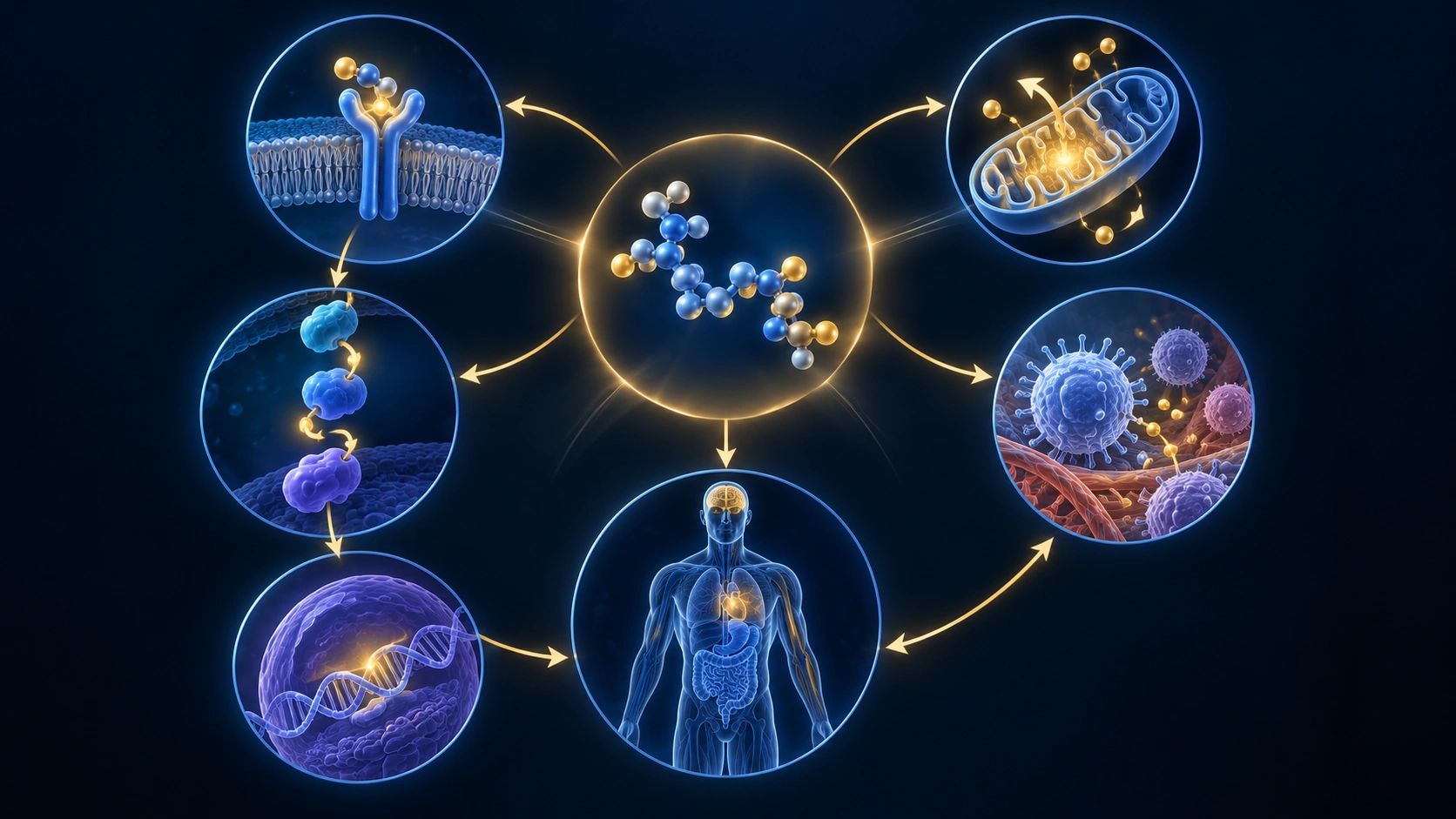
Alpha-MSH Guide: Melanocortin Signaling and Functions
POMC
↓
ALPHA-MSH
↓
MC1R / MC3R / MC4R / MC5R
↓
cAMP SIGNALING
↓
Depending on tissue:
- PIGMENTATION
- SATIETY
- ENERGY BALANCE
- IMMUNE REGULATION
- BARRIER SIGNALING
- NEUROENDOCRINE EFFECTS
↓
Potential:
- HOMEOSTATIC COORDINATION ACROSS SKIN, BRAIN, IMMUNITY, AND METABOLISM
The core idea is:
- ALPHA-MSH IS A MULTISYSTEM MELANOCORTIN SIGNAL.
WHAT THIS MECHANISM MAY SUGGEST
Mechanistically, alpha-MSH-related signaling deserves interest in:
- pigmentation disorders
- appetite regulation
- obesity biology
- inflammatory skin disease
- immune dysregulation
- barrier inflammation
- selected autoimmune conditions
- sexual-function pathways
- neuroendocrine signaling
- melanocortin receptor therapeutics
Its strongest conceptual importance may be:
- THE MELANOCORTIN SYSTEM ITSELF.
WHAT THIS MECHANISM DOES NOT PROVE
Alpha-MSH biology does not prove that it:
- should be increased in every inflammatory condition
- is appropriate for every patient wanting weight loss
- treats every autoimmune disease
- is simply a tanning peptide
- controls appetite independently of the rest of metabolism
- should be used whenever MC4R signaling seems “low”
- improves every barrier disorder
- is identical to KPV
- is identical to PT-141
- is identical to synthetic melanocortin analogs
Again:
- RECEPTOR SELECTIVITY MATTERS.
- TISSUE CONTEXT MATTERS.
- DOSE MATTERS.

HUMAN GENETIC EVIDENCE
Alpha-MSH, or alpha-melanocyte-stimulating hormone, is a vital peptide that plays a significant role in various physiological functions. This peptide consists of 13 amino acids and is derived from proopiomelanocortin (POMC), a large precursor protein that can be enzymatically processed into several biologically active peptides. These include not only alpha-MSH but also ACTH, beta-MSH, gamma-MSH, beta-endorphin, and other peptide fragments. This highlights a key principle in peptide signaling: one precursor can generate multiple signals, each interacting with melanocortin receptors to elicit completely different physiological effects.
HUMAN DISEASE BIOLOGY
POMC
↓
Tissue-specific peptide processing
↓
Possible products include:
ACTH
ALPHA-MSH, which has various functions in regulating energy homeostasis and skin pigmentation
BETA-ENDORPHIN
and others
↓
Different melanocortin receptors
↓
Different biological outputs
Again:
the biology depends not only on:
WHICH PRECURSOR EXISTS
but:
HOW IT IS PROCESSED, as this affects peptide signaling.
DIRECT THERAPEUTIC EVIDENCE
Alpha-MSH functions by acting through melanocortin receptors, which are G-protein-coupled receptors. There are five major melanocortin receptors: MC1R, MC2R, MC3R, MC4R, and MC5R. Each of these receptors responds to peptide signaling but does not respond to the same ligands in the same way.
DO NOT BEGIN WITH ALPHA-MSH
Begin with: WHICH MELANOCORTIN-CONTROLLED SYSTEM IS ACTUALLY DYSREGULATED?
Then:
PHYSIOLOGY
↓
PATTERN
↓
MECHANISM
↓
EVIDENCE
↓
RISK
↓
MONITORING
↓
DECISION
PHYSIOLOGY
Normal melanocortin signaling contributes to:
- pigmentation
- appetite
- satiety
- energy balance
- immune regulation
- skin signaling
- neuroendocrine integration
Again
alpha-MSH should be viewed as:
- A NETWORK SIGNAL.
EVIDENCE
Ask:
WHAT EXACTLY WAS STUDIED?
- alpha-MSH?
- KPV?
- MC1R agonist?
- MC4R agonist?
- PT-141?
- another melanocortin analog?
This is critical.
Because:
- MELANOCORTIN-PATHWAY EVIDENCE
does not mean:
- EVERY MELANOCORTIN PEPTIDE HAS THE SAME EFFECT.
PATTERN
What is actually present?
- hyperphagia?
- genetic obesity?
- inflammatory skin disease?
- pigmentation disorder?
- immune dysregulation?
- barrier inflammation?
- sexual-function disorder?
- something else?
Again:
- “LOW MELANOCORTIN SIGNALING”
is not a complete clinical diagnosis.
RISK
Potential considerations depend heavily on:
- WHICH RECEPTOR IS BEING ACTIVATED.
Possible consequences of melanocortin signaling may include:
- pigmentation changes
- appetite suppression
- nausea
- blood-pressure effects
- sexual effects
- immune modulation
- unintended cross-receptor activity
Again
- the system is broad.
So:
- SELECTIVITY MATTERS.
MECHANISM
Does the proposed melanocortin target match:
- THE DOMINANT BOTTLENECK?
If obesity is primarily driven by:
- SLEEP DEPRIVATION + EXCESS ENERGY + SEDENTARY BEHAVIOR,
that is different from:
- MC4R PATHWAY DEFECT.
If skin inflammation is driven by:
- ONGOING ALLERGEN EXPOSURE,
remove:
- THE TRIGGER.
If appetite dysregulation is driven by:
- LEPTIN / POMC / MC4R DYSFUNCTION,
the melanocortin pathway becomes:
- MUCH MORE DIRECTLY RELEVANT.
MONITORING
Monitoring should follow:
- THE TARGETED MELANOCORTIN SYSTEM.
METABOLIC
- appetite
- satiety
- weight
- waist
- body composition
- energy intake
SKIN
- pigmentation
- lesion activity
- inflammation
- photosensitivity
- standardized photography
IMMUNE
- disease-specific symptoms
- inflammatory activity
- infection burden if relevant
SEXUAL / NEUROENDOCRINE
- symptom-specific outcomes
- autonomic effects
- blood pressure where appropriate
Again:
monitor
- THE RECEPTOR-RELEVANT OUTPUT.

THE PRAXIS 5

MECHANISM
Alpha-MSH, or alpha-melanocyte-stimulating hormone, is a vital peptide that plays a significant role in various physiological functions. This peptide consists of 13 amino acids and is derived from proopiomelanocortin (POMC), a large precursor protein that can be enzymatically processed into several biologically active peptides. These include not only alpha-MSH but also ACTH, beta-MSH, gamma-MSH, beta-endorphin, and other peptide fragments. This highlights a key principle in peptide signaling: one precursor can generate multiple signals, each interacting with melanocortin receptors to elicit completely different physiological effects.
EVIDENCE
POMC
↓
Tissue-specific peptide processing
↓
Possible products include:
ACTH
ALPHA-MSH, which has various functions in regulating energy homeostasis and skin pigmentation
BETA-ENDORPHIN
and others
↓
Different melanocortin receptors
↓
Different biological outputs
Again:
the biology depends not only on:
WHICH PRECURSOR EXISTS
but:
HOW IT IS PROCESSED, as this affects peptide signaling.
RISK
Alpha-MSH functions by acting through melanocortin receptors, which are G-protein-coupled receptors. There are five major melanocortin receptors: MC1R, MC2R, MC3R, MC4R, and MC5R. Each of these receptors responds to peptide signaling but does not respond to the same ligands in the same way.
MONITORING
MC1R is strongly associated with melanocytes and pigmentation, playing a crucial role in alpha-MSH functions. However, it is important to note that MC1R is also expressed in various cell types, including immune cells, keratinocytes, fibroblasts, and other peripheral tissues. This highlights that MC1R is not merely a skin-color receptor, but a significant player in melanocortin receptors and peptide signaling throughout the body.
PATIENT CONTEXT
MC2R is different. It primarily functions as the receptor for ACTH and plays a central role in adrenal cortisol production through peptide signaling. Notably, alpha-MSH is not the main physiological ligand for MC2R, a distinction that matters in the context of melanocortin receptors.
SEVEN QUESTIONS TO ASK BEFORE ALPHA-MSH
1. WHICH MELANOCORTIN-CONTROLLED SYSTEM ARE WE TRYING TO CHANGE?
appetite?
pigmentation?
inflammation?
immune function?
sexual function?
2. WHICH RECEPTOR IS MOST RELEVANT?
MC1R?
MC3R?
MC4R?
MC5R?
3. IS FULL ALPHA-MSH ACTUALLY THE BEST WAY TO TARGET THAT RECEPTOR?
Or is:
A MORE SELECTIVE ANALOG
more biologically coherent in terms of alpha-MSH functions?
4. WHAT IS THE ACTUAL PATHOPHYSIOLOGY?
receptor defect?
excessive inflammatory signaling?
pigmentation problem?
hyperphagia?
barrier dysfunction?
5. WHAT TYPE OF EVIDENCE SUPPORTS THIS SPECIFIC MELANOCORTIN APPLICATION?
physiology?
genetics?
receptor-specific clinical trial?
fragment study?
animal model of peptide signaling?
6. WHAT WILL WE MONITOR?
appetite?
weight?
pigmentation?
inflammatory activity?
sexual function?
adverse cross-receptor effects?
7. WHAT WOULD DEFINE SUCCESS?
Not:
“MELANOCORTIN SIGNALING INCREASED.”
But:
THE SPECIFIC RECEPTOR-DEPENDENT PHYSIOLOGICAL PROBLEM IMPROVED WITHOUT CREATING UNWANTED EFFECTS IN THE OTHER SYSTEMS CONTROLLED BY THE MELANOCORTIN RECEPTORS.


Alpha-MSH
KEY TAKEAWAYS
1. WHICH MELANOCORTIN-CONTROLLED SYSTEM ARE WE TRYING TO CHANGE?
appetite?
pigmentation?
inflammation?
immune function?
sexual function?
2. WHICH RECEPTOR IS MOST RELEVANT?
MC1R?
MC3R?
MC4R?
MC5R?
3. IS FULL ALPHA-MSH ACTUALLY THE BEST WAY TO TARGET THAT RECEPTOR?
Or is:
A MORE SELECTIVE ANALOG
more biologically coherent in terms of alpha-MSH functions?
4. WHAT IS THE ACTUAL PATHOPHYSIOLOGY?
receptor defect?
excessive inflammatory signaling?
pigmentation problem?
hyperphagia?
barrier dysfunction?
5. WHAT TYPE OF EVIDENCE SUPPORTS THIS SPECIFIC MELANOCORTIN APPLICATION?
physiology?
genetics?
receptor-specific clinical trial?
fragment study?
animal model of peptide signaling?
6. WHAT WILL WE MONITOR?
appetite?
weight?
pigmentation?
inflammatory activity?
sexual function?
adverse cross-receptor effects?
7. WHAT WOULD DEFINE SUCCESS?
Not:
“MELANOCORTIN SIGNALING INCREASED.”
But:
THE SPECIFIC RECEPTOR-DEPENDENT PHYSIOLOGICAL PROBLEM IMPROVED WITHOUT CREATING UNWANTED EFFECTS IN THE OTHER SYSTEMS CONTROLLED BY THE MELANOCORTIN RECEPTORS.
THE BOTTOM LINE
Alpha-MSH is one of the best peptides for understanding:
- HOW ONE SIGNALING FAMILY CAN CONTROL COMPLETELY DIFFERENT HUMAN PHYSIOLOGIES.
The same peptide system influences:
- SKIN COLOR.
- APPETITE.
- BODY WEIGHT.
- IMMUNE RESPONSE.
- NEUROENDOCRINE SIGNALING.
- SEXUAL AROUSAL.
That seems unrelated until you understand:
- THE RECEPTORS.
The real model is:
ALPHA-MSH
↓
Which melanocortin receptor?
↓
Which tissue?
↓
Which intracellular response?
↓
Which physiological output?
At:
- MC1R
the dominant story may be:
- PIGMENTATION.
At:
- MC4R
the dominant story may be:
- SATIETY + ENERGY BALANCE.
At immune-cell melanocortin receptors:
the story may be:
- INFLAMMATORY REGULATION.
Same family.
Different:
- SIGNALING CONTEXT.
That is why alpha-MSH should not be thought of as:
- ONE PEPTIDE WITH ONE PURPOSE.
It is better understood as:
- A GATEWAY INTO THE MELANOCORTIN SYSTEM.
And the more advanced clinical question is not:
- “SHOULD WE USE ALPHA-MSH?”
It is:
- “WHICH MELANOCORTIN SIGNAL IS ACTUALLY FAILING, WHICH receptor controls the phenotype we are trying to change, does full alpha-MSH activate too many pathways for that goal, would a receptor-selective analog or fragment better match the biology, and what measurable receptor-specific outcome would prove that we moved the system in the intended direction?”
That is the difference between:
- NAMING A PEPTIDE
and:
- UNDERSTANDING RECEPTOR PHARMACOLOGY.
STOP MEMORIZING PEPTIDES. START UNDERSTANDING THE SYSTEM.